Aug 20, 2026 Artificial Intelligence
Key Takeaways
- Conversational AI executes tasks; generative AI creates content. One follows scripts, the other predicts and generates.
- Conversational AI uses NLU, NLG, ASR, and dialogue management for accurate, low-latency responses.
- Generative AI uses transformer models and RLHF, producing flexible but variable output.
- Conversational AI has near-zero hallucination risk. Generative AI needs RAG and guardrails to stay accurate.
- Conversational AI runs cheap on CPUs. Generative AI needs GPUs and costs more to run.
- Conversational AI is easy to audit. Generative AI is harder to trace step-by-step.
- Chatbot/support market: 60.21Bby2034(FortuneBusinessInsights).Codegeneration:~4B enterprise spend in 2025 (Menlo Ventures).
- Best enterprise systems use both: conversational AI for routing and structure, generative AI for open-ended answers.
- Pick conversational AI for compliance and legacy API workflows. Pick generative AI for unstructured data and creative output. Pick hybrid for complex, end-to-end needs.
While most tech executives treat conversational systems and generative models as competing software options, deployment data reveals a completely different reality. Selecting between these frameworks without evaluating intent recognition, deterministic routing, and foundational model generation directly impacts software reliability and operating margins. We see that modern enterprise architectures achieve peak unit economics not by picking a single side, but by orchestrating both under unified data governance.
Our team builds scalable enterprise systems every day. We see business leaders struggle with a common architectural dilemma: Should you invest in structured, rule-bound systems that prioritize exact compliance, or should you deploy open-ended foundation models that synthesize raw data into original outputs?
Understanding the core mechanical differences between conversational AI vs generative AI is no longer a theoretical debate. It is a core engineering requirement for companies who want to build systems that handle real-world scale, lower cost per transaction, and protect customer trust.
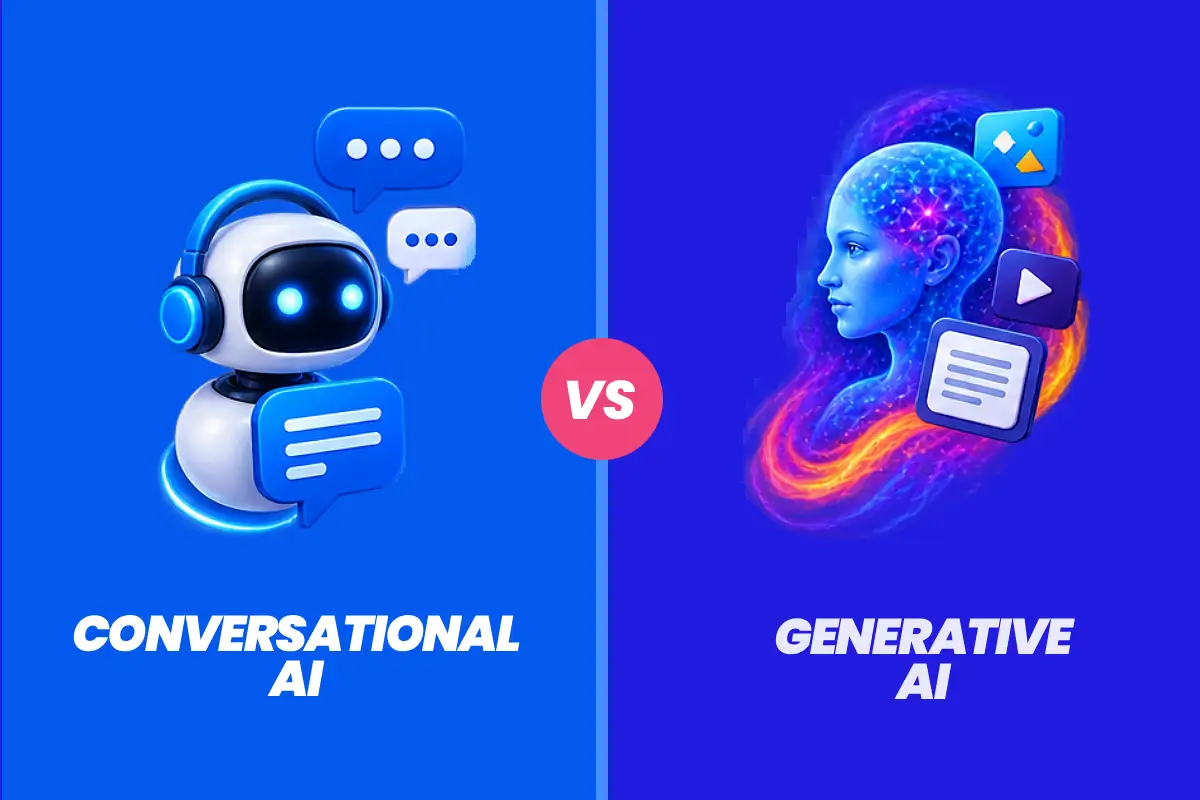
What is Conversational AI?
It is a system engineered specifically for structured, multi-turn human-to-machine dialogue. The primary goal of a conversational engine is state tracking and task execution. It ingests raw speech or text, isolates user intent, extracts named entities, passes those variables into structured business logic, and executes an action, such as querying an inventory database or booking a medical appointment.
The core stack behind conversational AI includes:
- Natural Language Understanding (NLU): Maps inputs against trained intent classifiers and slot-filling models to capture contextual parameters.
- Natural Language Generation (NLG) & System Execution: Retrieves approved templates or calls external REST APIs to complete transaction cycles.
- Automatic Speech Recognition (ASR) & Text Processing: Converts raw voice streams or text inputs into normalized strings.
- Dialogue Management (DM): Tracks conversation state through finite state machines or trained dialogue policy networks to determine the exact next step.
Because these systems rely on verified backend pathways, conversational architectures provide extreme predictability, low latency, and full auditability; making them important for transactional workflows.
What is Generative AI?
In generative AI, the focus shifts from transactional task execution to novel artifact synthesis. Generative AI refers to models, most commonly large language models (LLMs), that create new content, such as text, images, code, audio, or video. These are created based on patterns learned from massive training datasets.
This is the technology behind tools like ChatGPT, Midjourney, GitHub Copilot, etc. Instead of routing a user through a predefined decision tree, generative models predict the most statistically probable next token or pixel based on an input prompt.
The key architectural components include:
- Self-Attention Mechanisms: Processing long-range relationships across input vectors to maintain context across broad prompt windows.
- Foundational Pre-training: Exposing neural networks to billions of parameters across public and domain-specific datasets.
- Fine-Tuning & Reinforcement Learning (RLHF): Aligning raw probabilistic distribution engines with specific enterprise tone, domain facts, and safety guidelines.
Generative models do not require pre-scripted conversational trees to answer complex questions. Because their output is probabilistic rather than deterministic, they require specialized middleware guardrails to control output variance and prevent factual errors.
Also Read: Top Generative AI Trends
Technical Comparison Matrix: Engine Room Benchmarks
To help engineering teams evaluate conversational AI and generative AI side by side, we have benchmarked key operational parameters based on production system builds at Xicom:
| Performance Metric | Conversational AI Systems | Generative AI Systems |
| Primary Goal | Task execution, transaction routing, deterministic intent resolution. | Novel content synthesis, context transformation, unstructured data analysis. |
| Underlying Tech Stack | NLU classifiers, intent slot filling, Finite State Machines, Rule Engines, REST APIs. | Large Language Models (LLMs), Transformer networks, GANs, Diffusion models. |
| Output Variance | Zero to low. Outputs are mapped directly to approved content templates or API returns. | High. Outputs are non-deterministic, generating probabilistic variations per prompt. |
| System Latency | Low (typically 50ms – 300ms for text NLU engines). | Moderate to High (300ms to 3000ms+ depending on parameter size and token length). |
| Infrastructure Cost | Low, predictable compute footprint running on standard containerized microservices. | High compute requirements; requires specialized GPU/NPU acceleration and memory allocation. |
| Auditability & Traceability | High. State machine logs detail the precise decision tree and triggered backend API. | Complex. Multi-layer neural weight calculations make step-by-step logic tracing difficult. |
| Hallucination Risk | Near Zero. The system fails gracefully or routes to human agents when intent is missing. | Moderate to High. Requires RAG pipelines and vector database validation to enforce accuracy. |
| Integration Complexity | High focus on custom API integrations, CRM connectors, and legacy system webhooks. | High focus on vector search indexed storage, prompt engineering, and guardrail middleware. |
Core Operational Differences: Conversational AI vs Generative AI
To choose the right technology stack, software architects need to look past marketing claims and evaluate how these systems run under real operational conditions. While both frameworks process human language, their core execution, infrastructure demands, and risk profiles are fundamentally different.
Here is how conversational AI and generative AI compare across core operational vectors:
| Operational Vector | Conversational AI Platforms | Generative AI Frameworks |
| Execution Architecture | Deterministic Logic: Processes inputs through Natural Language Understanding (NLU) pipelines to identify intent, extract key variables, and trigger specific backend API workflows. | Probabilistic Synthesis: Predicts the most likely sequence of tokens using Large Language Models (LLMs) and Transformer layers, generating brand-new responses on the fly. |
| Response Reliability | Zero-to-Low Variance: Delivers pre-approved, template-driven responses or direct database returns. The system fails gracefully or transfers to a human agent when intent is unclear. | High Variance (Hallucination Risk): Dynamic output generation carries a risk of factual errors. Requires Retrieval-Augmented Generation (RAG) and guardrails to maintain accuracy. |
| Infrastructure & Compute Footprint | Lightweight & Scalable: Runs on standard CPU-based microservices with minimal RAM requirements. Handles millions of routine requests with predictable server costs. | Resource Intensive: Requires specialized GPU/NPU hardware acceleration and high memory allocation to manage large model parameters and extended prompt windows. |
| Audit Trails & Security | Fully Auditable: Conversation state machine logs provide an explicit decision tree and a verifiable record of triggered backend actions. | Complex Traceability: Multi-layer neural network calculations make step-by-step logic tracing difficult. Demands robust data-sanitization layers to protect sensitive information. |
| Development & Integration Focus | API & Database Centric: Implementation focuses on writing custom REST API connectors, database queries, and structured conversational flows. | Data Indexing & Prompt Design: Implementation focuses on vector database indexing, prompt engineering, and output-filtering middleware. |
| Primary Business Function | Transactional Execution: Excels at processing routine tasks like order lookups, appointment scheduling, and account updates without human intervention. | Content Creation & Analysis: Excels at summarizing unstructured contracts, refactoring complex software code, and drafting targeted marketing copy. |
Conversational vs Generative AI: Examine Some Real-World Cases
Treating conversational AI and generative AI as competing choices misses where the market has actually landed. The strongest products today combine them.
The conversational AI layer manages intent detection, session state, and routing. When a query falls outside pre-scripted answers, it hands off to a generative AI layer, often grounded through retrieval-augmented generation against your own knowledge base, to produce a relevant, accurate response. The conversational layer keeps the interaction structured and auditable. The generative layer keeps it flexible enough to handle the long tail of questions no one thought to script in advance.
Our AI development services are structured specifically around this model, because pure generative deployments in high-stakes environments almost always need a control layer around them.
Examine the real-world selection of generative AI and conversational AI use cases:
Conversational AI Use Cases
Conversational AI earns its keep in scenarios where consistency and task completion matter more than creative range.
- Customer support automation, handling account inquiries, order status, and troubleshooting without a live agent.
- IVR and voice banking systems, where a user needs to complete a transaction through voice with zero tolerance for error.
- Appointment scheduling and reminders across healthcare, legal, and services industries.
- Internal helpdesk bots that route IT tickets or answer HR policy questions.
- Lead qualification bots on websites that capture and route prospects to the right sales representatives.
Customer support remains the single largest application in this category, accounting for USD 60.21 billion by 2034, of the chatbot market, according to Fortune Business Insights. That’s not surprising. It’s the use case with the clearest ROI: fewer tickets reaching a human agent, faster resolution times, and 24/7 coverage without added headcount.
Generative AI Use Cases
Generative AI shines wherever the output needs to be original, contextual, and produced faster than a human could write it from scratch.
- Code generation and review, now the single largest enterprise GenAI spending category, at roughly $4 billion in 2025 per Menlo Ventures’ State of Generative AI in the Enterprise report, more than five times the next-highest department.
- Marketing and content creation, from ad copy to product descriptions at scale.
- Document summarization, condensing lengthy contracts, research papers, or reports into digestible briefs.
- Synthetic data generation, useful for training other models when real data is scarce or sensitive.
- Drug discovery and clinical research support, an area growing fast enough that life sciences GenAI adoption is projected at a 20.21% CAGR, per Precedence Research.
Architectural Convergence: The Hybrid Enterprise AI Framework
In enterprise software engineering, choosing between conversational platforms and generative engines is a false binary. The most resilient software platforms built today combine both paradigms into a single, unified hybrid architecture.
In this modern framework:
- The conversational AI layer acts as the front-end orchestration manager. It handles multi-turn state management, parses user intents, enforces business permissions, and routes execution paths.
- The generative AI layer acts as the dynamic synthesis engine. When a user asks an open-ended question that falls outside pre-scripted state paths, the query routes to a Retrieval-Augmented Generation (RAG) pipeline backed by vector search.
- The middleware layer enforces safety guardrails, sanitizes inputs, verifies database context, and formats the output before presenting it back to the user.
By deploying a hybrid model, enterprises capture the fluid adaptability of generative language synthesis while maintaining the operational control, transactional accuracy, and safety guardrails of structured conversational engines.
Also Read: AI Governance Frameworks
Strategic Evaluation: Selecting the Right Architecture for Your Tech Stack
To determine which framework fits your upcoming product development roadmap, evaluate your project against this decision framework:
Choose Conversational AI when:
- Accuracy is Non-Negotiable: The system must deliver 100% policy compliance without taking creative liberties.
- System Operations depend on Legacy APIs: Interactions rely on executing structured transactional calls into core CRMs, ERPs, or legacy databases.
- Compute Budgets are Strictly Constrained: You need high scalability with low infrastructure overhead.
- Workflows are Standardized: Requests fall within defined parameters like appointment booking, order tracking, or FAQ handling.
Choose Generative AI when:
- The Domain relies on Unstructured Data: Systems must ingest, parse, and synthesize information across thousands of raw documents, tickets, or audio files.
- Output Variety Drives Business Value: Creative asset generation, software coding, or automated document drafting is required.
- Interactions Require Contextual Adaptation: The solution must summarize nuanced topics or synthesize multi-source information dynamically.
Choose a Hybrid Architecture when:
- You need to automate complex end-to-end customer workflows that blend structured account execution with open-ended contextual support.
- You want to upgrade legacy chatbots with rich natural phrasing without sacrificing back-end transactional accuracy.
Final Takeaway
Choosing between conversational platforms and generative architectures isn’t about chasing the latest technology trends. It comes down to matching your specific operational goals, data privacy standards, and compute budgets with the right software engine. When we introduce automated decision-making into live enterprise workflows, we need an engineering structure that manages edge cases, keeps sensitive data secure, and integrates smoothly with core business systems that can’t be rebuilt overnight.
This is where we brings clear engineering value. For enterprises looking to deploy intelligence that scales operations, maintains compliance, and eliminates administrative complexity, we provide the software engineering expertise and technical roadmaps required to build safely. Rather than forcing your operations into rigid templates or unmanaged probabilistic models, we design modern, unified AI architectures tailored directly to your enterprise goals.
Modernize your core software platforms with custom enterprise intelligence.
Learn how Xicom’s enterprise AI development services can help you build auditable AI solutions, streamline technical operations, and lower infrastructure overhead across your engineering ecosystem.
FAQs
1. What’s the core difference between conversational AI and generative AI?
Conversational AI follows structured logic to complete tasks, like booking an appointment or checking an order status. Generative AI creates new content, like text or code, by predicting what comes next based on patterns it learned.
2. Which one is more accurate: conversational AI or generative AI?
Conversational AI is more accurate for defined tasks since it routes to pre-approved templates or fails gracefully when unsure. Generative AI can produce factual errors and needs RAG plus guardrails to stay reliable.
3. Is conversational AI cheaper to run than generative AI?
Yes. Conversational AI runs on standard CPU-based microservices with predictable costs. Generative AI needs GPU/NPU hardware, which raises infrastructure spend.
4. Can a business combine conversational AI and generative AI?
Yes, this is called a hybrid architecture. Conversational AI handles routing and structured tasks, while generative AI answers open-ended questions the conversational layer wasn’t scripted for.
5. When should I choose conversational AI over generative AI?
Choose conversational AI when compliance is critical, when you’re integrating with legacy CRMs or ERPs, or when your compute budget is limited.
6. When does generative AI make more sense for a business?
Generative AI works best for unstructured data, like summarizing contracts or documents, and for creative tasks like content writing or code generation.

Make your ideas turn into reality
With our AI & mobile app solutions
Explore related services
Based on this article's topic