How Much Does it Cost to Build an Android App?
Oct 29, 2026 App Development
Oct 29, 2026 App Development
Quick Answer
Android app development cost ranges from about $20,000 to $45,000 for a simple app, $45,000 to $100,000 for a medium-complexity app with accounts, a backend, and payments, and $100,000 to $250,000+ for a complex app with real-time features, AI, or heavy integrations. These figures assume a native Kotlin app built by a blended offshore or hybrid team; an all-US team typically costs 2 to 3 times more. Add Google Play’s one-time $25 registration fee and about 15% to 20% of the build cost each year for maintenance.
Android runs on more phones than any other operating system. StatCounter puts Android at 69.17% of worldwide mobile usage in September 2026. If your customers are spread across countries, price points, and device brands, an Android app is often the fastest way to reach them.
That reach comes with its own cost factors: thousands of device models to support, Google Play’s yearly target API deadlines, and a fee structure that changed in 2026. This guide shows what drives Android mobile app development cost, with prices by complexity, by feature, and by industry, so you can plan a realistic budget for 2027.
| Typical build cost | $20,000 to $250,000+ depending on complexity |
| Typical timeline | 2 to 12+ months |
| Yearly maintenance | 15% to 20% of the initial build cost |
| Google Play registration | $25, one time |
| Main language | Kotlin with Jetpack Compose (Java for older codebases) |
| 2026 target API rule | New apps and updates must target Android 16 (API level 36) from August 31, 2026 |
| Cross-platform savings | Often 30% to 40% less than separate native Android and iOS apps |
Complexity is the starting point for any estimate. It reflects how many screens and user roles the app has, whether it needs its own backend, and how many outside services it connects to.
| Complexity | What It Usually Includes | Estimated Cost | Timeline |
|---|---|---|---|
| Simple | A few screens, standard Material Design components, local data or a light backend, basic analytics | $20,000 – $45,000 | 2 – 4 months |
| Medium | User accounts, custom UI, backend with admin panel, push notifications, payments, maps or social sign-in | $45,000 – $100,000 | 4 – 7 months |
| Complex | Real-time chat or video, multiple user roles, offline sync, AI features, enterprise integrations, strict security needs | $100,000 – $250,000+ | 7 – 12+ months |
To check any quote, use this formula: total hours × blended hourly rate = cost to build an Android app. A medium app typically needs 1,200 to 2,500 hours across design, Android development, backend, and testing. At $40 per hour that is $48,000 to $100,000; at $150 per hour it is $180,000 to $375,000.
Many older guides quote $10,000 to $50,000 for any Android app. That range can cover a simple app, but it rarely includes a backend, an admin panel, security work, and testing across the devices your users actually own.
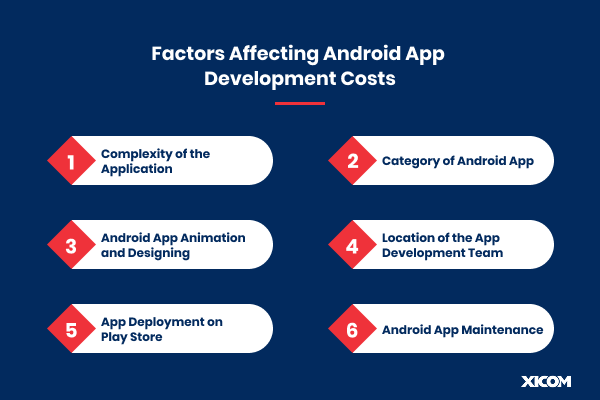
Features are where budgets grow quietly. Use these ranges to see what each feature adds; each includes design, Android development, backend work, and testing.
| Feature | Notes | Estimated Cost |
|---|---|---|
| Sign-up, login, and profiles | Email, phone, Google sign-in, passkeys | $2,000 – $5,000 |
| Push notifications | Firebase Cloud Messaging, segments, scheduling | $1,000 – $3,000 |
| Payments | Google Play Billing for digital goods, or Stripe and similar for physical goods and services | $3,000 – $8,000 |
| Maps and location | Google Maps, geofencing, live tracking | $3,000 – $10,000 |
| Real-time chat | One-to-one and group chat, media sharing, read receipts | $5,000 – $15,000 |
| Video calling | Video SDK integration, call quality handling on weak networks | $8,000 – $20,000 |
| Offline mode and sync | Local database, conflict handling, background sync | $4,000 – $12,000 |
| Admin panel | Users, content, orders, reports | $6,000 – $15,000 |
| AI features | Chat assistants, recommendations, image or text analysis, on-device or cloud models | $8,000 – $30,000+ |
| Home screen widgets | Glanceable info and quick actions | $2,000 – $5,000 |
| Wear OS companion app | Watch app for notifications, tracking, or quick actions | $10,000 – $25,000 |
Every industry comes with its own must-have features and rules. These ranges reflect a first release on Android; your scope can move them up or down.
| Industry or App Type | What Drives the Cost | Estimated Cost |
|---|---|---|
| Ecommerce and retail | Catalog, search, cart, payments, order tracking, recommendations | $45,000 – $120,000 |
| Grocery and food delivery | Customer, store, and driver apps; live tracking; delivery slots | $60,000 – $150,000 |
| Taxi and ride-hailing | Rider and driver apps, real-time matching, maps, fare logic | $70,000 – $160,000 |
| Healthcare and telemedicine | Video visits, scheduling, HIPAA controls, EHR integration | $40,000 – $180,000 |
| Fintech and banking | KYC onboarding, bank integrations, payments, fraud checks, compliance | $80,000 – $250,000+ |
| Social media and dating | Profiles, feeds or matching, chat, media uploads, moderation | $50,000 – $150,000 |
| Fitness and wellness | Workout content, tracking, Health Connect sync, subscriptions | $35,000 – $100,000 |
| Games | 2D casual at the low end; 3D, multiplayer, and live operations at the high end | $30,000 – $300,000+ |
| Streaming (video, music, live) | Media playback, DRM, subscriptions, CDN delivery | $40,000 – $200,000 |
Also Read: Telemedicine app development cost
Your technology choice changes the Android app development cost more than most people expect, especially once you plan for iPhone users too.
| Approach | Best For | Cost Impact |
|---|---|---|
| Native Android (Kotlin, Jetpack Compose) | Android-first products, apps that rely on device hardware, background services, or Wear OS | Baseline for one platform |
| Native Android and native iOS | Large consumer apps that need the best performance on both platforms | Roughly 1.6 to 2 times one native app |
| Cross-platform (Flutter, React Native, Kotlin Multiplatform) | Most business apps that need Android and iOS at launch | Often 30% to 40% less than two native apps |
If you need both platforms at launch, cross-platform app development is usually the most cost-effective route. For Apple-specific budgets, fees, and timelines, read our iOS app development cost guide.
Android’s reach comes from thousands of device models across Samsung, Google, Xiaomi, Motorola, and many other brands, with different screen sizes, chipsets, Android versions, and manufacturer customizations. That variety is the main reason testing often takes 15% to 20% of the development budget on Android, compared with roughly 10% to 15% on iOS.
Two Google Play changes in 2026 matter for anyone planning an Android app or maintaining an existing one.
Google raises the minimum target API level every year. From August 31, 2026, new apps and app updates must target Android 16 (API level 36) or higher, with an extension available to November 1, 2026. Existing apps that target Android 14 or lower become unavailable to new users on newer devices. Budget for this yearly update work as part of maintenance, because older codebases can need several weeks of changes.
Google Play charges a service fee on digital goods and subscriptions sold in your app. Physical goods and services, such as rides, food, or retail products, are not subject to it. Following the end of the Epic v. Google case, Google introduced new billing options starting June 30, 2026 in the US, UK, and EEA:
Rates for one-time in-app purchases depend on earnings tiers and programs, so check Google’s current rate card before you set prices.
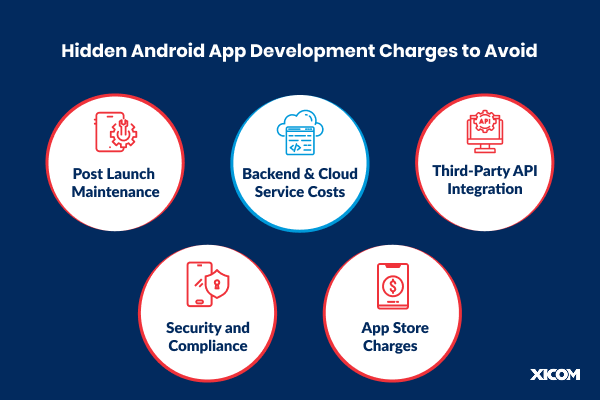
Who builds your app is the biggest multiplier on the final number. Experienced US-based app developers typically charge about $100 to $200 per hour in 2026. The ranges below are typical; individual quotes vary with experience and scope.
| Team Type | Typical Hourly Rate | Good For | Watch Out For |
|---|---|---|---|
| Offshore freelancer | $20 – $50 | Small, well-defined tasks | Single point of failure; no QA or backend team |
| US freelancer | $75 – $150 | Short projects needing US time zones | Limited capacity for full products |
| Offshore agency | $25 – $60 | Full products on a budget, long-term maintenance | Choose partners with strong communication and security practices |
| US agency | $100 – $200 | Projects that need onsite collaboration | Highest cost for the same hours |
| Hybrid (US product lead, offshore engineering) | Blended $40 – $80 | Most US companies balancing cost and control | Needs clear ownership and overlap hours |
If you already have a product team and need more capacity, you can hire Android developers on a dedicated basis.
Xicom’s Android app development services cover discovery, UI/UX design, Kotlin and Jetpack Compose development, backend and integrations, Google Play launch, and long-term maintenance, as part of our wider mobile app development services. Recent work includes Keeta, a multilingual food delivery app that reached 100,000+ Google Play downloads in its first quarter, and TADA, a ride-hailing platform that grew its user base 10x in Singapore within 12 months.
Android app development cost typically lands between $20,000 and $250,000, depending on complexity, features, industry, and who builds it. Budget $20,000 to $45,000 for a simple app, $45,000 to $100,000 for a medium app, and $100,000 or more for a complex one, then plan for testing across devices, yearly target API updates, and Google Play’s 2026 fee changes. A focused MVP, a sensible device matrix, and the right team model will do more for your budget than any single shortcut. For a cross-platform view, see our mobile app development cost guide.
Android app development cost is about $20,000 to $45,000 for a simple app, $45,000 to $100,000 for a medium-complexity app, and $100,000 to $250,000 or more for a complex app. These estimates assume a native Kotlin app built by a blended offshore or hybrid team; an all-US team typically costs 2 to 3 times more.
A simple Android app usually takes 2 to 4 months, a medium app 4 to 7 months, and a complex app 7 to 12 months or more. Clear requirements, standard components, and managed backend services shorten the timeline.
For the same features, Android and iOS development costs are usually similar. Android often needs more testing because of the wide range of devices, while iOS has stricter App Store review. If you need both platforms, a cross-platform app is often 30% to 40% cheaper than two native apps.
Google Play charges a one-time $25 registration fee. Since June 30, 2026 in the US, UK, and EEA, subscriptions sold through Google Play Billing carry a 10% service fee plus a 5% billing fee, while alternative billing or web links carry a 10% service fee plus your processor’s fees. Physical goods and services are not charged.
Most teams budget 15% to 20% of the initial development cost each year. Maintenance covers Google Play’s yearly target API requirements, Android version updates, library upgrades, bug fixes, security patches, and backend hosting.
Typical rates are $20 to $50 per hour for offshore freelancers, $75 to $150 for US freelancers, $25 to $60 for offshore agencies, and $100 to $200 for US agencies. Hybrid teams with US product leadership and offshore engineering often blend to about $40 to $80 per hour.
Outsourcing is usually cheaper for a first release, because you avoid recruiting, salaries, and benefits for a full team of designers, developers, and testers. Many companies outsource the build and keep product ownership in-house, then decide later whether to grow an internal team.

Based on this article's topic
Learn how to integrate Android AppFunctions into an AI-powered mobile app: what to expose, how to describe it for agents, permissions, testing and rollout.
How long does it take to develop an app? See typical timelines by complexity, phase, platform and app type, plus practical ways to launch sooner.
Swift vs Objective-C compared on safety, concurrency, performance, interop and hiring, plus a practical playbook for migrating legacy iOS code.