Jul 29, 2026 Artificial Intelligence
Key Takeaways
- Every commercially deployed AI system today, no matter how advanced it looks, is narrow AI — AGI in the full cross-domain sense does not exist in any deployable form yet.
- Agentic AI is the practical bridge available now: a foundation model plus tool-calling and retrieval that can chain multi-step tasks, but still can’t originate its own goals outside its built scope.
- RAG and context windows aren’t the same as true general memory — AGI would need dynamic memory consolidation, not just retrieval from a vector database.
- Future-proofing means decoupling foundation models from core business logic so you can swap models later without breaking your system.
- Under the EU AI Act Omnibus, standalone high-risk AI systems (healthcare, recruitment, banking) now have until December 2027 to comply, giving enterprises breathing room to build proper governance.
The line between domain-specific machine learning and general cognitive autonomy is shifting faster than standard enterprise software cycles can adapt. While narrow AI already powers operations, misjudging the leap toward artificial general intelligence leaves legacy systems exposed to architectural obsolescence. Understanding where current models end and true system autonomy begins isn’t academic, it dictates how you allocate capital today.
In boardrooms and engineering standups alike, the terms ASI, AGI or AI get tossed around interchangeably. But from an engineering standpoint, treating them as points on a single linear timeline misses the point entirely.
At Xicom, we spend our days building custom enterprise software, training targeted large language models, and architecting multi-agent production frameworks. We witness firsthand how misinterpreting these concepts leads directly to poor tech stack investments, brittle integration layers, and misaligned roadmaps.
Narrow artificial intelligence optimizes specific operations right now. Artificial general intelligence promises human-grade transfer learning across unstructured domains. Artificial superintelligence remains an operational hypothesis. Navigating this terrain requires looking past vendor hype. Enterprise engineering teams must understand the architectural realities, underlying mechanics, and concrete execution paths that connect specialized software models to next-generation autonomous environments.
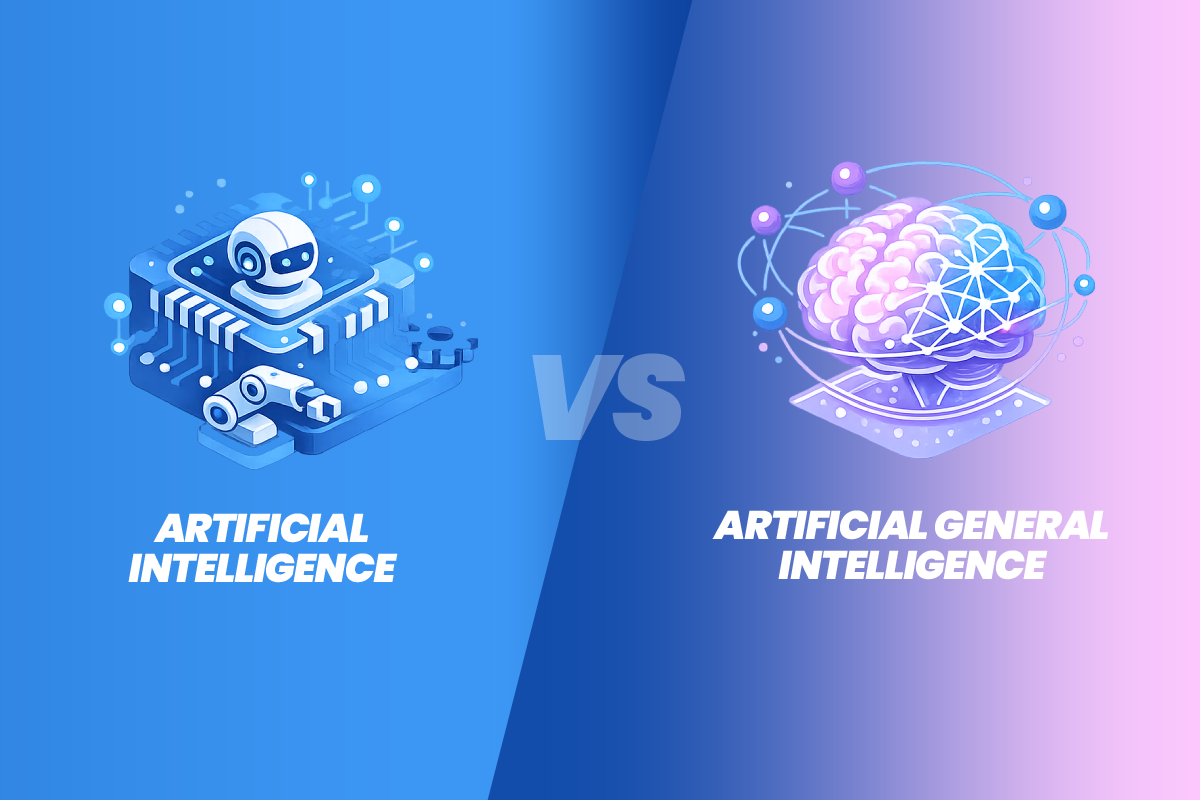
What is AI Vs AGI? The Core Distinction
What is Artificial Intelligence (AI)?
Artificial Intelligence (AI), as it exists commercially today, is narrow by design. It’s trained to do specific things: write copy, price a policy, flag fraudulent transactions, route a support ticket, and it does them well within that lane. Step outside the lane, and it stops working. A model tuned for medical imaging won’t help you underwrite a loan. That’s not a flaw; that’s the architecture.
What is Artificial General Intelligence (AGI)?
Artificial General Intelligence (AGI) refers to a system that can learn, reason, and apply knowledge across domains the way a human can, without being retrained for every new task. It doesn’t need a new dataset to go from writing a report to debugging code to planning a supply chain. A general intelligence system, in theory, would work this problem out on its own.
Here’s the part that matters for your roadmap: AGI, in this full sense, does not exist yet in any deployable, commercial form. What you’re licensing, integrating, or building on today, no matter how sophisticated the demo looks, it is after all Artificial Intelligence. It is highly capable, increasingly agentic, but still narrow.
AI Vs AGI Difference: Core Engineering and System Infrastructure Challenges
To evaluate the AGI Vs AI difference from an architectural perspective, we need to examine why today’s frontier foundation models, despite their impressive language fluency, still fall short of true general intelligence.
1. The Limits of Next-Token Prediction
Modern Large Language Models (LLMs) operate fundamentally as high-dimensional probabilistic engines. They predict the statistically likely next token given an input sequence. While scaling parameters and training compute creates surprisingly complex emergent capabilities, next-token prediction lacks explicit world models, physical common-sense intuition, and rigorous causal logic.
When presented with novel edge cases that sit entirely outside their training corpora, these systems display structural weak modes, often hallucinating incorrect data with high confidence.
2. Context Windows Vs True Long-Term Memory
In standard enterprise AI applications, engineers extend memory using context windows and Retrieval-Augmented Generation (RAG). We index enterprise documentation into vector databases like Pinecone, Qdrant, or PGVector, converting text into mathematical embeddings.
While effective for domain knowledge retrieval, RAG is not general cognitive memory. AGI requires dynamic memory consolidation: the ability to prune obsolete context, update dynamic operational models on the fly, and retain episodic awareness across years of continuous interaction all without overloading compute pipelines.
3. Compute Scale and Infrastructure Requirements
Training frontier models already demands immense capital expenditures. Market estimates vary depending on methodology and forecast horizon, Precedence Research projects the global AI market at $900 billion in 2026, growing to $4,216.29 billion by 2035, driven by rising enterprise infrastructure investment in hardware, deep learning, and AI software frameworks.
Moving from statistical pattern matching to dynamic AGI reasoning demands a massive jump in compute density, neuromorphic processor design, energy efficiency, and low-latency interconnects. The infrastructure required to run general cognitive loops continuously at scale is still being built out.
AI Vs AGI Vs ASI: Mapping the Spectrum of Intelligence
Understanding the full continuum from targeted utility models to theoretical superintelligence is essential for grounding technical strategies in realistic timelines.
1. Artificial Narrow Intelligence (ANI)
This is today’s operational workhorse. ANI includes everything from classical machine learning algorithms (XGBoost, Random Forests) to modern generative foundation models (LLMs, Diffusion Networks). According to data from Grand View Research, the global artificial intelligence market is projected to reach $3,497.3 billion in 2033, driven heavily by enterprise deployments in operations, customer engagement, and AI software engineering workflows.
- System Nature: Deterministic or probabilistic model inference bounded by task context.
- Data Dependencies: Requires curated, tokenized training data or high-quality embeddings.
- Execution Boundary: Fails when forced outside its training distribution.
2. Autonomous Agentic AI (The Enterprise Bridge)
While not full AGI, agentic workflows represent the current frontier of practical enterprise automation. By combining foundation models with function calling, vector storage (RAG), and recursive reasoning loops (ReAct framework), agentic software executes autonomous multi-step operations across API ecosystems. Businesses leverage these patterns today through specialized services offered by AI agent development companies to handle complex enterprise logic.
- System Nature: Foundation model plus orchestration layer — task-scoped autonomy, not general cognition.
- Data Dependencies: Structured tool/API schemas, retrieval indexes, and defined action spaces rather than open-ended world knowledge.
- Execution Boundary: Can chain and self-correct within a defined toolset, but cannot originate goals or operate meaningfully outside the workflows it was built for.
3. Artificial General Intelligence (AGI)
AGI represents the point where software displays dynamic transfer learning, self-correction, causal inference, and dynamic memory orchestration across all human domains.
- System Nature: Autonomous, cross-domain cognitive processing.
- Execution Boundary: Capable of handling novel, unseen scenarios without manual domain re-engineering or structural intervention.
4. Artificial Superintelligence (ASI)
ASI describes a theoretical state where software capabilities surpass combined human intelligence across all disciplines, including scientific synthesis, creative composition, emotional intelligence, and strategic coordination.
- System Nature: Exponential recursive self-improvement.
- Deployment Reality: Remains a long-term theoretical framework rather than an actionable software development target for enterprise teams.
| Metric / Dimension | Narrow Artificial Intelligence (ANI) | Agentic AI | Artificial General Intelligence (AGI) | Artificial Superintelligence (ASI) |
|---|---|---|---|---|
| Primary Architectural Mechanism | Pattern recognition via statistical optimization & deep learning layers | Foundation model + tool-calling orchestration + retrieval loops | Dynamic transfer learning, continuous memory synthesis, causal reasoning | Theoretical recursive self-improving neural frameworks |
| Domain Flexibility | Strictly bounded to defined task structures | Bounded to a defined toolset, chained across multiple steps | Fully flexible across infinite, unstructured domains | Beyond human boundary conditions and domain limits |
| Contextual Autonomy | Relies on fine-tuning, retrieval augmentations, or strict prompt inputs | Executes multi-step plans autonomously within human-defined guardrails | Autonomous goal-formulation, self-directed tool selection, environment adaptability | Universal self-governing cognitive network |
| Enterprise Readiness | Immediate (Production-Ready) | Immediate (Production-Ready, rapidly maturing) | In Research & Prototyping | Theoretical |
Key Elements of Production-Grade AI Agent Architecture
While true AGI remains on the horizon, enterprises do not need to wait to deploy high-value autonomous behavior. The practical bridge available today is Agentic AI Architecture.
At Xicom, we design and implement enterprise agent networks that give software systems operational autonomy while maintaining strict human-in-the-loop oversight and governance.
System Orchestration & Tool Calling
Rather than relying on a single model to perform every task, we deploy lightweight orchestrator models. These orchestrators break down broad user intent into discrete sub-tasks, passing structured execution payloads to dedicated tool endpoints via secure APIs.
Contextual Memory & RAG Layers
We build hybrid retrieval layers that blend traditional keyword indexing with dense vector search. This ensures that agentic workflows pull accurate, up-to-date domain context without tripping over context window limits or introducing hallucinations.
Guardrails & Deterministic Validation
Autonomous execution requires tight control loops. We integrate deterministic validation layers (e.g., Pydantic schemas, strict role-based authorization controls) that evaluate model outputs before any state change is written to enterprise production databases.
Strategic Roadmap: Future-Proofing Enterprise Software Architecture
Building software today that remains resilient tomorrow requires a clear, step-by-step engineering roadmap. Enterprise technology leaders should execute against four core principles:
1. Decouple Foundation Models from Core Software Logic
Never hardcode business logic directly into specific LLM prompts or vendor SDKs. Build an abstraction layer (using routing frameworks or custom middleware) between your core application layer and downstream model APIs. This design lets you swap out underlying models whether moving to a faster open-source LLM or integrating a future AGI reasoning engine with zero breaking changes to your core system logic.
2. Prioritize Data Infrastructure and Vector Preparation
Models are only as powerful as the context fed into them. Focus on structuring proprietary company data, setting up clean ETL data pipelines, and establishing centralized vector database infrastructure. High-quality structured data is the prerequisite for both modern agentic RAG systems and future general intelligence models.
3. Architect for API-Driven Tool Interoperability
Ensure all enterprise software capabilities from database queries to payment gateway execution are exposed through secure, RESTful, or gRPC API endpoints. Agentic systems operate by orchestrating tool calls. The cleaner your internal service-oriented architecture, the easier it is to drop intelligent agents into your operational workflows.
4. Maintain Full System Observability
Deploy tracing frameworks (such as OpenTelemetry or specialized LLM monitoring tools) across every AI-assisted workflow. Enterprise teams must track latency, token usage, cost per request, accuracy scores, and failure rates in real time to maintain system health and justify return on investment.
Compliance and Regulatory Considerations You Can’t Skip
If you’ve been keeping an eye on European tech policy, you know the regulatory clock was ticking toward August 2026. But the EU just threw enterprise teams a major lifeline. With the new AI Omnibus officially kicking in on July 27, 2026, regulators shifted the goalposts for high-risk systems. Standalone AI tools handling sensitive calls in healthcare, recruitment, and banking (Annex III) now have until December 2, 2027 to comply with embedded hardware getting until late 2028.
Beyond buying time, this update trims down paperwork, opens up testing sandboxes, and gives growing mid-cap companies the lighter rules originally meant only for small startups. Bottom line? You get breathing room to build proper audit trails and governance into your software without slamming the brakes on product launches.
This matters regardless of whether you’re building a narrow AI or an agentic layer on top of it: regulators are not waiting for AGI to start writing rules. Every autonomous decision your system AI Omnibus officially kicking in on July 27, 2026 makes today needs a documented audit trail, a defined accountability owner, and a clear boundary of authority.
Waiting until a system is smart enough to require governance is the wrong sequencing that governance has to be designed in from the first sprint. This is precisely where a structured AI consulting company earns its budget: mapping your specific regulatory exposure before a single model goes into production, not after.
Conclusion
Navigating the transition from narrow machine learning models to autonomous multi-agent environments demands an architectural strategy built on real-world engineering, not market speculation. When we integrate autonomous logic into live enterprise systems, we need an architecture that handles edge cases cleanly, preserves system security, and interfaces effortlessly with legacy infrastructure.
This is precisely where Xicom bridges the gap. For enterprise leaders seeking to deploy resilient software that scales operations, maintains strict regulatory compliance, and eliminates workflow friction, we deliver the senior engineering expertise and custom software blueprints needed to execute safely. Instead of relying on rigid legacy software, we partner with you to engineer modular, agent-ready architectures built to optimize your operations today while remaining fully ready for tomorrow’s intelligent breakthroughs.
Transform your software systems with custom enterprise intelligence. Learn how Xicom’s AI development team can optimize your engineering architecture, lower operational overhead, and accelerate digital transformation across your enterprise
FAQs
1. Is AGI available commercially today?
No. Every deployable AI system in production today, no matter how advanced, is narrow AI. It performs specific tasks well within a defined domain but cannot transfer reasoning across unrelated fields the way AGI is theorized to.
2. What’s the difference between agentic AI and AGI?
Agentic AI chains a foundation model together with tools, APIs, and retrieval systems to complete multi-step tasks autonomously within a defined scope. AGI would reason and adapt across entirely new domains without that scaffolding. Agentic AI is available and production-ready now; AGI is not.
3. Do enterprises need to wait for AGI to build autonomous systems?
No. Agentic AI architecture already delivers meaningful autonomy for enterprise workflows today, with human-in-the-loop oversight and deterministic guardrails, without depending on AGI-level reasoning.
4. When do the EU AI Act’s high-risk obligations take effect?
Under the Digital Omnibus, standalone high-risk AI systems under Annex III must comply by December 2, 2027. High-risk AI embedded in regulated products under Annex I has until August 2, 2028.
5. Why does governance matter before AGI exists?
Regulators are already requiring audit trails, accountability owners, and defined authority boundaries for narrow and agentic AI systems in production today. Governance built in from the first sprint is far cheaper than retrofitting it later.

Make your ideas turn into reality
With our AI & mobile app solutions
Explore related services
Based on this article's topic