AI agent evaluation is what separates an agent that impressed in a demo from one you can trust with customers. Agents plan, call tools and act over several steps, so a single correct-looking answer can hide a wrong tool call, a wasted loop or an action that should never have run. This guide sets out a practical agent evaluation framework: what to test, which metrics to track, where automated judges fall short and how to build your first test suite.
Key Takeaways
Grade the outcome first, then use the step-by-step transcript to diagnose failures.
Run each task several times. An agent that succeeds once in three tries is not ready for customers.
Start with 20 to 50 tasks drawn from real failures, not hundreds of synthetic ones.
LLM-as-judge scoring scales well but has known biases, so calibrate it against human labels.
Wire evals into CI/CD so a prompt or model change cannot ship without passing them.
What Is AI Agent Evaluation And Why Do Agents Need Different Testing?
AI agent evaluation is the practice of scoring how well an agent completes multi-step tasks, using a fixed set of test tasks, graders and pass criteria. It differs from regular software testing because agents are non-deterministic: the same input can produce different paths and different results on each run.
It also differs from evaluating AI models on their own. A model eval asks whether one response is accurate. AI agent testing asks whether a sequence of decisions, tool calls and actions reached the right end state without causing harm along the way.
Three things make agents harder to test:
Many valid paths. An agent might solve a refund request in four steps or six. Both can be correct, so tests that demand one exact sequence break for no good reason.
Actions with side effects. Agents write to databases, send emails and update records. A wrong answer in a chatbot is embarrassing; a wrong action can cost money.
Compounding errors. A small mistake in step two, such as reading the wrong order ID, carries through every step after it.
Evaluation also has a partner. AI agent observability records what an agent did in production. Evaluation grades whether it was right. Strong teams use production traces to find new failures, then turn those failures into test cases.
What Should You Test In An AI Agent?
Test four layers: the final outcome, the path the agent took, each tool call and its safety boundaries. The outcome tells you whether the agent worked. The other three tell you why it failed and whether it got there safely.
1. The Final Outcome
Check the end state, not just the reply. If the task was to cancel order 4471 and refund the customer, confirm the order status changed and the refund record exists. Anthropic’s engineering team recommends grading the outcome rather than a fixed sequence of steps, because agents often find valid approaches that test designers did not expect.
2. The Trajectory
The trajectory is the full record of the agent’s reasoning and actions. Grade it for efficiency and judgment: did it take a sensible route, avoid loops and ask for clarification when the request was ambiguous? Score trajectories with ranges, such as under eight steps, not one exact path.
3. Tool Calls
Most agent failures we see start at the tool layer. Check three things for each call: the right tool was chosen, the arguments were correct, and the agent handled errors properly when the tool failed. In multi-agent systems, add the handoffs between agents to this layer.
4. Safety And Policy
Test what the agent must never do: issue a refund above its limit, expose another customer’s data, or act on instructions hidden in a document. These tests should be pass or fail with no partial credit. If your agent retrieves documents, also test retrieval quality, as covered in our guide to production RAG architecture.
Which AI Agent Evaluation Metrics Matter Most?
The AI agent evaluation metrics that matter most are task success, reliability across repeated runs, tool-call accuracy, safety violations, efficiency and cost. Track them per task type, because an agent can be excellent at order lookups and weak at refunds.
Metric
What it measures
How to grade it
Task success rate
Share of tasks that reach the correct end state
Code check on the final state where possible; LLM judge with a rubric otherwise
pass^k (reliability)
Chance the agent succeeds on all k repeats of the same task
Run each task k times; count tasks where every run passed
Tool selection accuracy
Whether the agent picked the right tool at each step
Compare against expected tools, allowing valid alternatives
Argument correctness
Whether tool inputs were right, such as IDs, dates and amounts
Exact or schema checks in code
Safety violation rate
Actions or outputs that break policy
Pass or fail checks; any violation fails the task
Step efficiency
Steps taken compared with a reasonable range
Code check against a step budget
Cost and latency per task
Tokens, tool calls and time per completed task
Read from traces
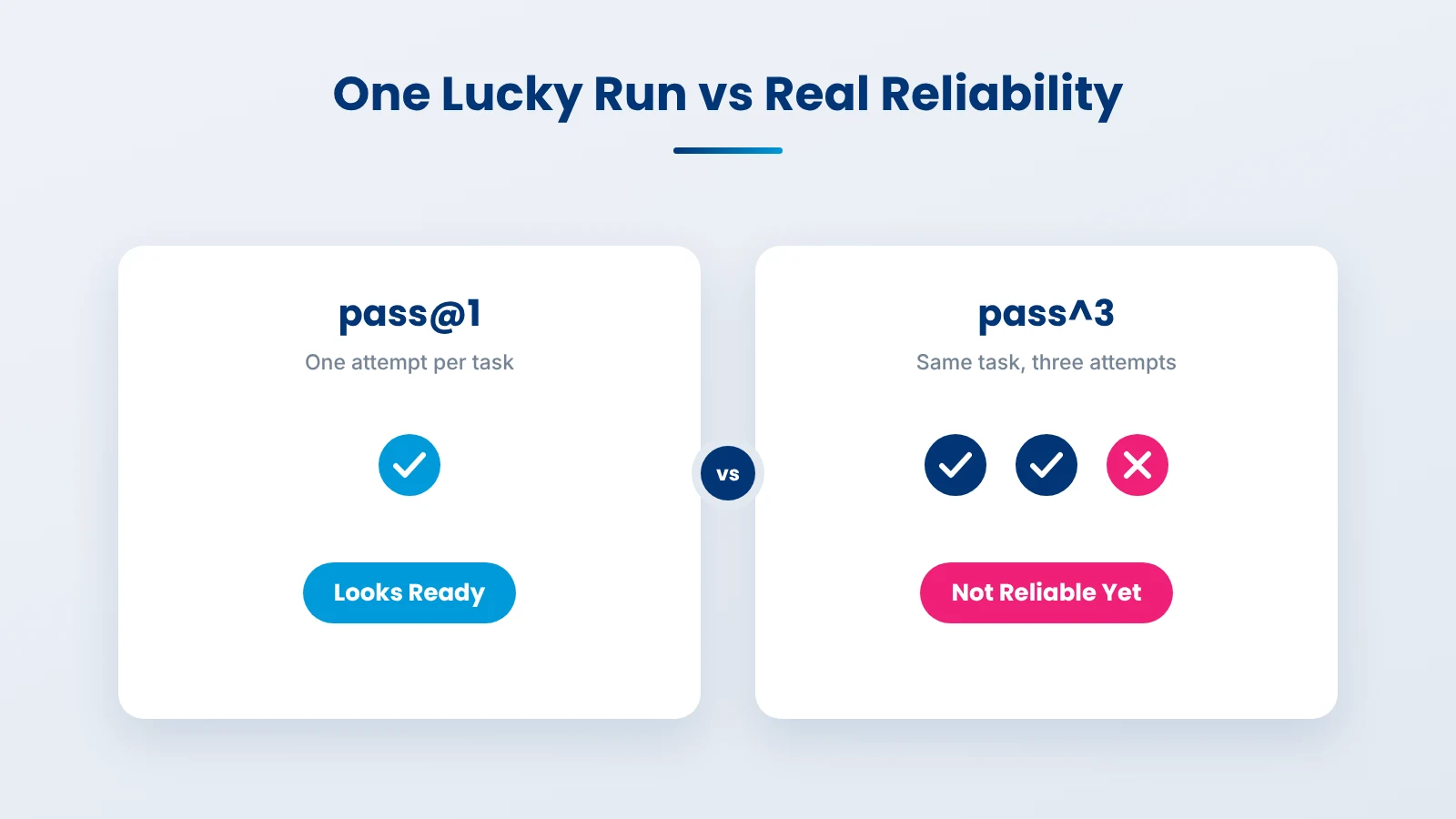
Why Pass^k Matters More Than One Lucky Run
Most teams report pass@1: run the task once and see if it worked. That hides inconsistency. pass^k asks whether the agent succeeds on every one of k attempts, which is what a customer-facing agent needs.
The gap is large. Anthropic’s guide to agent evals gives the arithmetic: an agent with a 75% success rate per attempt passes all three of three attempts only about 42% of the time. When Sierra introduced the τ-bench benchmark, a GPT-4o agent scored about 25% on pass^8 in its retail domain, roughly 60% below its single-run score.
In practice, run each test task at least three times before a release and report both numbers. If pass@1 is high but pass^3 is low, the agent is not stable yet, and more prompt tuning will not fix that on its own.
How Should You Grade Agents: Code, LLM-As-Judge Or Humans?
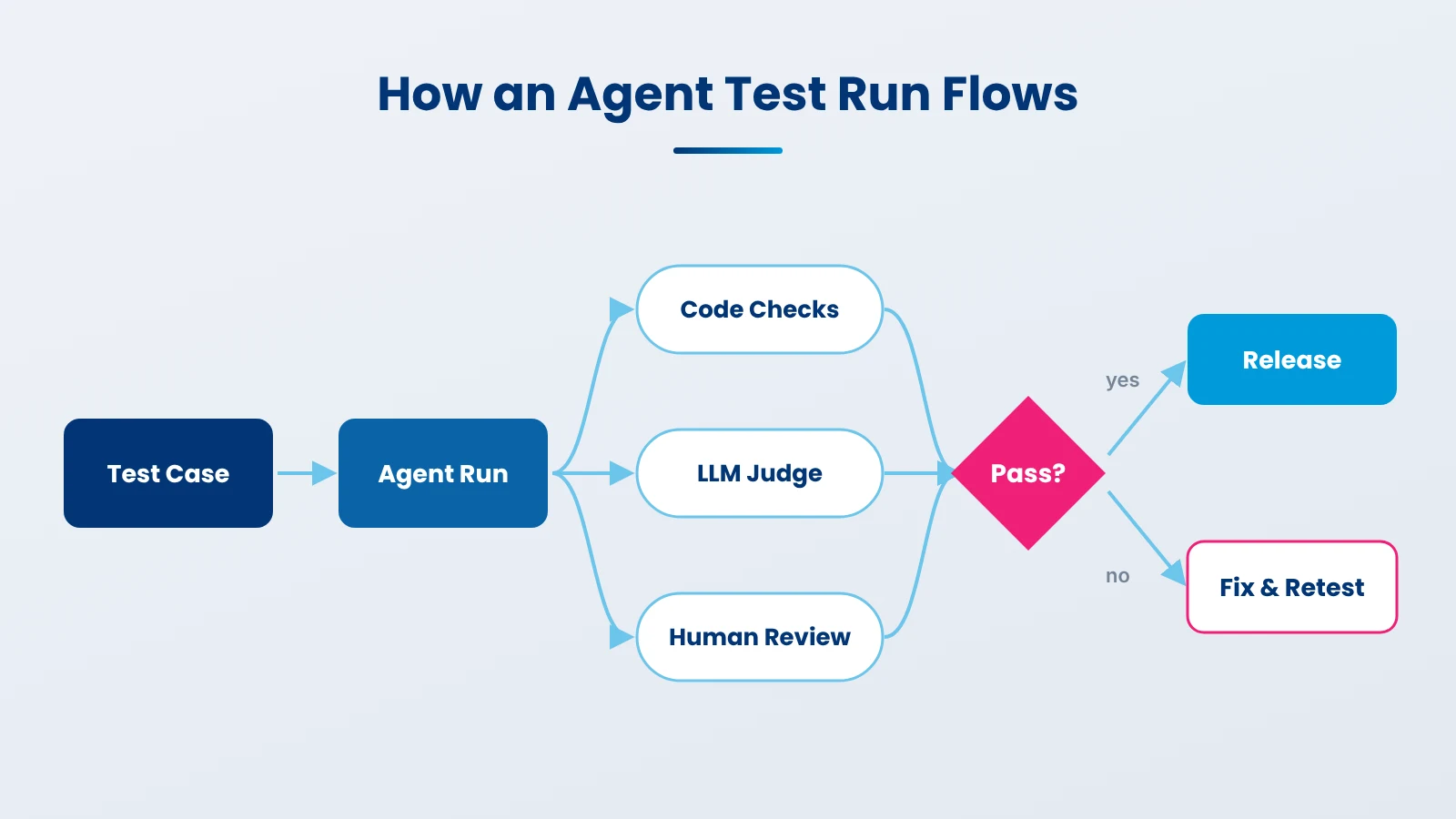
Use all three, each where it fits. Code-based checks are fast and objective, LLM-as-judge scoring handles open-ended quality, and human review sets the standard the other two are measured against.
Grader
Best for
Main limitation
Code-based checks
Final state, tool arguments, schemas, step counts, policy rules
Cannot judge tone, helpfulness or reasoning quality
LLM-as-judge
Answer quality, rubric scoring, comparing two versions
Non-deterministic and biased; needs calibration
Human review
Building gold labels, edge cases, high-risk tasks
Slow and expensive at scale
The Known Limits Of LLM-As-Judge
LLM evals that use a model as the grader are now standard, and for good reason. In the study that popularized the method, strong judges such as GPT-4 agreed with human preferences more than 80% of the time, about the same rate at which humans agree with each other.
The same study identified biases to design around: position bias (favoring the first answer shown), verbosity bias (favoring longer answers) and self-enhancement bias (favoring answers from the same model family). Practical fixes:
Swap the order of answers in pairwise comparisons and keep only consistent verdicts.
Score against a written rubric with specific criteria, not a vague 1 to 10 rating.
Use a different model family as judge from the one that runs the agent.
Check the judge against 50 to 100 human-labeled examples before trusting it, and recheck after any judge or rubric change.
For high-stakes domains such as finance and healthcare, keep a human reviewer on a sample of every release, whatever the automated scores say.
How To Build An Agent Evaluation Framework Step By Step
A working agent evaluation framework needs test tasks, graders, pass criteria and a place in your release process. You can have a useful first version running in about two weeks. Here is the sequence we follow.
Define success with the business owner. Write down what a completed task means for each task type, in terms someone outside engineering would accept. This definition drives every grader you build.
Collect 20 to 50 real tasks. Pull them from support tickets, pilot logs and known failures. Anthropic’s guidance is that a small set drawn from real failures is enough to start, because early changes have large effects.
Write each task as a test case. Include the input, the starting environment, the expected end state and any rules the agent must not break. See the example below.
Choose a grader per check. Use code wherever the answer is objective, an LLM judge for quality, and humans for the gold labels you calibrate against.
Run every task several times. Report pass@1 and pass^3 for each task type.
Gate releases in CI/CD. Run the suite on every prompt, model, tool or framework change. Block the release if safety tests fail or success drops below your threshold.
Feed production back in. Each week, turn new failures from production traces into test cases. This is where evaluation joins your wider LLMOps process.
Example Test Case
This is the shape of a single test for a customer service agent. Most eval tools accept something similar in YAML or JSON.
id: refund-partial-damaged-item-012
input: "My blender arrived cracked. Order 4471. I want my money back."
setup:
  order_4471: {status: delivered, total: 89.00, item: blender}
expected_end_state:
  refund_issued: true
  refund_amount: 89.00
  ticket_status: resolved
must_call_tools: [lookup_order, create_refund]
must_not:
  - refund_amount > 89.00
  - reveal another customer's data
max_steps: 8
graders:
  - type: code      # end state, tool calls, step count
  - type: llm_judge # tone and clarity, scored against rubric v2
runs: 3              # report pass@1 and pass^3
Notice what it does not specify: the exact order of steps. The agent can check the return policy first or ask a clarifying question, and still pass, as long as it reaches the right end state within the rules.
If you are still choosing your stack, our guides on building an AI agent and comparing AI agent frameworks cover how framework choice affects tracing and testing.
Building an AI agent for production?
Get an evaluation plan with test tasks, graders and release gates from Xicom’s AI engineers.
Five tools cover most AI agent evaluation needs today. Two are open-source libraries you run in code, and three are platforms that add datasets, dashboards and production scoring. Many teams pair one of each.
Open-source platform (MIT core), cloud or self-hosted
LLM-as-judge evaluators, datasets and manual labeling alongside tracing
Teams that need evals and traces to stay in their own cloud
Two tips from practice. First, keep your test cases in your own repository in a plain format, so you can switch tools without rewriting them. Second, check that the tool can grade the end state of your systems, not just the text the agent returns; that usually means writing a few custom code-based graders.
On our agent projects, the evaluation suite is written before the agent is finished. We start by agreeing on success criteria with the client’s business owner, then build a first set of test tasks from their real tickets and edge cases. Safety and policy tests are pass or fail and block any release. We run each task several times, report reliability alongside accuracy, and add new production failures to the suite every sprint.
Our delivery runs on CMMi Level 3 processes, so evaluation results, test changes and release decisions are documented and repeatable.
AI agent evaluation is not a one-time test before launch. It is a standing suite that grows with every failure you find and runs on every change you ship. Start small: 20 to 50 real tasks, graded on the outcome, checked on tool calls and safety, and repeated enough times to measure reliability. Calibrate your LLM judges against human labels, gate releases on the results, and feed production traces back in each week. Teams that do this ship agent updates with confidence, and they catch problems in testing instead of in front of customers.
Want reliable AI agents?
Talk to Xicom about building, testing and launching AI agents your team can trust.
AI agent evaluation is the process of testing how well an AI agent completes multi-step tasks. It checks the final outcome, the tools the agent called and the steps it took, along with safety rules and consistency across repeated runs. Results come from code-based checks, LLM-as-judge scoring and human review.
How is AI agent testing different from LLM evals?
LLM evals usually score a single model response for accuracy or quality. AI agent testing covers a whole sequence of reasoning, tool calls and actions that change real systems. It has to check the end state, the tool arguments and safety limits, and it must run tasks several times because agents can take a different path on each attempt.
How many test cases do I need to start?
Start with 20 to 50 tasks drawn from real user requests and known failures. That is enough to catch the large problems early changes tend to cause. Grow the set each week by adding failures from production, and keep separate groups for core tasks, edge cases and safety tests.
What is pass^k in AI agent evaluation?
pass^k is the chance an agent succeeds on every one of k attempts at the same task. It measures reliability rather than best-case ability. An agent that passes 75% of single attempts passes all three of three attempts only about 42% of the time, which is why customer-facing agents should be judged on pass^k.
Can I trust an LLM as the judge?
Yes, with calibration. Strong LLM judges agree with human preferences at roughly the rate humans agree with each other, but they show position, verbosity and self-preference biases. Use a written rubric, swap answer order, use a different model family as judge and check scores against human-labeled examples.
When should agent evaluations run?
Run the full suite on every change to prompts, models, tools or frameworks, and block the release if safety tests fail or success drops below your threshold. Also run lighter online scoring on a sample of production traffic, so you catch drift between releases.
The Author
Rahul Mahajan
Founder and CEO · Xicom
With over two decades of experience leading technology and business strategy, Rahul Mahajan has shaped the AI and digital transformation direction of enterprises across industries including Healthcare, Retail, FinTech, and Education. Under his leadership as the Founder and CEO of Xicom, the company has scaled to a 350+ member team and delivered 1800+ projects for clients across 50+ countries.
Discover how AI in travel and hospitality improves guest experiences, automates bookings, optimizes hotel operations, and transforms travel management.
AI agent observability explained: what to trace, which metrics to alert on, how LangSmith, Langfuse, Phoenix and Datadog compare, plus a rollout checklist.