
How Much Does It Cost to Develop a Custom CRM System?
Custom CRM development costs $30,000 to $300,000+. See costs by tier and feature, AI add-ons, migration, upkeep and a 3-year comparison with Salesforce.
Nov 17, 2026 Software Development
The energy and utilities industry is undergoing significant changes as electricity demand increases, renewable energy becomes more widely adopted, and infrastructure faces growing operational pressure. Utilities must manage complex power networks, maintain ageing assets, balance fluctuating demand, and provide reliable services while controlling costs. Artificial intelligence (AI) is helping address these requirements by improving forecasting, automating operational decisions, and extracting useful insights from large volumes of data generated across energy systems. The International Energy Agency’s latest analysis projects that electricity consumption from data centres will nearly double, increasing from 485 TWh in 2025 to 950 TWh by 2030.
AI is becoming relevant across the energy value chain, from power generation and transmission to distribution, consumption, and customer service. Machine learning, computer vision, predictive analytics, and generative AI can help energy companies improve asset performance, anticipate equipment failures, integrate renewable sources, and respond more effectively to changing demand. These capabilities also support utilities in modernizing existing infrastructure without necessarily replacing their entire operational environment.
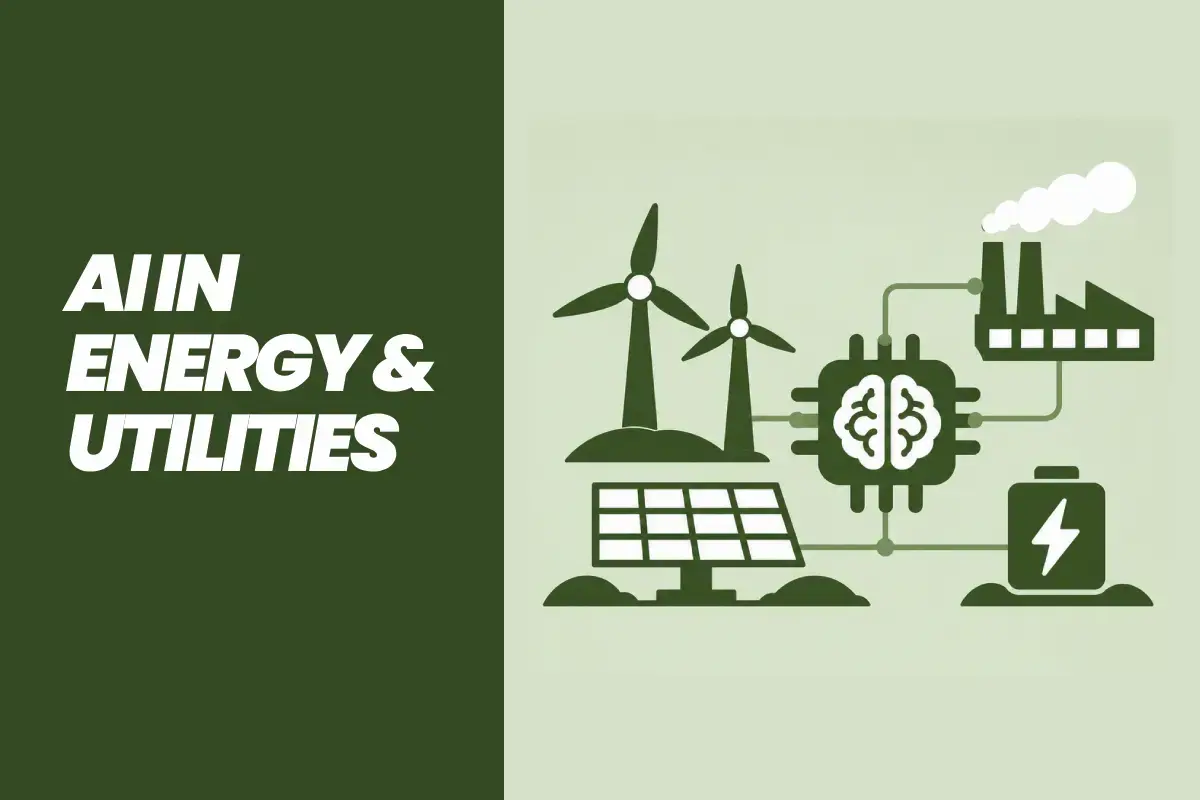
Traditional energy operations rely on scheduled maintenance, historical consumption patterns, manual inspections, and established operating rules. While these approaches remain important, they can struggle to respond to rapidly changing conditions and large, interconnected systems.
AI adds the ability to analyze operational data continuously and identify patterns that may not be apparent through conventional analysis. For example, machine learning models can detect early signs of equipment deterioration, forecast electricity demand, and identify unusual activity across distribution networks. Computer vision can examine images from drones and inspection cameras, while optimization algorithms can help balance generation, storage, and consumption.
The value of AI is not limited to automating individual tasks. It can connect information from different operational systems and help organizations make decisions across generation, grid management, asset maintenance, and customer operations.
Different AI technologies support different operational requirements. Their suitability depends on the type of data available, the decisions involved, and the reliability requirements of the energy system.
| AI technology | Applications in energy and utilities |
|---|---|
| Machine learning | Demand forecasting, equipment failure prediction, energy price forecasting |
| Deep learning | Complex pattern recognition, renewable generation forecasting, fault detection |
| Computer vision | Infrastructure inspection, equipment monitoring, vegetation management |
| Natural language processing | Document analysis, customer query classification, regulatory document processing |
| Generative AI | Technical knowledge retrieval, operational assistance, report generation |
| Optimization algorithms | Grid balancing, energy storage scheduling, generation planning |
These technologies are often combined. For instance, computer vision can identify visible damage in an asset image, while machine learning models assess the likelihood of equipment failure using inspection findings and sensor data.
Power generation facilities must maintain output while managing fuel consumption, operating costs, equipment efficiency, and environmental requirements. AI can analyze data from turbines, boilers, generators, cooling systems, and other plant equipment to identify opportunities for improving performance.
Machine learning models can evaluate operating conditions such as temperature, pressure, vibration, fuel input, and output levels. By comparing these variables with historical performance, AI systems can identify operating patterns associated with reduced efficiency or abnormal equipment behavior.
AI can also support generation planning by forecasting electricity demand and estimating the output required from different power sources. Plant operators can use these insights to plan operating schedules, reduce unnecessary fuel consumption, and coordinate generation with grid requirements.
Energy infrastructure includes turbines, transformers, generators, pipelines, substations, transmission lines, and other assets that require regular monitoring. Traditional maintenance often follows fixed schedules or begins after equipment problems become visible. Predictive maintenance uses operational data to identify potential failures before they cause major disruptions.
AI models analyze information from sensors, inspection records, maintenance histories, and equipment performance data. They can detect changes in vibration, temperature, pressure, and other indicators that may signal deterioration. Maintenance teams can then prioritize inspections and repairs according to equipment condition and operational risk.
| Equipment | AI-based maintenance application |
|---|---|
| Transformers | Detecting abnormal temperature patterns, insulation deterioration, and changes in operating conditions |
| Turbines | Monitoring vibration, temperature, and performance deviations |
| Transmission lines | Identifying structural damage, overheating, and vegetation-related risks |
| Pumps and motors | Detecting abnormal vibration, pressure changes, and efficiency loss |
| Pipelines | Identifying leakage indicators, corrosion patterns, and pressure irregularities |
Predictive maintenance can reduce unplanned downtime and help organizations use maintenance resources more effectively. However, AI predictions should complement engineering inspections and established safety procedures rather than replace them.
Solar and wind generation depend on weather conditions that can change throughout the day. Variations in sunlight, wind speed, cloud cover, and temperature make renewable output difficult to predict accurately. AI can improve forecasting by combining historical generation data with weather information and real-time operating conditions.
Machine learning models can estimate solar and wind output over different time horizons. These forecasts help grid operators plan generation schedules, manage reserve capacity, and coordinate energy storage. AI can also identify performance deviations in renewable installations, helping operators detect issues such as underperforming solar panels or wind turbine faults.
| Renewable source | AI applications |
|---|---|
| Solar | Solar generation forecasting, panel performance monitoring, fault detection |
| Wind | Wind speed forecasting, turbine performance optimization, predictive maintenance |
| Hydropower | Water availability forecasting, reservoir management, generation scheduling |
More accurate renewable forecasts can help utilities accommodate variable generation while maintaining grid stability. AI can also support the integration of renewable energy into systems that were originally designed around more predictable generation sources.
Modern electricity grids must manage power flows across interconnected generation, transmission, distribution, and consumption systems. The growing use of renewable energy, electric vehicles, distributed generation, and battery storage adds complexity to grid operations.
AI can analyze information from smart meters, grid sensors, substations, and control systems to provide a more detailed view of network conditions. It can help identify congestion, forecast changes in electricity demand, and recommend adjustments to power distribution.
AI-powered optimization systems can also support grid balancing by evaluating available generation, storage capacity, and expected consumption. These capabilities help grid operators make better-informed decisions, particularly when renewable output and demand fluctuate.
Electricity demand changes according to weather, time of day, industrial activity, population patterns, and consumer behavior. Accurate forecasting helps utilities determine how much electricity must be generated, purchased, stored, or distributed.
AI models analyze historical consumption data alongside external variables such as temperature, humidity, calendar events, and economic activity. They can generate forecasts at different levels, including national grids, regions, substations, and individual customer groups.
Utilities can use these forecasts to plan generation, manage peak demand, and reduce the need for expensive backup power. AI can also identify periods when demand is likely to exceed available capacity and support demand-response programs that encourage consumers to shift electricity use.
Power distribution networks are exposed to equipment failures, weather events, vegetation interference, and other conditions that can interrupt electricity supply. Identifying the location and cause of a fault quickly is essential for restoring service.
AI systems can analyze sensor readings, smart meter alerts, outage records, and inspection images to identify abnormal network conditions. They can help distinguish between different fault types and estimate the affected areas. Computer vision can also examine images of poles, cables, and substations to identify visible damage or potential hazards.
During outages, AI can support restoration planning by helping operators prioritize affected locations, assess available network capacity, and determine possible switching actions. Final decisions should remain subject to operational controls and safety requirements.
Energy storage helps balance differences between electricity generation and demand. Batteries can store excess renewable energy and release it when generation falls or consumption increases. Managing these systems requires decisions about charging, discharging, temperature, battery health, and expected demand.
AI models can forecast electricity prices and demand to determine when batteries should charge or discharge. They can also monitor battery temperature, voltage, current, and charging patterns to identify conditions associated with degradation or abnormal operation.
For utilities operating large battery installations, AI can help coordinate storage capacity with renewable generation and grid requirements. These capabilities can improve asset utilization and support more reliable energy management.
Distributed energy resources include rooftop solar installations, local battery systems, small-scale generators, and electric vehicle charging infrastructure. Their growing adoption means electricity can be generated and consumed across many locations rather than only through centralized power plants.
AI can help utilities forecast the output of distributed resources and understand how they affect local network conditions. In microgrids, AI-based control systems can coordinate local generation, storage, and consumption according to availability and demand.
During grid disturbances, microgrids may operate independently where the system design and operating permissions allow it. AI can support decisions about available power, storage use, and load prioritization, helping maintain essential services.
Energy markets are influenced by demand, generation availability, fuel prices, weather, transmission constraints, and regulatory conditions. These variables can cause electricity prices to fluctuate considerably.
AI models can analyze historical market data and current operating conditions to forecast prices and identify market trends. Energy companies can use these insights to support purchasing, bidding, generation scheduling, and trading decisions.
AI can also help evaluate scenarios involving renewable generation, fuel costs, and demand changes. However, market forecasts are uncertain and should be considered alongside regulatory requirements, risk limits, and human oversight.
Water utilities manage treatment plants, pumping stations, pipelines, reservoirs, and distribution networks. These operations require continuous monitoring to maintain water quality, control energy consumption, and prevent supply interruptions.
AI can analyze sensor data from treatment facilities to monitor parameters such as flow, pressure, turbidity, and chemical levels. Models can identify unusual readings and help operators detect process deviations. Predictive maintenance can also identify potential problems in pumps, motors, and other equipment.
In water distribution networks, AI can analyze pressure patterns and flow data to identify possible leaks or unusual consumption. These insights can help utilities prioritize inspections and reduce water losses. AI-based forecasting can further support decisions about water demand, reservoir levels, and pumping schedules.
Utilities operate large asset portfolios spread across extensive geographic areas. Maintaining accurate information about asset condition, location, age, maintenance history, and operational importance is essential for long-term planning.
AI can combine asset records, inspection reports, sensor readings, geographic information, and maintenance data to support asset management. Predictive models can estimate failure risk, while computer vision can assess infrastructure images collected through drones and inspection vehicles.
These insights help organizations prioritize repairs, plan asset replacements, and allocate maintenance budgets. AI can also support infrastructure monitoring by identifying changes in asset condition over time.
Electricity theft, meter tampering, and billing irregularities can cause revenue losses for utilities. Detecting these activities across large customer bases can be difficult through manual checks alone.
AI models can analyze smart meter readings, consumption histories, billing records, and customer patterns to identify unusual behavior. For example, a sudden change in consumption that does not align with previous usage or comparable customers may require further investigation.
Anomaly detection systems can help utilities prioritize suspicious cases for inspection. However, unusual consumption does not automatically indicate theft. Utilities should validate alerts before taking action to avoid incorrectly flagging customers.
Smart meters provide more frequent information about electricity consumption than conventional meters. This data can help utilities understand usage patterns and improve customer-level demand analysis.
AI can group customers according to consumption behavior, identify peak usage periods, and forecast demand at a more granular level. Utilities can use these insights to design demand-response programs, improve tariff planning, and communicate relevant energy-saving opportunities.
For consumers, AI-powered energy management systems can recommend adjustments to appliance usage, heating, cooling, and charging schedules. These recommendations can help reduce consumption during peak periods and improve energy efficiency.
Utility customers contact service providers for billing questions, payment issues, new connections, outages, meter readings, and service requests. High interaction volumes can increase waiting times and place pressure on support teams.
AI-powered conversational systems can handle common queries through websites, mobile applications, and messaging platforms. Natural language processing helps these systems understand customer requests, retrieve relevant account or service information, and provide appropriate responses.
AI can also classify incoming complaints, summarize customer interactions, and route complex cases to the right teams. Generative AI can assist service representatives by retrieving information from internal knowledge bases and preparing responses. Sensitive account changes and disputed transactions should continue to follow appropriate verification and approval procedures.
Energy companies often operate a combination of legacy equipment, operational technology, enterprise applications, and newer digital platforms. AI adoption therefore depends on how well new capabilities connect with existing infrastructure.
Integration may involve linking AI models with supervisory control and data acquisition systems, energy management systems, geographic information systems, asset management platforms, and customer information systems. The objective is to make relevant information available for analysis without disrupting essential operations.
| Integration approach | Role in AI adoption |
|---|---|
| API integration | Connects AI applications with enterprise software and business systems |
| Data pipelines | Collects and transfers information from operational and enterprise sources |
| Edge computing | Processes data closer to equipment where low latency or limited connectivity matters |
| Cloud platforms | Supports scalable data storage, model training, and analytics |
| Digital twins | Combines asset and system data to simulate performance and evaluate scenarios |
Integration should account for the difference between information technology and operational technology environments. Systems responsible for controlling physical infrastructure require strict access controls, testing, and operational safeguards.
AI performance depends on the quality, availability, and consistency of the data used to train and operate models. Energy companies may collect information from equipment sensors, smart meters, weather services, maintenance systems, customer platforms, and market databases. These sources often differ in format, frequency, and level of detail.
Before expanding AI initiatives, organizations need to understand where their data resides, how reliable it is, and whether it can be accessed securely.
| Data challenge | Implication for AI |
|---|---|
| Data silos | Prevents models from using information across departments and systems |
| Inconsistent formats | Makes it difficult to combine operational and enterprise data |
| Missing or inaccurate readings | Reduces forecast and prediction reliability |
| Limited historical records | Restricts model training and performance evaluation |
| Poor data governance | Creates concerns around ownership, access, and accountability |
A structured data foundation helps utilities improve model accuracy and maintain consistent information across applications. Data quality should also be monitored after deployment because changes in equipment, operating conditions, and customer behavior can affect model performance.
Moving from an AI pilot to enterprise-wide adoption requires more than selecting a suitable model. Organizations must consider operational requirements, system compatibility, workforce readiness, and the business value of each use case.
AI initiatives should begin with clearly defined objectives, such as reducing equipment downtime, improving demand forecast accuracy, lowering energy losses, or shortening outage restoration times. These objectives provide a basis for selecting performance indicators and evaluating results.
Deployment approaches should reflect the criticality of the application. An AI model that recommends maintenance priorities has different requirements from one that influences real-time grid operations. High-impact applications need rigorous validation, fail-safe mechanisms, and clear procedures for human intervention.
Utilities should also plan for ongoing model monitoring, updates, technical support, and employee training. Involving operations, engineering, IT, cybersecurity, and compliance teams early can help prevent integration issues later.
Energy and utility infrastructure is critical to public services and economic activity. AI systems operating in this environment must meet strict expectations around security, reliability, transparency, and accountability.
Organizations need AI governance policies that define who owns AI systems, who can access their data, how model outputs are reviewed, and who is responsible when recommendations lead to operational decisions. Models used in safety-critical environments require appropriate validation and human oversight.
Cybersecurity is equally important. Connecting AI applications to operational systems can introduce additional access points and potential vulnerabilities. Utilities should apply identity controls, network segmentation, encryption, continuous monitoring, and secure software practices.
Regulatory requirements vary across markets and types of utility operations. AI initiatives should therefore be reviewed against applicable energy regulations, data protection obligations, industry standards, and critical infrastructure security requirements.
Despite its potential, AI adoption can be difficult in an industry where infrastructure has long operating lifecycles and service reliability is essential. Organizations must address technical and operational constraints before scaling solutions.
| Challenge | Business implication |
|---|---|
| Legacy infrastructure | Integration may require upgrades or additional data connectivity |
| Poor data quality | Can reduce the reliability of predictions and recommendations |
| Cybersecurity risks | Increases the need for stronger controls and monitoring |
| Skills shortages | Makes it difficult to develop, operate, and maintain AI systems |
| Model reliability | Requires continuous validation as operating conditions change |
| High initial investment | Makes it important to prioritize use cases with measurable value |
| Workforce adoption | Requires training and clear processes for using AI outputs |
A practical adoption strategy focuses on specific operational problems, evaluates results through measurable indicators, and expands successful applications gradually. This approach helps organizations manage risk while building confidence in AI-supported operations.
AI is likely to play a larger role as energy systems become more distributed, data-intensive, and interconnected. More accurate forecasting, automated grid management, and coordinated energy storage could help utilities manage the growing share of renewable generation.
Digital twins may become more useful for simulating grid behavior, evaluating infrastructure changes, and planning maintenance. Generative AI could also support engineers and field teams by making technical documentation, maintenance histories, and operating procedures easier to access.
The expansion of electric vehicles, smart buildings, microgrids, and distributed energy resources will create further opportunities for AI-driven coordination. However, progress will depend on reliable data, secure integration, effective governance, and the ability to demonstrate measurable operational value.
AI is creating opportunities for energy and utility companies to improve generation efficiency, anticipate infrastructure failures, forecast demand, manage renewable energy, and deliver better customer services. Its value comes from connecting data across operational and enterprise systems and turning that information into timely insights. Organizations that combine well-defined business objectives with reliable data, secure integration, workforce readiness, and appropriate governance will be better positioned to scale AI across their operations.
Explore how Xicom’s enterprise AI development services can help connect your existing systems with intelligent capabilities that support measurable improvements in energy operations.
AI in energy and utilities is the use of machine learning, computer vision, predictive analytics, and generative AI to improve how energy is generated, transmitted, distributed, and consumed. Utilities use it to forecast demand, predict equipment failures, integrate renewable energy, detect faults, and automate customer service. Much of this can run on their existing infrastructure.
AI improves demand forecasting by analyzing historical consumption together with temperature, humidity, calendar events, and economic activity. Machine learning models can forecast at the level of a national grid, a region, a substation, or a customer segment. Utilities use these forecasts to plan generation, manage peak demand, and cut reliance on expensive backup power.
AI-driven predictive maintenance uses sensor data, inspection records, and maintenance history to spot early signs of equipment deterioration before a failure happens. Models track changes in vibration, temperature, and pressure on assets such as transformers, turbines, and pipelines. Maintenance teams can then prioritize repairs by risk instead of fixed schedules, which reduces unplanned downtime.
AI helps integrate renewable energy by forecasting solar and wind output from weather data, historical generation, and real-time conditions. With more accurate forecasts, grid operators can plan reserve capacity, schedule energy storage, and balance supply against demand. AI also detects underperforming solar panels or wind turbine faults, which keeps renewable assets productive and the grid stable.
In smart grid management, AI analyzes data from smart meters, grid sensors, substations, and control systems to give operators a detailed, near real-time view of network conditions. It can identify congestion, forecast load changes, recommend power distribution adjustments, and balance generation with storage. This matters more as electric vehicles, rooftop solar, and batteries make grids more complex.
Yes. AI detects possible electricity theft by analyzing smart meter readings, billing records, and consumption histories for unusual patterns, such as sudden drops in usage that don’t match a customer’s past behavior or similar customers. Anomaly detection helps utilities prioritize cases for inspection. Unusual consumption doesn’t automatically mean theft, so every alert should be verified before any action is taken.
Utilities can integrate AI with legacy infrastructure through API integration, data pipelines, edge computing, cloud platforms, and digital twins. These connect AI models to existing SCADA, energy management, GIS, asset management, and customer information systems without disrupting core operations. Systems that control physical infrastructure need strict access controls, testing, and safeguards.
AI can be used safely in critical energy infrastructure if it has strong governance, cybersecurity, and human oversight. Utilities should define who owns each AI system, validate models rigorously, and apply identity controls, network segmentation, and encryption. In safety-critical applications such as real-time grid operations, AI should support operator decisions rather than replace established safety procedures.

Custom CRM development costs $30,000 to $300,000+. See costs by tier and feature, AI add-ons, migration, upkeep and a 3-year comparison with Salesforce.

MVP development cost explained: realistic ranges by complexity, platform and product type, AI MVP budgets, three worked examples and ways to reduce cost.
Enterprise software development cost explained: ranges by project type, key cost drivers, hybrid delivery savings, AI costs and a formula with 3 sample budgets.