AI in Pharmaceutical Research: Drug Discovery, Molecular Design, and Research Innovation
Explore how AI in pharmaceutical research supports drug discovery, from target identification and virtual screening to toxicity and trial design.
Nov 23, 2026 Artificial Intelligence
Procurement functions are responsible for managing supplier relationships, controlling expenditure, securing materials and services, and ensuring that purchasing activities align with organizational requirements. However, fragmented supplier information, inconsistent purchasing data, lengthy approval cycles, and limited visibility into external markets can complicate these responsibilities. Artificial intelligence (AI) is changing how procurement teams manage these activities by introducing intelligent data analysis, predictive capabilities, and automation across the purchasing lifecycle. According to APQC’s 2025 research on AI in procurement, 58% of surveyed organizations had not yet implemented AI in procurement, indicating considerable scope for adoption.
Machine learning (ML) models can identify patterns across historical transactions, natural language processing (NLP) can interpret supplier documents and commercial agreements, and generative AI can assist with sourcing documentation, contract reviews, and procurement inquiries. When integrated with enterprise resource planning (ERP), supplier management, and source-to-pay platforms, these capabilities provide procurement teams with better visibility into expenditure, supplier performance, and purchasing requirements. AI therefore extends procurement technology beyond transaction processing to support strategic sourcing, supplier evaluation, contract management, and purchasing decisions.
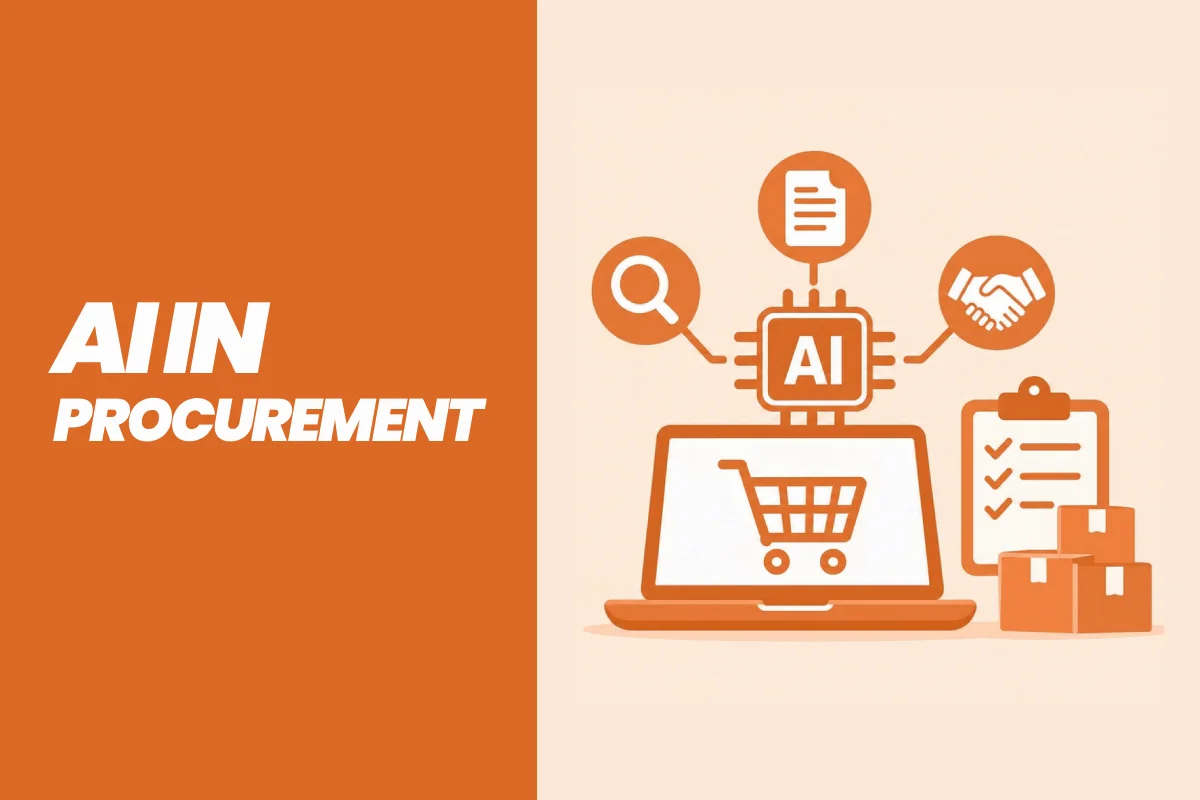
Traditional procurement operations involve several interconnected activities, beginning with identifying purchasing requirements and extending through supplier selection, contract negotiation, order placement, delivery monitoring, and invoice settlement. Although enterprise procurement platforms have digitized many of these activities, decision-making frequently depends on manual data interpretation and coordination between departments.
AI introduces an intelligence layer across these processes. Machine learning algorithms examine purchasing history, supplier records, market information, and operational requirements to identify relationships that may not be immediately apparent through conventional reporting. Predictive models estimate future purchasing requirements, while recommendation systems identify suitable suppliers based on price, delivery capabilities, quality records, and contractual obligations.
Generative AI further enables employees to interact with procurement information through natural language. Procurement professionals can request supplier comparisons, summarize contract clauses, generate requests for proposals, or retrieve purchasing information without manually examining multiple documents.
The transformation encompasses three broad areas:
AI-powered spend analysis consolidates purchasing information from ERP systems, invoices, purchase orders, and supplier databases to identify expenditure patterns and cost-saving opportunities.
Machine learning models classify transactions according to purchasing categories, supplier names, business units, and expenditure types. Unlike conventional classification methods that depend heavily on predefined rules, ML algorithms can interpret inconsistent descriptions and identify similarities between transactions recorded differently across systems.
For example, purchases recorded as industrial fasteners, mounting hardware, and mechanical fastening components may belong to the same procurement category. AI can recognize these relationships and consolidate the expenditure information.
Key applications of AI in spend analysis:
| Application | How AI contributes |
|---|---|
| Spend classification | Categorizes transactions using descriptions, supplier records, and purchasing history |
| Maverick spend detection | Identifies purchases outside approved procurement channels |
| Duplicate detection | Flags potentially duplicated transactions and payments |
| Supplier consolidation | Identifies opportunities to combine purchases across departments |
| Expenditure forecasting | Estimates future spending across categories and business units |
| Price variance analysis | Identifies differences between negotiated and actual purchase prices |
These capabilities help procurement teams identify unnecessary expenditure, improve purchasing visibility, and establish stronger negotiating positions.
AI helps procurement teams identify suppliers that match technical, commercial, operational, and regulatory requirements by examining information from supplier databases, industry directories, certifications, and capability statements.
NLP models extract relevant information from supplier profiles, product catalogues, and technical documentation. Recommendation algorithms then compare supplier capabilities against purchasing requirements.
For instance, a manufacturing enterprise seeking precision-machined components can use AI to identify vendors with relevant machining capabilities, quality certifications, production capacity, and geographical proximity.
| Evaluation parameter | AI-enabled assessment |
|---|---|
| Technical capabilities | Matches supplier capabilities with product specifications |
| Commercial suitability | Compares quotations, pricing structures, and payment terms |
| Quality performance | Examines historical rejection rates and quality records |
| Delivery reliability | Evaluates lead times and on-time delivery |
| Regulatory compliance | Reviews certifications and compliance documentation |
| Capacity | Assesses available production capabilities against requirements |
Supplier recommendation systems can generate shortlists based on these parameters, allowing procurement professionals to evaluate potential vendors more efficiently.
AI supports strategic sourcing by examining purchasing history, market conditions, supplier capabilities, and business requirements to inform sourcing decisions.
Generative AI can prepare initial drafts of requests for information (RFIs), requests for proposals (RFPs), and requests for quotations (RFQs). It can organize technical specifications, incorporate commercial evaluation criteria, and structure supplier questionnaires.
During sourcing events, NLP models analyze supplier responses, extract relevant information, identify missing details, and compare proposals against predefined requirements.
Applications across the sourcing process:
| Sourcing activity | AI application |
|---|---|
| Market research | Identifies potential suppliers and sourcing opportunities |
| RFx preparation | Generates initial sourcing documents and questionnaires |
| Proposal evaluation | Extracts and compares technical and commercial information |
| Supplier shortlisting | Ranks vendors against predefined evaluation criteria |
| Scenario analysis | Evaluates alternative sourcing strategies |
| Sourcing recommendations | Identifies suitable suppliers based on business requirements |
For example, an enterprise sourcing industrial equipment can use AI to compare technical specifications, warranty provisions, delivery commitments, and commercial terms across multiple supplier proposals.
AI-powered pricing intelligence systems analyze historical purchase prices, supplier quotations, commodity indices, market information, and external economic indicators to establish price benchmarks.
Predictive models estimate potential price movements by identifying historical patterns and examining relevant market signals. Procurement professionals can use these forecasts to determine when to negotiate, consolidate purchasing volumes, or consider alternative suppliers.
Generative AI can also summarize supplier pricing histories, identify differences between previous and current quotations, and prepare negotiation points.
| Pricing consideration | AI capability |
|---|---|
| Historical pricing | Compares current quotations with previous purchase prices |
| Market benchmarking | Evaluates supplier quotations against market indicators |
| Commodity movements | Tracks changes in relevant raw material prices |
| Currency fluctuations | Examines exchange-rate exposure |
| Total cost of ownership | Compares purchase, transportation, maintenance, and lifecycle costs |
| Negotiation preparation | Summarizes pricing discrepancies and potential negotiation areas |
Total cost of ownership (TCO) analysis is particularly useful when suppliers offer different commercial arrangements. A supplier offering machinery at a lower purchase price may have higher maintenance expenses and longer replacement lead times. AI-supported analysis helps procurement teams assess the broader financial implications before making a decision.
Also Read: AI in Energy & Utilities
AI-based supplier risk management systems examine internal procurement records and external information to identify potential disruptions involving supplier financial stability, geopolitical developments, regulatory changes, and logistics operations.
Machine learning models analyze supplier financial indicators, delivery histories, quality incidents, geographical exposure, and compliance records. NLP systems can examine news reports, regulatory announcements, and supplier disclosures to identify developments that may affect supplier operations.
Key supplier risk indicators monitored by AI:
| Risk category | Indicators examined |
|---|---|
| Financial | Credit deterioration, financial instability, payment-related concerns |
| Operational | Capacity constraints, production interruptions, delivery delays |
| Quality | Product defects, rejection rates, recalls |
| Geopolitical | Political instability, trade restrictions, regional disruptions |
| Regulatory | Compliance violations and certification issues |
| Environmental | Natural disasters and climate-related supply disruptions |
For example, if a supplier operates manufacturing facilities in a region experiencing political instability, AI can identify the geographical exposure and examine its potential implications for supply continuity.
By consolidating these indicators, procurement teams can prioritize supplier assessments and identify potential disruptions earlier.
AI-powered contract management systems use NLP and large language models (LLMs) to interpret contractual language, extract important clauses, and organize information into searchable repositories.
These systems identify payment conditions, pricing schedules, termination rights, warranty obligations, confidentiality requirements, and renewal dates. Procurement professionals can also retrieve contract information through conversational interfaces instead of manually reviewing entire documents.
| Contract management activity | AI-enabled capability |
|---|---|
| Document extraction | Identifies clauses, dates, values, and obligations |
| Contract comparison | Highlights deviations between agreements |
| Risk identification | Flags unusual or non-standard provisions |
| Compliance monitoring | Tracks contractual obligations and milestones |
| Renewal management | Identifies upcoming expiry and renewal dates |
| Information retrieval | Answers questions using approved contract repositories |
Generative AI can compare supplier agreements against approved templates and highlight deviations from standard commercial or legal provisions. For example, a contract containing an unusually long payment period or an unfavorable liability clause can be flagged for further review.
AI can also monitor contractual milestones and notify responsible employees about upcoming renewals, expiring certifications, and outstanding supplier obligations.
AI enables continuous supplier performance monitoring by analyzing procurement transactions, delivery records, quality inspection results, production reports, and supplier communications.
Machine learning algorithms identify recurring performance patterns and detect deviations from established benchmarks. For instance, a supplier may maintain acceptable average delivery performance while gradually experiencing longer lead times for a particular product category. Predictive analytics can identify this deterioration before it significantly affects operations.
Important performance metrics include:
| Performance metric | What AI evaluates |
|---|---|
| On-time delivery | Actual delivery dates against committed schedules |
| Quality performance | Defect rates, rejection rates, and inspection results |
| Order fulfillment | Accuracy and completeness of delivered orders |
| Cost performance | Price consistency and adherence to negotiated rates |
| Responsiveness | Supplier response and issue-resolution timelines |
| Service levels | Compliance with agreed SLAs |
AI can generate supplier performance summaries and identify areas requiring corrective action. Procurement teams can examine whether declining performance is associated with capacity constraints, transportation disruptions, material shortages, or quality-related issues.
AI-powered procurement intake systems provide employees with a centralized interface through which they can describe purchasing requirements using natural language.
Conversational AI assistants interpret these requests, identify the relevant purchasing category, retrieve information from approved catalogues, and recommend suitable suppliers or buying channels. They can also check whether similar requests already exist and determine whether additional approvals are required.
For example, an employee requesting laptops for a new department can interact with a procurement assistant that identifies the required specifications, recommends approved models, checks available purchasing agreements, and directs the request through the appropriate approval workflow.
| Employee requirement | AI assistant response |
|---|---|
| Product identification | Interprets the requested product or service |
| Supplier selection | Recommends approved suppliers and catalogues |
| Policy clarification | Retrieves relevant purchasing guidelines |
| Budget validation | Checks available budget information where integrated |
| Approval requirements | Identifies applicable approval workflows |
| Request submission | Directs the employee through requisition creation |
Generative AI can also answer questions about supplier eligibility, purchasing policies, budget requirements, and approval procedures by retrieving information from internal procurement documentation.
Also Read: AI in Travel & Hospitality
AI automates several activities involved in converting approved purchasing requirements into purchase orders.
When an employee submits a purchase requisition, AI can interpret the requested items, classify the purchasing category, and validate the information against internal catalogues and procurement policies. The system can identify missing specifications, duplicate requests, budget inconsistencies, and potentially unauthorized purchases.
Once the requisition receives the necessary approvals, AI can assist with generating purchase orders using supplier records, negotiated pricing, contractual terms, and delivery information already available within enterprise systems.
| Processing stage | AI application |
|---|---|
| Requisition creation | Interprets purchasing requirements |
| Information validation | Identifies missing or inconsistent details |
| Supplier selection | Recommends approved suppliers |
| PO generation | Populates order information using existing records |
| Approval routing | Directs requests according to approval policies |
| Order monitoring | Identifies delays and processing exceptions |
Intelligent automation can also route purchase orders to the appropriate approvers according to organizational thresholds and purchasing policies. This reduces repetitive administrative activities and improves consistency across purchasing transactions.
AI streamlines invoice processing through intelligent document processing, combining optical character recognition (OCR), NLP, and machine learning to extract and interpret invoice information.
The system identifies important fields such as supplier names, invoice numbers, purchase order references, quantities, tax amounts, payment terms, and total values. Extracted information can then be compared with corresponding purchase orders and goods receipt records.
This process is commonly known as three-way matching.
For example, when a supplier submits an invoice for 500 components, the system checks whether the purchase order authorized that quantity and whether the goods receipt confirms delivery. If the invoice indicates 550 components, AI can flag the discrepancy for investigation.
| Invoice validation | What AI checks |
|---|---|
| Supplier verification | Matches supplier details with approved records |
| Purchase order matching | Compares invoice information with the PO |
| Goods receipt matching | Verifies delivered quantities |
| Duplicate detection | Identifies potentially repeated invoices |
| Price validation | Checks invoice prices against agreed rates |
| Exception handling | Routes discrepancies for human review |
Machine learning models can also identify unusual payment requests, inconsistent supplier banking details, and deviations from established purchasing patterns. Straightforward invoices that satisfy predefined validation rules can proceed through automated approval workflows.
AI-powered forecasting systems analyze historical consumption, purchasing patterns, production schedules, sales forecasts, inventory levels, seasonal variations, and external indicators to estimate future purchasing requirements.
Machine learning models identify relationships between these variables and generate demand forecasts at product, category, facility, or business-unit levels.
For example, a manufacturing enterprise can combine production schedules with historical material consumption to estimate future requirements for steel components, hydraulic fittings, and electrical assemblies. Procurement teams can use these forecasts to plan supplier orders and negotiate purchasing commitments in advance.
| Planning activity | AI contribution |
|---|---|
| Demand forecasting | Estimates future purchasing requirements |
| Inventory optimization | Recommends stock levels and reorder quantities |
| Lead-time prediction | Estimates supplier delivery timelines |
| Procurement scheduling | Identifies suitable purchasing windows |
| Scenario planning | Evaluates alternative demand and supply conditions |
| Shortage prediction | Identifies materials at risk of becoming unavailable |
AI can also support inventory optimization by recommending reorder quantities and identifying materials that may experience shortages or excess stock. These capabilities help procurement departments align purchasing decisions with operational requirements.
AI can examine supplier documentation, transaction histories, and compliance records to identify missing information, policy deviations, and potential regulatory concerns.
For instance, NLP systems can review supplier certificates and identify documents approaching their expiration dates. Anomaly detection models can also flag purchases made outside approved supplier agreements or transactions that do not follow established approval procedures.
Sustainability monitoring represents another relevant application. AI can consolidate supplier information concerning carbon emissions, energy consumption, material sourcing, waste management, and environmental certifications.
| Monitoring area | AI application |
|---|---|
| Purchasing compliance | Identifies transactions outside approved policies |
| Supplier documentation | Tracks certifications and document validity |
| Regulatory requirements | Examines relevant supplier compliance records |
| Carbon emissions | Consolidates supplier emissions information |
| Sustainable sourcing | Evaluates environmental sourcing criteria |
| Reporting | Summarizes supplier sustainability disclosures |
Machine learning models can help identify suppliers with comparatively high environmental footprints, while generative AI can summarize sustainability disclosures and organize relevant information for procurement reporting.
These capabilities support more consistent supplier assessments and provide procurement teams with additional information when evaluating commercial and sustainability objectives.
Also Read: AI in Treasury Management
AI-driven procurement applications combine multiple technologies, each addressing different information-processing and decision-making requirements. Their effectiveness depends on how well they are integrated with procurement workflows and enterprise information systems.
| Technology | Role in procurement |
|---|---|
| Machine learning | Supports spend classification, demand forecasting, supplier scoring, and anomaly detection |
| Natural language processing | Interprets contracts, supplier communications, and procurement documents |
| Generative AI | Assists with RFx preparation, contract summaries, and procurement inquiries |
| Large language models | Enable conversational access to procurement information and document analysis |
| Intelligent document processing | Extracts and validates information from invoices, quotations, and contracts |
| Predictive analytics | Estimates supplier risks, pricing movements, and future purchasing requirements |
| Robotic process automation | Executes repetitive activities across purchasing and financial systems |
| AI agents | Coordinate multi-step procurement workflows under defined permissions and controls |
These technologies are complementary rather than interchangeable. For example, invoice processing may combine document extraction, machine learning, and workflow automation, while a supplier intelligence platform may rely on predictive analytics, NLP, and external data integration.
The value of AI in procurement extends beyond reducing manual processing. When deployed across interconnected procurement activities, it can improve purchasing decisions and strengthen organizational control over expenditure and supplier relationships.
| Business benefit | Procurement impact |
|---|---|
| Cost optimization | Identifies unnecessary expenditure, pricing discrepancies, and consolidation opportunities |
| Faster procurement cycles | Reduces delays in document processing, approvals, and purchasing workflows |
| Supplier visibility | Provides a consolidated view of supplier capabilities and performance |
| Better decision-making | Supports sourcing, pricing, and demand planning with predictive insights |
| Risk management | Identifies supplier vulnerabilities and potential supply disruptions |
| Policy compliance | Detects purchasing activities that deviate from established procedures |
| Operational scalability | Handles increasing transaction and documentation volumes |
The extent of these benefits depends on data quality, process maturity, integration capabilities, and the suitability of the selected AI applications.
AI delivers greater value when procurement intelligence is connected to the systems that manage organizational purchasing and financial operations. Standalone AI applications may provide useful AI recommendations, but their operational impact remains limited when they cannot access reliable enterprise information or participate in established workflows.
ERP platforms provide information concerning purchasing transactions, budgets, inventory, suppliers, and financial commitments. Source-to-pay platforms manage activities ranging from sourcing and contract execution to purchasing and payment processing. Supplier relationship management (SRM) systems maintain supplier profiles, performance information, and relationship records.
Integrating AI with these platforms allows models to analyze information across different procurement activities and deliver recommendations within existing workflows.
| Enterprise system | Information available | AI integration opportunity |
|---|---|---|
| ERP | Purchasing, inventory, budgets, financial transactions | Spend analysis and procurement planning |
| Source-to-pay | Sourcing events, contracts, orders, invoices | Workflow automation and sourcing intelligence |
| SRM | Supplier profiles and performance records | Supplier evaluation and risk monitoring |
| Contract lifecycle management | Agreements, clauses, renewal dates | Contract analysis and obligation tracking |
| Warehouse management | Stock levels and material movements | Inventory and replenishment recommendations |
| Business intelligence | Historical reports and operational metrics | Predictive analytics and procurement dashboards |
APIs, enterprise integration platforms, and secure data pipelines facilitate information exchange between these systems. Organizations may also use retrieval-augmented generation (RAG) to enable language models to retrieve relevant information from internal procurement policies, supplier agreements, and approved documentation before generating responses.
For example, an AI-powered sourcing application can retrieve historical supplier prices from an ERP system, examine supplier performance records from an SRM platform, and compare the information against current quotations. Procurement professionals can then review the resulting recommendations within their sourcing workflow.
Enterprise AI adoption requires more than selecting suitable models or deploying automation software. Procurement departments must establish the information architecture, governance arrangements, and operational processes necessary to support reliable AI applications.
Data quality is an important consideration because procurement information frequently originates from multiple systems with inconsistent supplier identifiers, product descriptions, category definitions, and transaction records. Establishing standardized supplier master data and consistent purchasing classifications can improve model accuracy and analytical reliability.
Organizations must also determine which activities can be automated and which require human authorization. Routine invoice extraction or document classification may support higher levels of automation, whereas supplier selection, contract negotiations, and high-value purchasing decisions require appropriate professional oversight.
Security and access controls must govern the use of supplier information, commercial agreements, pricing data, and financial records. Enterprises should also establish procedures for monitoring model performance, validating recommendations, and maintaining audit trails.
| Adoption consideration | Enterprise requirement |
|---|---|
| Data readiness | Standardized supplier, transaction, and contract information |
| System integration | Connectivity with ERP, SRM, and source-to-pay platforms |
| Governance | Defined approval authority and accountability |
| Security | Role-based access and protection of commercial information |
| Model validation | Continuous monitoring of accuracy and reliability |
| Workforce readiness | Training procurement professionals to use AI-supported workflows |
| Change management | Defined processes for adopting AI-assisted operations |
A phased implementation strategy can help organizations evaluate AI applications according to their operational value, data availability, integration requirements, and business risk.
AI is expanding the role of procurement from transactional purchasing administration to a more analytical and strategically informed enterprise function. Its applications across spend management, strategic sourcing, supplier evaluation, contract analysis, demand forecasting, and procure-to-pay automation provide opportunities to improve expenditure visibility, strengthen supplier relationships, and support more consistent purchasing decisions. Enterprises that align AI capabilities with their procurement systems, data architecture, and governance requirements can establish a more responsive procurement function capable of supporting evolving operational and commercial priorities.
Xicom develops enterprise AI solutions that help organizations analyze purchasing information, evaluate supplier performance, automate procurement workflows, and generate actionable insights. Our AI development services encompass intelligent automation, predictive analytics, and enterprise system integration to support procurement operations.
AI in procurement means using machine learning, natural language processing (NLP) and generative AI to analyze purchasing data, evaluate suppliers, automate source-to-pay workflows and support sourcing decisions. Connected to ERP and supplier management systems, it moves procurement past transaction processing into spend analysis, contract review, risk monitoring and demand forecasting.
The most common uses are spend analysis, supplier discovery and evaluation, RFx drafting and proposal comparison, pricing intelligence, supplier risk monitoring, contract analysis, guided buying, purchase order automation, invoice processing with three-way matching, demand forecasting, and compliance and sustainability tracking. Each use relies on a different mix of ML, NLP and generative AI.
The main benefits are lower costs, faster procurement cycles, clearer supplier visibility, better sourcing and pricing decisions, earlier detection of supply risks, stronger policy compliance, and the ability to handle growing transaction volumes without adding headcount. How much of this an organization gets depends on its data quality, process maturity and system integration.
AI classifies transactions even when the same items are described differently across systems, which manual or rule-based classification can’t do reliably. For example, it can recognize that “industrial fasteners” and “mounting hardware” belong in one category. It also flags maverick spend, duplicate payments, price variances and supplier consolidation opportunities.
AI-powered three-way matching automatically checks each invoice against its purchase order and goods receipt to confirm that quantities, prices and supplier details agree. Intelligent document processing (OCR, NLP and machine learning) pulls the invoice data. Invoices that match are approved automatically, and mismatches go to a person for review, such as an invoice billing for 550 units against a 500-unit order.
Yes. Generative AI can draft first versions of RFIs, RFPs and RFQs, summarize contract clauses, compare agreements against approved templates, and flag non-standard terms such as long payment periods or unfavorable liability clauses. Procurement and legal professionals should still review and approve the final documents.
AI combines internal supplier data with outside sources such as news, regulatory announcements and financial signals to spot early signs of disruption. It tracks financial, operational, quality, geopolitical, regulatory and environmental risks, so procurement teams can decide which suppliers to assess first and act before a problem affects supply continuity.
AI connects to ERP, source-to-pay, SRM and contract lifecycle management platforms through APIs, integration platforms and secure data pipelines. Many enterprises also use retrieval-augmented generation (RAG), which lets a language model answer from approved internal policies, contracts and supplier records. The insights then appear inside the workflows teams already use.

Based on this article's topic
Explore how AI in pharmaceutical research supports drug discovery, from target identification and virtual screening to toxicity and trial design.
Agentic AI vs RPA explained for enterprises. Compare differences, costs, use cases, and risks, plus when to use each, a hybrid model, and a migration roadmap.
Compare the best AI automation tools for enterprises in 2027. See features, pricing models, limitations, build vs buy guidance, and a security checklist.