Agentic AI vs RPA (2027): Key Differences Explained
Agentic AI vs RPA explained for enterprises. Compare differences, costs, use cases, and risks, plus when to use each, a hybrid model, and a migration roadmap.
Nov 20, 2026 Artificial Intelligence
The EU AI Act is no longer a future regulation. It is being enforced in phases, and in 2026 the EU changed several of its key deadlines through the Digital Omnibus on AI. Many guides published in 2024 and 2025 now show dates that no longer apply.
If your company builds or uses AI that reaches users in the European Union, EU AI Act compliance is now a product and engineering priority, not just a legal one. This guide explains who the law applies to, what changed with the Digital Omnibus, the updated timeline through 2028, what providers and deployers must do, and a practical checklist you can start using today.
The EU AI Act (Regulation (EU) 2024/1689) is the world’s first comprehensive law regulating artificial intelligence. It sets rules based on how much risk an AI system poses to people’s health, safety, and fundamental rights.
The most important point for non-EU businesses is its reach. The Act applies based on where AI is used, not where the company is based. It covers:
This means an AI company in India or the US that sells a SaaS product to EU customers, or whose AI output is used in the EU, may need to comply.
Also Read: HIPAA Compliance for Healthcare Software and AI
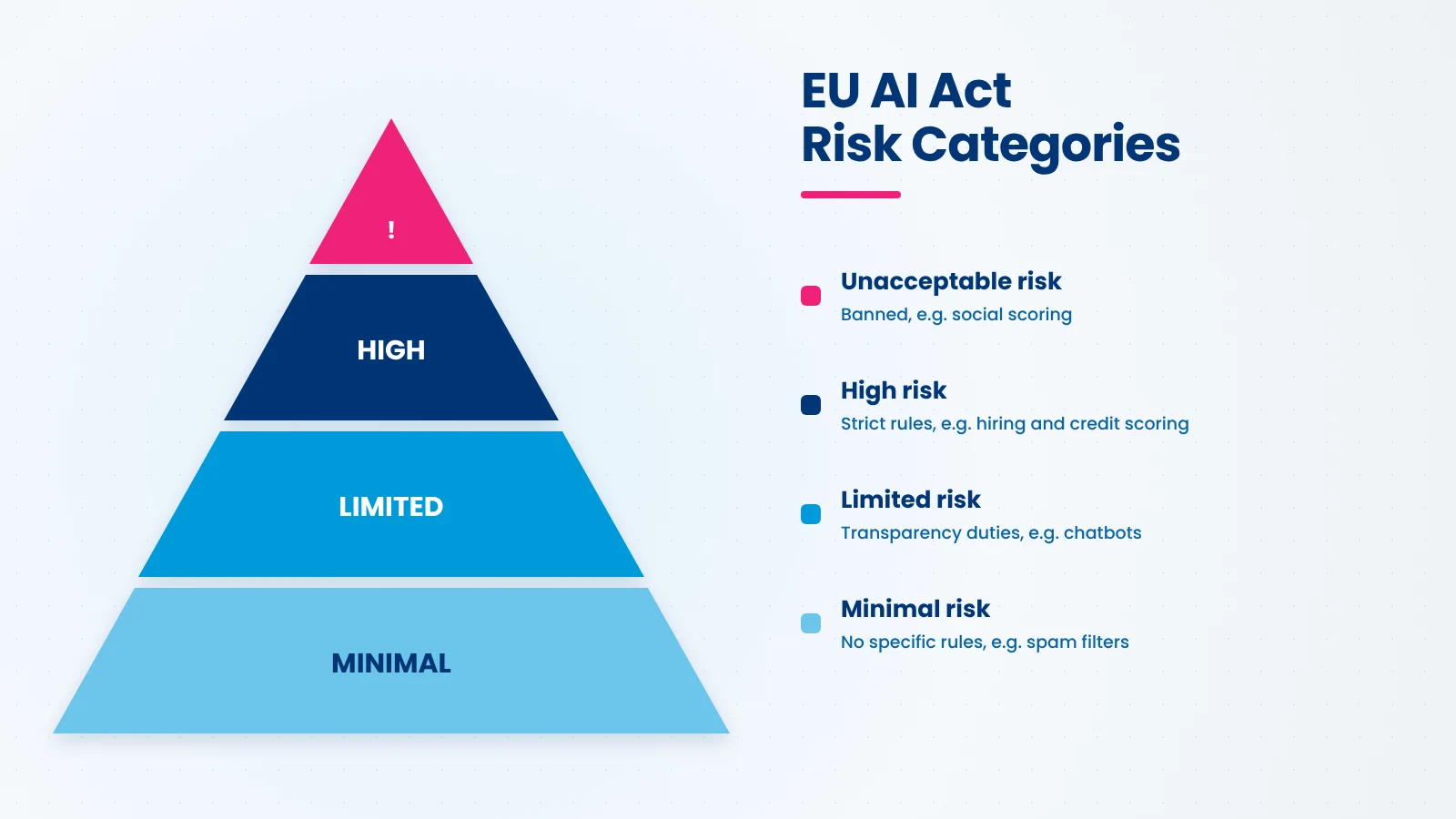
The EU AI Act uses a risk-based approach. The higher the risk, the stricter the rules.
These AI practices are banned outright. Examples include social scoring of individuals, manipulative techniques that exploit vulnerable people, untargeted scraping of facial images to build recognition databases, and emotion recognition in workplaces and schools (with limited exceptions).
High-risk AI systems are allowed but carry the heaviest obligations. They include AI used in recruitment and hiring, credit scoring, education and exam scoring, access to essential services, law enforcement, border control, and AI that acts as a safety component in regulated products such as medical devices and machinery.
These systems must be transparent with users. Chatbots must tell people they are talking to AI, and AI-generated or manipulated content such as deepfakes must be clearly labeled.
Most AI applications, such as spam filters, recommendation engines, and AI in video games, fall here. They face no specific obligations under the Act, though voluntary codes of conduct are encouraged.
The Digital Omnibus on AI is the first major amendment to the EU AI Act. It was proposed by the European Commission in November 2025, adopted by the European Parliament and the Council in June 2026, and published in the Official Journal in July 2026. It is now in force.
The main reason for the change was practical. The harmonised technical standards and conformity assessment setup needed for high-risk AI were not ready in time. Here are the key changes for businesses:
One point matters more than any headline about a “delay.” The Digital Omnibus is not a pause on AI regulation. Most transparency obligations were not delayed, the rules for general-purpose AI models still apply, and the EU AI Office has its full enforcement role. Companies that stop preparing now risk running out of time.
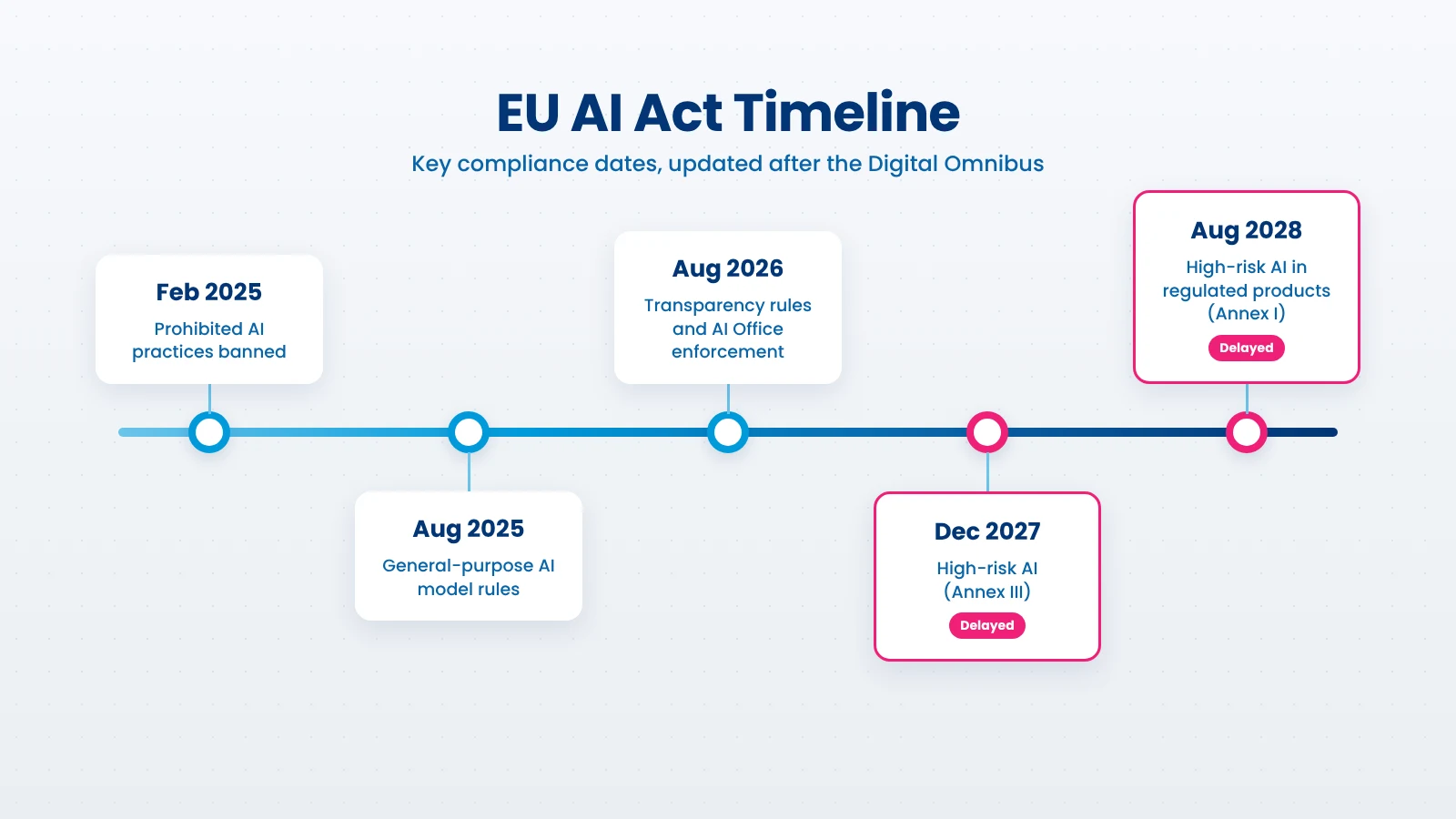
| Date | What Applies | Who It Affects |
|---|---|---|
| 2 February 2025 | Prohibited AI practices banned; AI literacy provisions begin | All providers and deployers |
| 2 August 2025 | Obligations for general-purpose AI (GPAI) models | Foundation and GPAI model providers |
| 2 August 2026 | General application of the Act, transparency rules, and AI Office enforcement | Providers and deployers of chatbots, generative AI, and other covered systems |
| 2 December 2027 | High-risk AI obligations for Annex III systems | AI used in hiring, credit, education, law enforcement, border control |
| 2 August 2028 | High-risk AI obligations for Annex I systems | AI embedded in regulated products such as medical devices and machinery |
Your obligations depend on your role. Providers carry most of the responsibility for high-risk systems, while deployers have narrower but still important duties. Note that a deployer can become a provider if it puts its own name on a system or substantially modifies it.
| Requirement | Provider | Deployer |
|---|---|---|
| Risk management system | Required across the full lifecycle | Use the system according to instructions |
| Data governance | Ensure training data quality and relevance | Ensure input data is relevant |
| Technical documentation | Prepare and maintain | Keep records of use |
| Human oversight | Design the system to allow it | Assign trained people to oversee it |
| Logging | Build automatic logging into the system | Retain the logs |
| Transparency | Provide clear instructions for use | Inform affected people where required |
| Registration and conformity | Conformity assessment and EU database registration | Register in specific public sector cases |
The EU AI Act has three tiers of fines. For large companies, the higher of the two amounts applies:
Example: a company with €200 million in annual turnover that breaches a high-risk obligation faces a maximum fine of €15 million, because that is higher than 3% of its turnover (€6 million). For SMEs and startups, the lower of the two amounts applies, so a qualifying SME with the same turnover would face a maximum of €6 million.
The EU AI Act does not create a separate category for AI agents. Instead, an agent is classified by what it does. This makes agentic AI compliance a question of use case, not technology.
Because agents act with more autonomy, they need clear limits on what they can do, audit trails of their actions, and a human checkpoint for high-impact decisions. Building these controls in from the start costs far less than retrofitting them later.
Also Read: GDPR Compliance Consulting for AI and Software Projects
Use this checklist to move from awareness to action:
Compliance is easier when it is part of how AI is built, not something added at the end. At Xicom, we follow a compliance-by-design approach across our AI development services and AI agent development work. That includes risk classification at the planning stage, clear technical documentation, audit logging, and human-in-the-loop workflows for high-impact decisions.
Xicom holds ISO/IEC 42001, ISO/IEC 27001, and SOC 2 Type II certifications. Our AI governance consulting team helps businesses assess existing AI systems, close compliance gaps, and build governance frameworks that keep pace with EU AI Act updates.
The Digital Omnibus gave businesses more time for high-risk AI, but it did not reduce what is required. Transparency rules and general-purpose AI obligations already apply, and the high-risk deadlines in December 2027 and August 2028 are closer than they seem. EU AI Act compliance works best when you start with an inventory, classify your systems, and build oversight into your products now. If you need help assessing your AI systems or building new ones that meet the rules.
For the official text, see the EU AI Act on EUR-Lex and the European Commission’s AI Act page.
Yes. The EU AI Act applies based on where AI is used, not where a company is based. If your AI system is placed on the EU market or its output is used in the EU, you may need to comply, even if your company is in India, the US, or elsewhere.
Under the Digital Omnibus, obligations for standalone high-risk AI systems listed in Annex III apply from 2 December 2027. High-risk AI embedded in regulated products under Annex I, such as medical devices and machinery, applies from 2 August 2028.
Most AI chatbots are limited risk, not high-risk. They must clearly tell users they are interacting with AI. A chatbot can become high-risk if it is used for high-impact decisions, such as screening job applicants or assessing creditworthiness.
Fines reach up to €35 million or 7% of global turnover for prohibited practices, up to €15 million or 3% for most other violations, and up to €7.5 million or 1% for supplying incorrect information. SMEs pay the lower of the two amounts.
A provider develops an AI system and places it on the market under its own name. A deployer uses an AI system in its professional work. Providers carry most obligations for high-risk systems, while deployers must use systems correctly, ensure human oversight, and keep logs.
Yes. The Act has no separate category for AI agents, so each agent is classified by its use case. A customer support agent is usually limited risk, while an agent making decisions in hiring or lending is high-risk and needs oversight, logging, and documentation.

Based on this article's topic
Agentic AI vs RPA explained for enterprises. Compare differences, costs, use cases, and risks, plus when to use each, a hybrid model, and a migration roadmap.
Compare the best AI automation tools for enterprises in 2027. See features, pricing models, limitations, build vs buy guidance, and a security checklist.
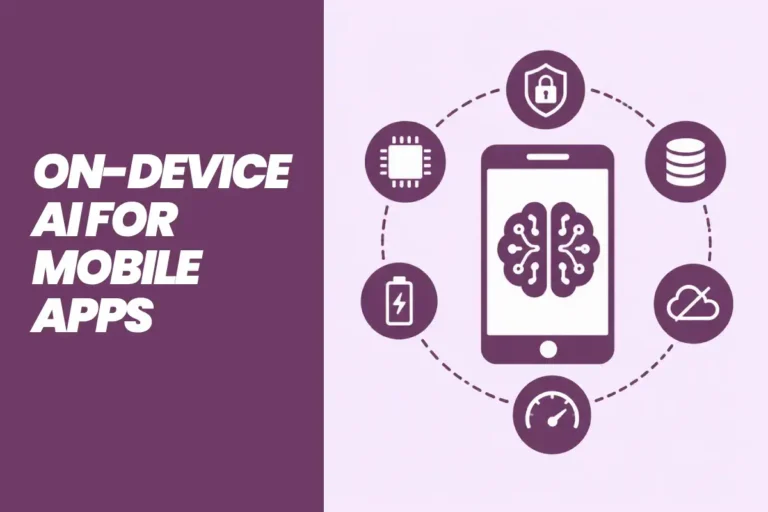
See how on-device AI works in mobile apps, which Android, iOS and cross-platform frameworks to use, real use cases and the steps to build.