LLM Hallucination Detection: Methods, Metrics, Benchmarks and Tools for Production AI
LLM hallucination detection explained: black-box to white-box methods, detector metrics, benchmarks, self-hosted tools and a production rollout plan.
Nov 24, 2026 Artificial Intelligence
The development of reliable AI models depends on access to datasets that adequately represent the conditions in which those models will operate. However, collecting and preparing sufficient real-world data can be difficult, particularly when applications involve sensitive information, rare events, specialized environments, or expensive data acquisition processes. Synthetic data generation addresses these constraints by producing artificial datasets that reproduce selected characteristics and relationships found in real-world information. According to LXT’s 2025 AI maturity survey, 65% of surveyed organizations reported using synthetic data to train AI models, indicating its growing role in enterprise AI development.
Synthetic data can represent customer transactions, medical images, equipment sensor readings, financial records, conversations, and other information required for model development. Depending on the application, it can supplement limited datasets, represent underrepresented scenarios, support model testing, and provide controlled inputs for simulations. Statistical models, generative AI, and simulation environments offer different ways to produce this information. Their usefulness, however, depends on whether generated samples preserve the characteristics relevant to the intended task and whether their quality, privacy, and downstream performance can be adequately evaluated.
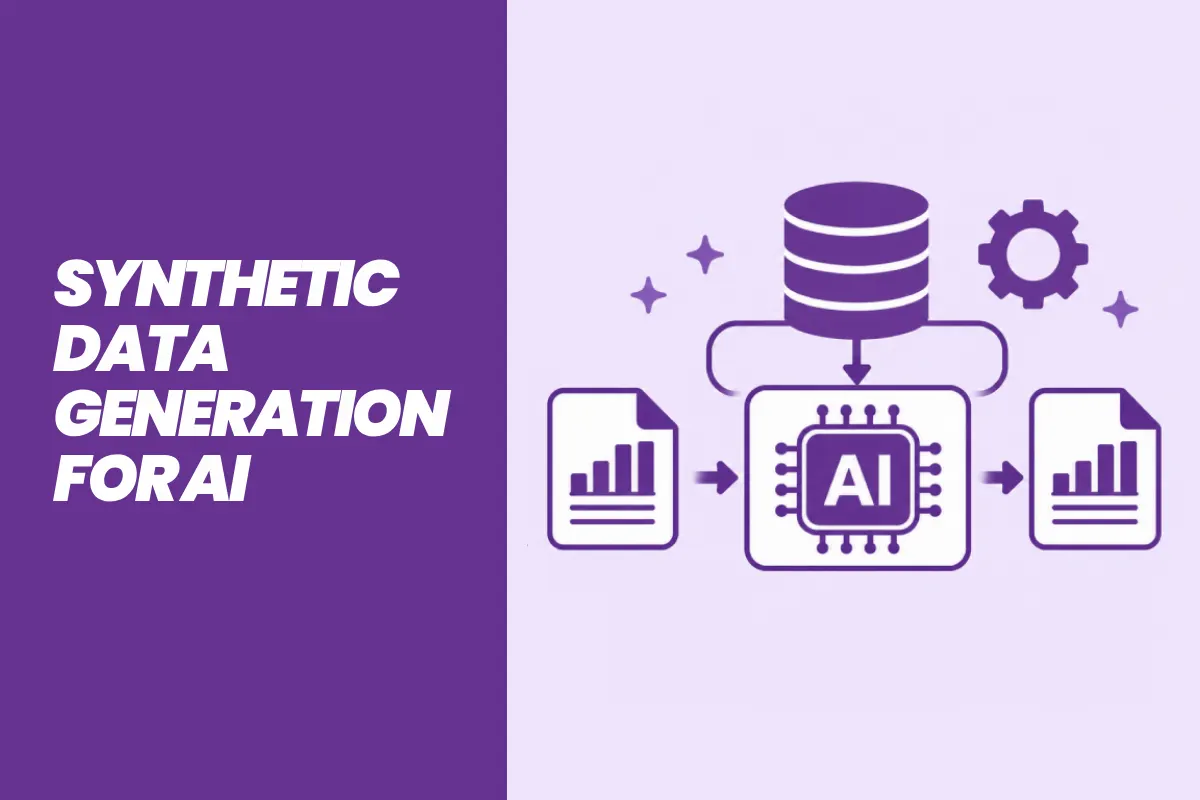
Access to suitable training data remains a practical constraint across many AI initiatives. Organizations may possess substantial operational information but lack the specific examples required to train a model for a particular task. Synthetic data helps address this gap by allowing teams to generate additional samples under defined conditions.
Several limitations make this approach relevant:
Synthetic data does not eliminate the need for real-world information. Instead, it supplements available datasets and provides controlled examples that address specific gaps.
The generation method determines the data characteristics that can be reproduced and the degree of control over the output. The choice depends on the data type and intended application.
Statistical methods use probability distributions, correlations, and variable relationships in source datasets to generate new records. Rule-based methods apply predefined conditions and business constraints, such as valid transaction dates, account balances, and payment categories.
These approaches suit applications requiring structured, predictable data.
| Method | How it works | Applications |
|---|---|---|
| Probability distributions | Reproduces statistical patterns | Financial and customer records |
| Bayesian networks | Models conditional relationships | Risk and healthcare data |
| Rule-based generation | Applies predefined constraints | Software testing and operational records |
| Copula models | Reproduces dependencies between variables | Finance and insurance |
Generative adversarial networks (GANs) use two competing neural networks: a generator creates synthetic samples, while a discriminator distinguishes them from real data. Through repeated training, the generator improves its outputs.
GANs generate images, video frames, and structured records, including variations in objects, textures, and environmental conditions. However, training instability and limited output diversity can affect their performance.
Variational autoencoders (VAEs) learn compressed representations of training data in a latent space. An encoder maps inputs into this space, and a decoder reconstructs them. New samples are generated by drawing values from the learned distribution.
VAEs support structured data augmentation and pattern exploration, including the generation of synthetic medical images and patient records. Their effectiveness depends on how well they preserve relevant data characteristics.
Diffusion models learn to transform random noise into structured outputs by reversing a sequence of noise-adding steps. They are widely used to generate detailed images for applications such as medical imaging, manufacturing defect detection, and satellite imagery.
Generation can also be guided by characteristics such as object position, background, and lighting.
Transformers learn sequential patterns and contextual relationships to generate text, conversations, question-answer pairs, and structured records. Large language models (LLMs) can be guided through prompts, examples, and domain-specific instructions.
For example, financial services teams can generate customer conversations covering payment disputes, account enquiries, and loan requests for testing or fine-tuning language models. Generated content must be checked for factual consistency, duplication, and fabricated details.
Simulation-based methods model physical systems, environments, and operational processes using defined rules, physics-based models, and controlled scenarios. They are useful when real-world data is expensive, unsafe, or difficult to collect.
Autonomous vehicle developers, for instance, can simulate road conditions, pedestrian movements, weather, and vehicle interactions. Digital twins extend this approach by representing the behaviour and operating conditions of specific assets or processes.
| Generation approach | Suitable data types | Typical applications |
|---|---|---|
| Statistical and rule-based models | Tabular records | Finance, customer data, testing |
| GANs | Images, video, tabular data | Computer vision and augmentation |
| VAEs | Images and structured data | Pattern exploration and augmentation |
| Diffusion models | Images and structured signals | Medical imaging and visual recognition |
| Transformers and LLMs | Text, conversations, documents | NLP and enterprise AI |
| Simulation environments | Sensor readings and operational data | Robotics, autonomous systems, industrial AI |
The characteristics of synthetic data vary according to the information being generated. A method suitable for structured financial records may not be appropriate for medical images or equipment sensor readings. Organizations must therefore select generation techniques according to the data format, relationships, and conditions their AI models need to learn.
| Data type | Examples of generated information | AI applications |
|---|---|---|
| Tabular | Customer profiles, transactions, claims, inventory records | Predictive analytics and fraud detection |
| Textual | Conversations, reports, contracts, support requests | NLP and language model development |
| Images | Medical scans, product defects, satellite imagery | Image classification and object detection |
| Video | Traffic sequences, surveillance scenarios, human activities | Video analytics and activity recognition |
| Time-series | Equipment readings, energy consumption, financial sequences | Forecasting and anomaly detection |
| Multimodal | Connected text, images, audio, and sensor data | Multimodal AI and contextual understanding |
Tabular generation must preserve relationships between fields, such as customer accounts and their associated transactions. Image generation must account for visual characteristics, object boundaries, and relevant environmental conditions. Time-series generation must retain temporal dependencies, while multimodal datasets must maintain alignment between connected data types. These distinctions influence both the generation process and the evaluation criteria.
AI models require sufficient examples to learn patterns associated with their intended tasks. However, specialized applications may not have enough labelled observations to support training. Synthetic data can expand the available dataset by generating additional samples based on known characteristics and domain requirements.
For example, an organization developing an AI system to classify industrial components may have only a limited collection of images for certain component types. Synthetic images can introduce variations in orientation, lighting, surface appearance, and background conditions, giving the model a broader range of examples.
| Data limitation | Synthetic data contribution |
|---|---|
| Small training datasets | Generates additional representative samples |
| Limited labelled examples | Produces samples with predefined labels |
| Restricted domain coverage | Introduces controlled variations |
| Expensive data collection | Reduces dependence on repeated physical collection |
Synthetic samples should complement, rather than automatically replace, real observations. Their effectiveness must be established through evaluation against independent real-world data.
Classification datasets frequently contain uneven distributions. A fraud detection model, for example, may encounter millions of legitimate transactions but relatively few confirmed fraudulent activities. Training on such data can make the model favour the majority class and overlook less frequent events.
Synthetic data generation can increase the representation of underrepresented categories. Models can generate additional examples of suspicious transactions, equipment failures, or uncommon medical conditions, helping the classifier learn characteristics associated with these events.
| Application | Underrepresented category | Synthetic data use |
|---|---|---|
| Banking | Fraudulent transactions | Generates additional suspicious transaction patterns |
| Manufacturing | Equipment failures | Represents different failure conditions |
| Healthcare | Rare conditions | Expands examples for selected diagnostic tasks |
| Cybersecurity | Unusual attack patterns | Simulates less frequently observed threats |
Generated minority-class examples must reflect plausible scenarios. Simply increasing the number of records does not guarantee better detection, particularly if synthetic samples introduce unrealistic patterns or reinforce existing biases.
Computer vision systems depend on visual examples that represent the objects, environments, and conditions they must recognize. Collecting sufficiently diverse images can be difficult when certain conditions are uncommon or require controlled photography.
Synthetic image generation can introduce variations in lighting, camera angles, object positions, backgrounds, textures, and environmental conditions. GANs, diffusion models, and rendering engines can produce images with specific characteristics, while simulation environments can generate labelled scenes.
| Computer vision task | Synthetic data application |
|---|---|
| Object detection | Generates images with objects in different positions |
| Defect detection | Creates examples of surface cracks and manufacturing defects |
| Medical image analysis | Produces selected variations of scans and tissue images |
| Facial recognition research | Generates controlled facial variations |
| Satellite image analysis | Simulates terrain, weather, and land-cover conditions |
For example, a manufacturing company can generate images of components with different scratch patterns, surface irregularities, and lighting conditions. These images can supplement inspection datasets and help train models to identify defects across varying production environments.
Natural language processing systems require examples of language patterns, user intentions, entities, and contextual relationships. Synthetic text can expand these datasets by generating conversations, domain-specific questions, support requests, and annotated documents.
LLMs can produce multiple variations of a user request while preserving its underlying intent. They can also generate question-answer pairs, dialogue sequences, and structured examples for intent classification. These datasets can support supervised training, model fine-tuning, and evaluation.
| NLP application | Synthetic data generation |
|---|---|
| Intent classification | Generates variations of user requests |
| Entity recognition | Produces text with labelled names, dates, and identifiers |
| Sentiment analysis | Creates examples representing different sentiment categories |
| Conversational AI | Generates multi-turn dialogue scenarios |
| Document processing | Produces sample invoices, forms, and business documents |
For example, an enterprise developing a customer support assistant can generate conversations involving order tracking, refunds, billing disputes, and service requests. Human reviewers can verify the examples before they are incorporated into training or testing datasets.
Model testing requires datasets that expose weaknesses under different input conditions. Real-world test data may not cover every scenario, particularly when systems must handle unusual combinations of inputs, incomplete information, or unexpected events.
Synthetic datasets allow teams to create controlled test cases with specific characteristics. Developers can generate invalid records, boundary values, unusual user requests, and combinations of conditions to evaluate model responses. This is particularly relevant for testing classification systems, recommendation engines, document processing applications, and conversational AI.
| Testing requirement | Synthetic data application |
|---|---|
| Boundary conditions | Generates values near defined limits |
| Missing information | Creates incomplete or partially populated records |
| Unusual inputs | Simulates uncommon input combinations |
| Negative testing | Produces invalid or contradictory examples |
| Repeatability | Recreates identical test scenarios across model versions |
For example, an AI-powered loan processing system can be tested with synthetic applications containing missing income details, inconsistent employment records, and unusual debt-to-income ratios. These cases help determine whether the system identifies exceptions and routes them for appropriate review.
Autonomous systems must interpret changing physical environments and respond to interactions between objects, people, and equipment. Collecting real-world examples for every possible condition is impractical and may introduce safety risks.
Simulation environments can generate synthetic driving scenes, pedestrian movements, road obstacles, weather conditions, and sensor readings. Robotics developers can also simulate object manipulation, equipment movement, and interactions within industrial environments.
| Application | Synthetic data generated |
|---|---|
| Autonomous vehicles | Road scenes, traffic interactions, and obstacle conditions |
| Industrial robotics | Object positions and manipulation scenarios |
| Drone navigation | Terrain, obstacles, and environmental conditions |
| Warehouse automation | Moving equipment, inventory, and pedestrian interactions |
For example, an autonomous vehicle developer can simulate low-visibility driving, sudden pedestrian crossings, and unexpected obstacles to evaluate perception and decision-making models. Simulation improves scenario coverage, although performance must also be assessed through real-world testing.
Financial institutions use AI to identify suspicious transactions, assess credit risk, detect account misuse, and monitor payment activity. These systems require representative examples of both routine and unusual financial behaviour.
Synthetic transaction records can represent different spending patterns, transaction frequencies, account activities, payment channels, and suspicious sequences. They can also help teams test detection systems without repeatedly exposing sensitive customer records.
| Financial AI application | Synthetic data use |
|---|---|
| Fraud detection | Generates suspicious transaction patterns |
| Credit risk modelling | Represents different borrower profiles |
| Anti-money laundering | Simulates unusual transaction sequences |
| Payment monitoring | Creates varied payment behaviours |
| Account security | Models atypical login and access patterns |
For example, a bank can generate synthetic transaction sequences involving unusual payment frequency, unfamiliar locations, and irregular transfer amounts. These records can help evaluate whether fraud detection models identify suspicious combinations rather than relying on isolated transaction values.
Predictive maintenance models analyze equipment readings to identify patterns associated with deterioration and potential failure. However, historical failure data may be limited because well-maintained machinery does not frequently experience serious breakdowns.
Synthetic time-series data can represent normal operating conditions, gradual performance degradation, abnormal temperature changes, vibration patterns, and different failure scenarios. Simulation models can generate readings under specified operating conditions, while machine learning models can reproduce patterns observed in historical sensor datasets.
| Equipment condition | Synthetic data application |
|---|---|
| Normal operation | Represents expected sensor readings |
| Gradual degradation | Simulates changing performance indicators |
| Component wear | Generates patterns associated with deterioration |
| Overheating | Models abnormal temperature sequences |
| Mechanical failure | Represents selected failure signatures |
For example, an industrial equipment manufacturer can generate sensor sequences representing bearing wear and abnormal vibration. These samples can supplement available maintenance records and help test models designed to detect early warning signals.
Synthetic data supports generative AI development, including fine-tuning language models and evaluating retrieval-augmented generation (RAG) systems.
For supervised fine-tuning, organizations generate instruction-response pairs covering industry terminology, preferred formats, classification requirements, and domain-specific interactions.
After review, these examples help adapt models to specific applications and tasks.
For RAG evaluation, teams generate questions, alternative queries, expected answers, and challenging test cases from approved knowledge-base documents to assess information retrieval and use.
| AI development activity | Synthetic data application |
|---|---|
| Supervised fine-tuning | Generates instruction-response examples |
| Domain adaptation | Creates industry-specific language samples |
| Query testing | Produces variations of user questions |
| Retrieval evaluation | Creates questions linked to expected source documents |
| Answer evaluation | Generates reference answers for comparison |
| Robustness testing | Introduces ambiguous and incomplete queries |
An enterprise HR assistant can use synthetic questions about leave, benefits, and reimbursements to test whether its RAG system retrieves relevant documents and generates accurate responses.
Synthetic data should support training and evaluation, not serve as authoritative knowledge; the knowledge base must retain verified organizational information.
Synthetic data may resemble real information without preserving the characteristics required for a specific AI task. Visual or statistical similarity alone does not establish its usefulness; datasets must be evaluated against defined requirements before model development.
| Evaluation dimension | What it examines | Possible assessment |
|---|---|---|
| Statistical similarity | Distributions and relationships | Compare distributions and correlations |
| Structural consistency | Record validity and relationships | Apply schema and constraint checks |
| Diversity | Variation across samples | Measure coverage and duplication |
| Downstream utility | Usefulness for the AI task | Test model performance on real data |
| Privacy risk | Exposure of original information | Conduct privacy and disclosure tests |
| Bias representation | Coverage across relevant groups | Compare subgroup performance |
Evaluation metrics should reflect the intended application. Fraud detection datasets require representative suspicious transaction patterns, while synthetic medical images must retain clinically relevant features. Quality assessment should therefore focus on the dataset’s intended use rather than a single universal score.
Synthetic data is often considered for applications involving sensitive information, but artificial generation does not automatically guarantee privacy. A model trained on identifiable or confidential source data may memorize individual records or reproduce distinctive characteristics in its outputs.
Organizations should assess whether generated samples reveal information about people represented in the source dataset. Relevant risks include membership inference, where an attacker attempts to determine whether a particular record was included in model training, and attribute disclosure, where sensitive characteristics are inferred from generated information.
Differential privacy can provide formal privacy guarantees by limiting how much the output of a statistical or machine learning process can depend on any individual record. However, its implementation involves trade-offs between privacy protection and data utility.
Other safeguards include:
The NIST guidelines on differential privacy emphasize that synthetic data techniques without formal privacy guarantees may remain vulnerable to privacy attacks. Organizations should therefore evaluate privacy independently of statistical similarity or perceived anonymity.
Synthetic data can expand dataset coverage, but it also introduces limitations that may affect model reliability. The most important concern is that generated information reflects the assumptions, limitations, and biases of the method used to produce it.
These limitations make independent evaluation essential. Synthetic data should be introduced gradually, with performance compared against models trained on real data or carefully constructed combinations of real and synthetic samples.
The appropriate method depends on the data format, intended application, available source information, and degree of control required. Organizations should avoid selecting a generation model solely because it is widely used or produces realistic-looking outputs.
| Requirement | Suitable approach |
|---|---|
| Structured business records | Statistical models or tabular GANs |
| Realistic images | GANs or diffusion models |
| Domain-specific text | LLM-based generation |
| Rare equipment failures | Simulation and time-series models |
| Autonomous driving scenarios | Physics-based simulation |
| Privacy-sensitive datasets | Validated generation with privacy assessment |
| Multimodal training data | Combined generative and simulation approaches |
Selection should also account for the availability of source data, annotation requirements, generation costs, validation effort, and downstream model performance. A simpler statistical approach may be sufficient for structured test records, whereas autonomous systems may require sophisticated simulation environments to reproduce physical interactions.
Synthetic data generation provides AI teams with a way to expand training datasets, reproduce uncommon scenarios, test model behaviour, and develop applications where access to real-world information is constrained. Its effectiveness depends on selecting suitable generation techniques and validating the resulting data against the requirements of each application. Statistical similarity, structural consistency, downstream utility, and privacy protection must all be considered before generated datasets enter enterprise AI workflows. When supported by appropriate controls and real-world evaluation, synthetic data can strengthen model development without making organizations entirely dependent on the availability of large, manually collected datasets.
Synthetic data generation capabilities help enterprises address data scarcity, expand training datasets, test model performance, and improve AI evaluation. Xicom’s AI development services help build customized AI solutions that incorporate synthetic data to meet specific industry requirements, data complexities, and project objectives.
Synthetic data generation is the process of creating artificial datasets that reproduce relevant patterns, relationships, and characteristics of real-world data. AI teams use it to supplement limited training datasets, simulate rare events, test models, and develop applications when collecting real-world data is expensive or restricted.
Synthetic data is generated using statistical models, rule-based methods, generative adversarial networks (GANs), variational autoencoders (VAEs), diffusion models, large language models (LLMs), and simulation environments. The appropriate technique depends on the data type, application requirements, and level of realism needed.
No. Synthetic data is generally used to supplement real-world datasets rather than replace them entirely. Although it can expand dataset coverage and represent uncommon scenarios, models must still be evaluated against independent real-world data to confirm that they perform reliably in production environments.
The commonly used techniques include statistical and rule-based generation, GANs, VAEs, diffusion models, transformer-based generation, and simulation-based methods. Statistical models work well for structured records, GANs and diffusion models support image generation, LLMs generate textual datasets, and simulations reproduce physical or operational scenarios.
Synthetic data can improve AI model performance by introducing additional examples, increasing representation of minority classes, and exposing models to different input conditions. However, improvement is not guaranteed. Generated samples must preserve meaningful patterns and be validated against real-world test datasets to establish whether they improve accuracy and generalization.
Synthetic data generation creates new artificial samples based on learned patterns, statistical relationships, rules, or simulated environments. Data augmentation expands existing datasets by modifying available samples, such as changing image orientation, brightness, or scale. Both techniques improve dataset coverage, but they differ in how new training examples are produced.
Financial institutions use synthetic transaction records to represent suspicious payment patterns, unusual account activities, and uncommon financial behaviours. These datasets can help train and evaluate fraud detection, credit risk, anti-money laundering, and payment monitoring systems without repeatedly exposing sensitive customer records.

LLM hallucination detection explained: black-box to white-box methods, detector metrics, benchmarks, self-hosted tools and a production rollout plan.

Explore how AI in pharmaceutical research supports drug discovery, from target identification and virtual screening to toxicity and trial design.

Explore 12 AI in procurement use cases, from spend analysis and supplier risk to invoice matching, plus benefits and how to integrate AI with ERP systems.