
AI in Pharmaceutical Research: Drug Discovery, Molecular Design, and Research Innovation
Explore how AI in pharmaceutical research supports drug discovery, from target identification and virtual screening to toxicity and trial design.
Nov 24, 2026 Artificial Intelligence
LLM hallucination detection is the practice of checking a model’s output, claim by claim, for statements that are false, unsupported by the source material, or invented outright. It sits between your model and your users. When a support bot quotes a refund policy that does not exist, or a RAG assistant cites a clause that is not in the contract, a detection layer is what catches it before anyone acts on it.
The problem is measurable. In the HaluEval benchmark, ChatGPT produced hallucinated content in about 19.5% of sampled responses to general user queries. Vectara’s Hallucination Leaderboard, which tests summarization of thousands of documents, still shows widely used frontier models hallucinating at rates between roughly 3% and 12%, even when told to use only the source text. At production volume, a single-digit rate still means hundreds of wrong answers a day.
This guide covers how detection actually works: the methods, the metrics used to judge a detector, the benchmarks worth trusting, the tools and platforms available (including self-hosted options), and a rollout plan you can adapt.
An LLM hallucination is an output that reads fluently and confidently but is false, unfaithful to the provided source, or impossible to verify. That fluency is what makes hallucinations dangerous: they look exactly like correct answers.
Before choosing a detection method, it helps to be precise about which kind of error you are trying to catch. Two distinctions matter most.
For most enterprise systems built on retrieval-augmented generation, faithfulness is the more useful and more measurable target. You control the source, so you can check against it. Open-world factuality needs an external reference, which is harder to build and maintain.
Extrinsic errors are often harder to catch, because there is nothing in the source to contradict them. A claim that is simply absent needs a detector that flags “unsupported”, not just “contradicted”.
LLMs predict likely text, not verified facts. Hallucinations usually trace back to a few causes:
The TruthfulQA authors also found that larger models were not automatically more truthful, because they learned to repeat popular misconceptions found in human text. Scale alone does not solve the problem, which is why a separate detection layer is worth building.
Also Read: RAG vs Fine Tuning
These three terms are often used interchangeably, but they answer different questions and run at different points in the lifecycle.
| Detection | Prevention | Evaluation | |
|---|---|---|---|
| Question it answers | Is this specific answer hallucinated? | How do we make hallucinations less likely? | How often does our system hallucinate? |
| When it runs | At inference time, per response | At design, training and prompt time | Offline, before release and on a schedule |
| Typical techniques | Groundedness checks, LLM judges, self-consistency, NLI | Better retrieval, prompt constraints, fine-tuning, refusing when evidence is missing | Labeled test sets, benchmarks, regression suites |
| Output | A score, flag or block decision | A lower baseline hallucination rate | A rate, plus precision and recall of your detectors |
Prevention lowers the baseline, but it never reaches zero. Detection catches what gets through. Evaluation tells you whether both are working and whether a model or prompt change made things worse.
A common mistake is investing heavily in one and skipping the others. Teams that only improve retrieval often discover that the model still adds unsupported details. Teams that only add a runtime detector have no idea how accurate that detector is. If you are planning a new LLM product, it is worth designing all three layers together from the start, which is a core part of how we approach custom AI development services.
LLM hallucination detection methods fall into three families, based on how much access you have to the model:
The techniques below are listed roughly from the easiest to deploy to the most involved.
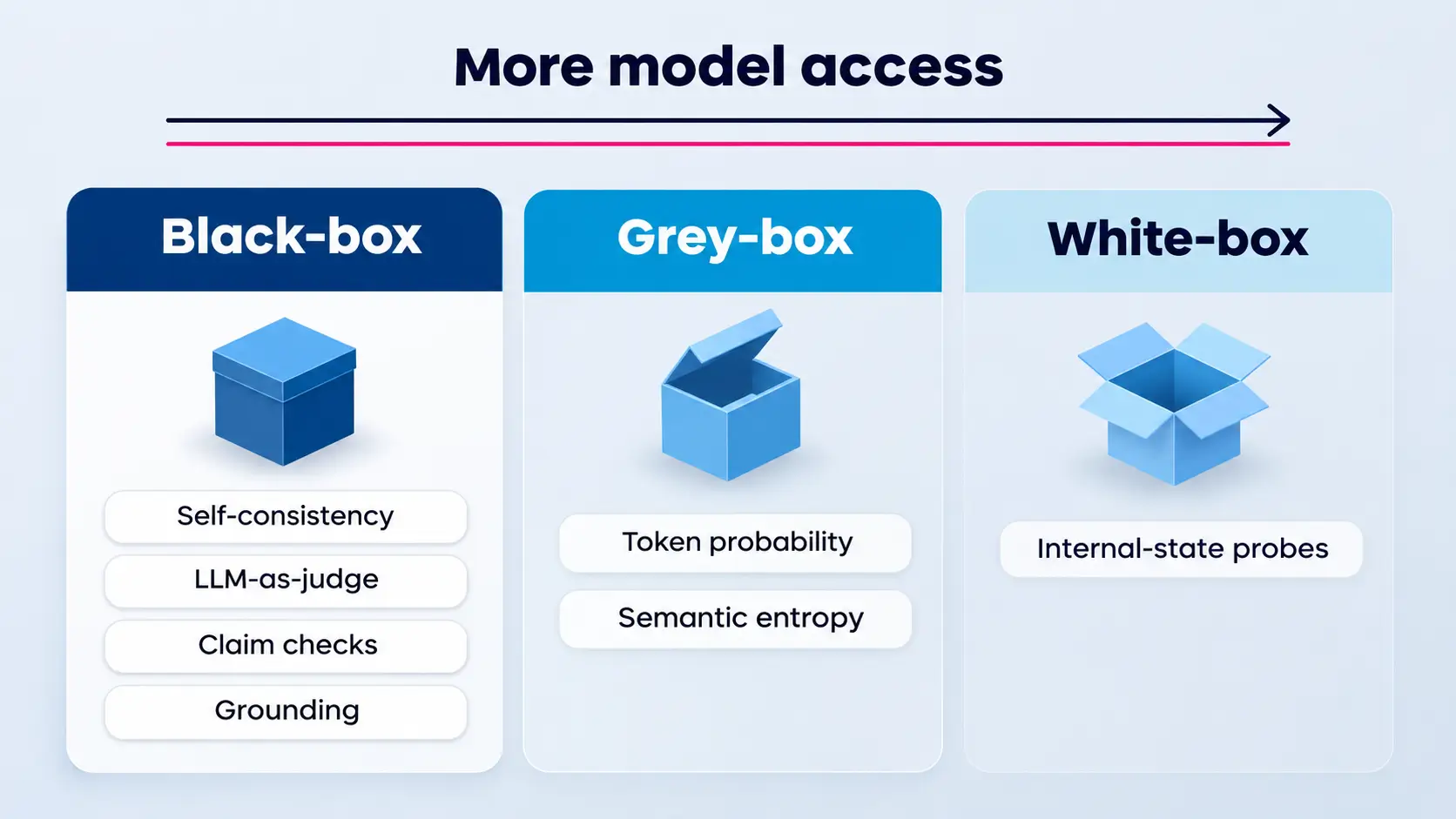
Self-consistency is the most widely used black-box approach, and the clearest example is SelfCheckGPT, published at EMNLP 2023. The idea is simple. If a model actually knows a fact, several independently sampled answers to the same prompt will agree on it. If the model is making something up, the samples tend to drift apart and contradict each other.
How it works in practice:
In the original paper, this sampling-only approach beat grey-box baselines that relied on token probabilities for sentence-level detection, without needing any external database.
Where LLM hallucination detection with self-consistency fails:
Cost and latency trade-off: every check multiplies generation cost by the number of samples, typically 3 to 10, and adds latency unless samples run in parallel. Many teams therefore run self-consistency offline, or only on high-risk queries, rather than on every live response.
Semantic entropy, published in Nature in 2024 by researchers at the University of Oxford, fixes the paraphrase problem. It samples several answers, groups them by meaning rather than exact wording, and measures uncertainty across those meaning clusters. High entropy signals a likely confabulation, meaning an arbitrary, incorrect answer. The authors note it needs no task-specific data, but the Oxford team also acknowledges it can make generation several times more expensive.
Here, a second model reviews the answer and decides whether it is supported by the source or by its own knowledge. ChainPoll, from Galileo, improves on a single judge call by asking the judge several times with chain-of-thought reasoning and averaging the yes or no verdicts into a score. The averaged score also shows how sure the judge is.
LLM judges are flexible and easy to set up, but they carry their own risks:
Always validate a judge against human labels from your own domain before trusting its scores.
Natural language inference (NLI) models classify a claim as entailed, contradicted or neutral with respect to a source passage. The strongest setups first split an answer into small, single-fact claims, the same “atomic fact” idea used by FActScore, and then check each claim separately. This pinpoints exactly which sentence is wrong instead of flagging the whole answer.
Small, purpose-built classifiers fit here as well. Vectara’s open HHEM-2.1 model, for example, has about 110 million parameters, small enough to run cheaply alongside a production system.
For RAG systems, a groundedness check asks one question: is every claim in the answer supported by the passages that were actually retrieved? Unsupported claims can be removed, rewritten, shown with a warning or sent for human review. This is the most practical starting point for most enterprise teams, because the source of truth already exists in the pipeline. Groundedness checks also depend heavily on retrieval quality, which is why custom RAG development and detection are best designed together.
When an answer is not tied to a fixed set of retrieved documents, claims can be checked against an external trusted source, such as a product database, policy repository, knowledge base or knowledge graph. Structured sources make verification sharper. A knowledge graph can confirm that a specific drug, part number or account actually has the property claimed. The weak point is the reference itself. An outdated or incomplete knowledge base produces false alarms and missed errors.
Grey-box methods read the model’s own confidence: token log-probabilities, entropy over the next-token distribution, or the lowest-probability tokens in a claim. They are cheap because no extra generation is needed. On their own they are noisy, since a model can be confidently wrong, but they work well as one input to a combined score.
White-box methods train lightweight classifiers, often called probes, on a model’s hidden activations to predict whether it is producing a true or false statement. The main obstacle is labeled training data. HaloScope, a NeurIPS 2024 spotlight paper, addresses this by using unlabeled generations collected in production. It estimates which of them are likely truthful from the structure of their embeddings, then trains a binary truthfulness classifier on top. These methods are fast at inference time, but they only work with open-weight models that you host.
| Method | What it checks | Needs a reference? | Cost and latency | Best use case |
|---|---|---|---|---|
| Self-consistency (SelfCheckGPT) | Agreement across sampled answers | No | High: several extra generations | Closed-book QA, offline audits of API models |
| Semantic entropy | Uncertainty across meaning clusters | No | High: sampling plus clustering | Short factual answers where confabulation is the main risk |
| LLM-as-judge and polling (ChainPoll) | A second model’s verdict on support or correctness | Optional | Medium to high, depending on judge size | Flexible checks across many tasks |
| NLI and claim-level checks | Each claim entailed, contradicted or neutral vs source | Yes | Low to medium with small models | Summaries, RAG answers, policy and document QA |
| Groundedness vs retrieved context | Claims supported by retrieved passages | Yes, retrieved chunks | Low to medium | Production RAG assistants |
| Retrieval and knowledge-graph verification | Claims vs a trusted external source | Yes, curated source | Medium | Product data, catalogs, regulated facts |
| Token probability and entropy | The model’s own confidence | No | Low | A cheap extra signal in a combined score |
| Internal-state probes (HaloScope) | Hidden activations | No, after training | Low at inference | Self-hosted open-weight models at scale |
There are two kinds of numbers to track, and teams often mix them up. The first measures your LLM system: how often it hallucinates. The second measures your detector: how well it catches those hallucinations. You need both, because a low reported hallucination rate means nothing if the detector reporting it misses half the errors.
A hallucination detector is a binary classifier: each output, or each claim, is either hallucinated or not. Score it the same way you would score any classifier.
Which metric to prioritize depends on risk. A medical or financial assistant usually favors recall and accepts more false alarms routed to human review. A consumer chatbot may favor precision, so it doesn’t block good answers.
Response-level scoring labels a whole answer as good or bad. It is simple, but it hides where the error is, and a long answer with one wrong sentence counts the same as one that is entirely invented. Claim-level scoring breaks the answer into individual facts and labels each one. It costs more to annotate and compute, but it supports targeted fixes, such as removing a single unsupported sentence instead of discarding the whole response.
Public benchmark scores rarely carry over to your data. A detector that does well on Wikipedia biographies may struggle with insurance policy language or clinical notes. The only reliable way to know how well your LLM hallucination detection works is to build a labeled set, even a few hundred examples, from your own queries, retrieved documents and model outputs. Then measure precision and recall on it, and re-run it after every model, prompt or retrieval change.
Also Read: SLM vs LLM
An LLM hallucination detection benchmark serves one of two purposes. Some benchmarks measure how often models hallucinate. Others measure how well a detector spots hallucinations. Knowing which is which keeps you from comparing the wrong numbers.
| Benchmark | What it measures | Scale and verified finding | Main limitation |
|---|---|---|---|
| TruthfulQA | Whether a model repeats common human misconceptions | 817 questions across 38 categories, including health, law and finance. The best model tested was truthful on 58% of questions, against 94% for humans. | Short, adversarial questions, and widely used for training, so it is at risk of contamination |
| HaluEval | How well LLMs recognize hallucinated content | 35,000 samples across QA, dialogue, summarization and general queries. ChatGPT hallucinated in about 19.5% of general-query responses. | Most hallucinated samples are generated synthetically rather than occurring naturally |
| FaithDial | Faithfulness in knowledge-grounded dialogue | Built by editing the Wizard of Wikipedia dataset, whose original turns contained hallucinations in more than 60% of cases | Dialogue-specific and Wikipedia-grounded |
| RAGTruth | Word-level hallucinations in RAG outputs | Nearly 18,000 naturally generated responses from several LLMs, manually annotated. A small model fine-tuned on it was competitive with prompt-based GPT-4 detectors. | Covers three task types (QA, data-to-text, news summarization) |
| FActScore | Factual precision of long-form text, scored per atomic fact | ChatGPT scored 58% on biographies, and scores dropped further for rarer people | Biography-focused, and depends on the knowledge source used |
| Vectara Hallucination Leaderboard (HHEM) | How often models add unsupported content when summarizing | Over 7,700 private articles scored with the HHEM model. Recent rates range from under 2% to over 24% across models. | Summarization only, and scores depend on HHEM’s own accuracy |
LLM hallucination detection tools fall into three groups that do different jobs. Most mature teams use one tool from each group rather than expecting one product to do everything.
Use these before release and on every change, to catch regressions in faithfulness.
Use these to sample live traffic, score it, and spot drift when hallucination rates rise.
Use these when a flagged answer must be blocked, rewritten or replaced with a safe fallback before it reaches the user.
For regulated industries, where the detector runs can matter as much as how accurate it is. Every check sends the prompt, the retrieved documents and the model’s answer to the detector. If that detector is a third-party SaaS, sensitive data such as patient records, claims files, contracts or financial data leaves your environment.
| Self-hosted or private cloud | Managed SaaS | |
|---|---|---|
| Data residency | Prompts, documents and traces stay in your VPC or on-premise | Data goes to the vendor’s infrastructure |
| Compliance fit | Easier to align with HIPAA, GDPR, SOC 2 and internal data policies | Depends on vendor certifications and contracts |
| Setup and maintenance | Your team runs databases, upgrades and scaling | Vendor handles operations |
| Detector models | You can run open models such as HHEM-2.1-open, Lynx or your own probes | Limited to what the vendor offers |
| Cost profile | Infrastructure plus engineering time | Usage-based subscription |
If you need a self-hosted hallucination detection tool for LLM workloads, a practical stack often looks like this: an open-source evaluation framework in CI, a self-hosted observability platform such as Langfuse or Phoenix for traces, an open guardrail library for runtime checks, and a small open detector model running on your own GPUs. This keeps the whole loop inside your environment without depending on a single vendor.
There is no single best platform for LLM hallucination detection. The right choice depends on your architecture, risk level and data constraints. Use this checklist to compare options:
If your team is weighing these trade-offs across several systems, structured AI consulting services can shorten the evaluation by testing two or three shortlisted tools on your own data before you commit.
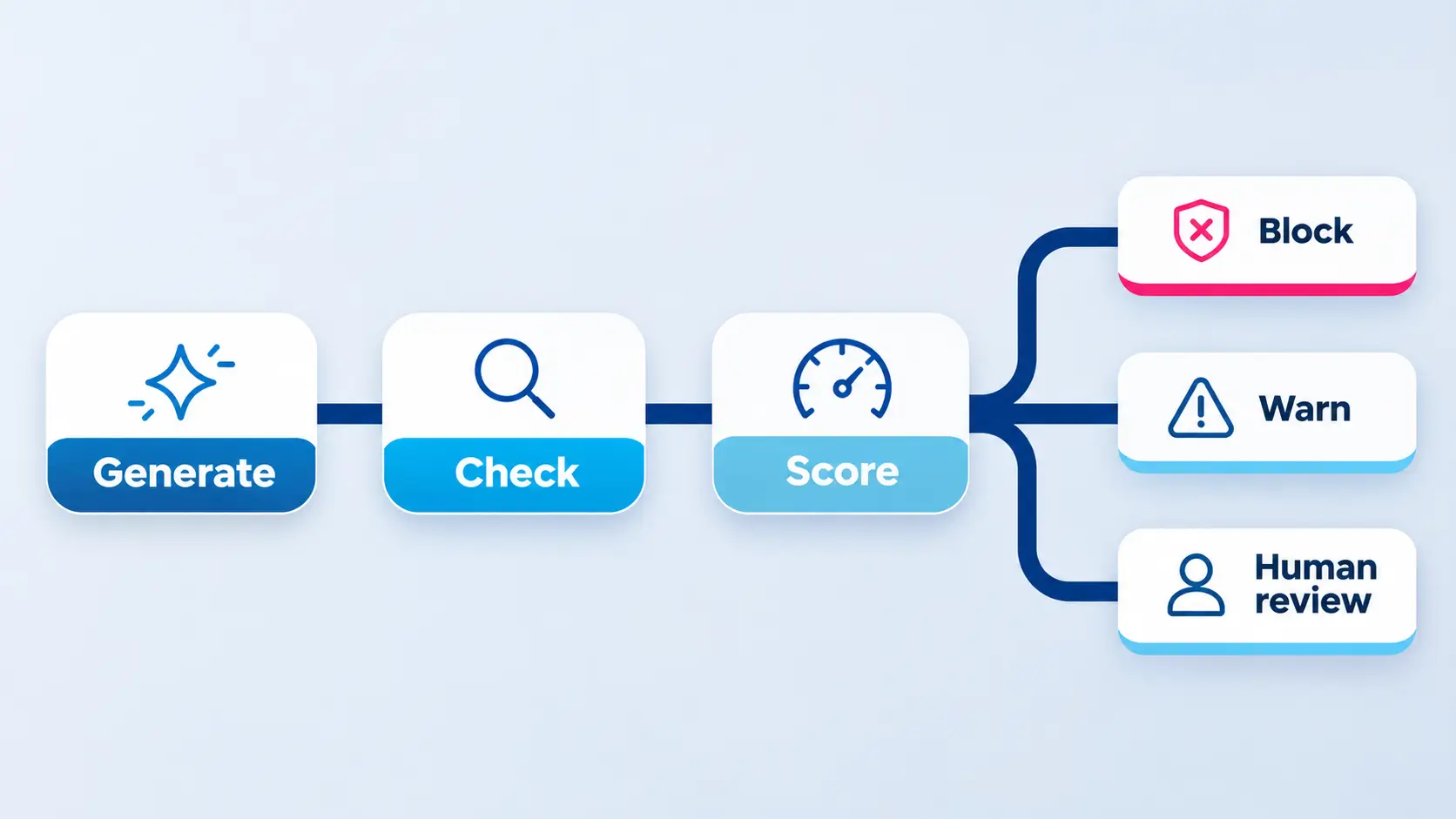
Moving from a demo to dependable hallucination detection for LLM systems in production is mostly an engineering and process problem, not a research one. This sequence works for most RAG assistants and agent workflows.
Building an LLM or RAG system that needs to be reliable from day one? Xicom’s team of 150+ AI engineers and data scientists designs retrieval, evaluation and hallucination checks together, so accuracy is measured before launch, not after. Talk to our AI experts.
For teams building on their own models or fine-tuned open-weight models, white-box probes and self-hosted detectors become an option too. That is usually decided early, as part of LLM development services, rather than added later.
Hallucination detection is no longer just a product-quality feature. It is becoming evidence that an AI system is under control.
Teams that need to formalize these controls across multiple AI systems often pair technical detection with AI governance consulting to align policies, documentation and monitoring with the frameworks they report against.
| Industry | Typical scenario | What a hallucination could cause | Detection focus |
|---|---|---|---|
| Healthcare | A clinical assistant summarizes patient notes or answers questions about care guidelines | A wrong dosage, allergy or contraindication in a summary | Claim-level groundedness against the record, high recall, mandatory clinician review |
| Legal | An assistant summarizes contracts or researches case law | Invented citations or misstated clauses and dates | Citation verification against a trusted legal database, intrinsic-error checks on numbers and parties |
| Finance | A research or advisory copilot answers questions on filings and market data | Wrong figures, invented guidance or misread disclosures | Retrieval-based verification against source filings, numeric consistency checks |
| Insurance | A claims or policy assistant explains coverage to agents and customers | Telling a customer something is covered when it is not | Groundedness against policy wording, blocking uncertain coverage answers |
| Customer support | A support bot or agent answers product, billing and refund questions | Made-up policies, prices or steps that create liability and churn | Fast groundedness checks on every answer, fallback to a human agent when flagged |
The pattern repeats across all five: the higher the cost of a wrong answer, the more the system should favor recall, claim-level checks and human review over speed. Detection also matters more as systems become autonomous. In agentic RAG workflows, an agent may act on its own output across several steps, so a single unsupported claim early on can carry through every action that follows. Teams building those systems through AI agent development should check outputs at each step, not just the final answer.
Hallucinations are not a bug that the next model release will remove. They come with how LLMs generate text, so they have to be managed. Effective LLM hallucination detection combines the right methods for your risk level, metrics that show how well your detectors actually perform, benchmarks used for shortlisting rather than final judgment, and tooling that runs where your data is allowed to go.
Start with groundedness checks on your highest-risk use case, build a labeled set from your own data, and measure precision and recall before you trust any score. Then add layers, such as LLM judges, self-consistency or claim-level verification, where the cost of a wrong answer justifies the extra latency. Teams that treat detection as an ongoing engineering discipline, not a one-time feature, are the ones whose AI systems earn lasting user trust.
LLM hallucination detection is the process of checking a model’s output for claims that are false, unsupported by the provided source, or fabricated. It typically runs at inference time and uses methods such as groundedness checks, LLM-as-judge, NLI entailment or self-consistency to score each response, then flags, blocks or routes risky answers for review.
The main LLM hallucination detection methods are self-consistency sampling (SelfCheckGPT), semantic entropy, LLM-as-judge with polling (ChainPoll), NLI and claim-level entailment, groundedness checks against retrieved context, knowledge-graph verification, token-probability signals and internal-state probes. Black-box methods work with any API model, while white-box probes need a self-hosted open-weight model.
Self-consistency samples several answers to the same prompt and compares them. If a model truly knows a fact, the samples agree. If it is guessing, they diverge. Sentences that the samples do not support are flagged. It needs no reference data, but it multiplies generation cost and can miss errors the model repeats consistently.
The key LLM hallucination detection metrics are precision, recall, F1, AUROC and AUC-PR for the detector itself, plus hallucination rate, faithfulness score and abstention rate for the overall system. Measure them against a labeled set from your own domain, because public benchmark results rarely carry over directly to production data.
No single benchmark covers every case. TruthfulQA tests misconceptions, HaluEval tests hallucination recognition, RAGTruth covers RAG outputs at word level, FActScore measures long-form factual precision, FaithDial covers dialogue, and Vectara’s HHEM leaderboard tracks summarization hallucination rates. Use them to shortlist models and detectors, then validate on your own data.
The best platform for LLM hallucination detection depends on your stack and data rules. Evaluation frameworks such as RAGAS, DeepEval and TruLens suit offline testing. Langfuse, Arize Phoenix and Datadog cover live monitoring. Guardrails AI and NeMo Guardrails handle runtime blocking. Many teams combine one tool from each group.
Yes. Open-source tools such as Langfuse, Arize Phoenix, RAGAS, DeepEval, TruLens and NeMo Guardrails can run in your own cloud or on-premise, alongside open detector models such as HHEM or Lynx. This keeps prompts, documents and traces inside your environment, which matters for HIPAA, GDPR and SOC 2 obligations.
No. RAG reduces hallucinations by grounding answers in retrieved documents, but models still add unsupported details, misread passages or answer from poor retrieval. Benchmarks like RAGTruth were built specifically because hallucinations persist in RAG outputs. That is why RAG systems still need groundedness checks and ongoing evaluation.

Based on this article's topic
Explore how AI in pharmaceutical research supports drug discovery, from target identification and virtual screening to toxicity and trial design.

Explore 12 AI in procurement use cases, from spend analysis and supplier risk to invoice matching, plus benefits and how to integrate AI with ERP systems.
Agentic AI vs RPA explained for enterprises. Compare differences, costs, use cases, and risks, plus when to use each, a hybrid model, and a migration roadmap.