Apr 14, 2025 Artificial Intelligence
Quick Answer
Telemedicine app development costs about $40,000 to $80,000 for an MVP with video visits, scheduling, and payments; $80,000 to $180,000 for a full-featured app with e-prescribing and EHR integration on iOS, Android, and web; and $180,000 to $400,000+ for an enterprise platform with remote patient monitoring and AI. These figures assume a blended offshore or hybrid team; an all-US team typically costs 2 to 3 times more. HIPAA controls, video minutes, and third-party integrations add ongoing costs.
A telemedicine app looks simple from the patient’s side: book a slot, join a video call, get a prescription. Behind that flow sit HIPAA safeguards, an EHR connection, an e-prescribing network, insurance checks, and a video service that cannot drop a call halfway through a consultation. Each of those pieces has its own cost, and leaving any of them out of the budget is the most common reason healthcare app projects run over.
This guide gives you a cost model that adds up. It covers what each part of the build costs, the monthly fees to plan for, the US rules that shape your feature list in 2026, and how long each stage takes. It is written for clinics, health systems, digital health startups, and enterprises planning a telehealth product for the US market and beyond.
Key Takeaways
- A telemedicine MVP costs roughly $40,000 to $80,000 and takes 3 to 5 months; a full-featured app with e-prescribing and EHR integration costs $80,000 to $180,000 and takes 5 to 9 months.
- Compliance is built in, not bolted on. Encryption, audit logs, access controls, and business associate agreements (BAAs) with every vendor that touches patient data are part of the first release.
- Video is inexpensive per visit. At Zoom Video SDK’s published rate, a 20-minute, two-person visit costs about $0.14 after the free monthly minutes.
- US policy is still moving: Medicare telehealth flexibilities run through December 31, 2027, and DEA flexibility for prescribing controlled substances by telemedicine runs through December 31, 2026.
- EHR integration and e-prescribing are usually the costliest integrations, so decide early whether your MVP needs them.
How Much Does It Cost to Build a Telemedicine App?
The cost to build a telemedicine app depends mostly on four decisions: which care model you support, how many platforms you launch on, whether you integrate with an EHR and e-prescribing network on day one, and how much AI or device data you add. The table below groups typical projects into three tiers.
| App Tier | What You Get | Estimated Cost | Timeline |
|---|---|---|---|
| MVP | Cross-platform patient app, provider web dashboard, scheduling, intake forms, HIPAA-ready video visits, secure messaging, card payments, admin panel, core security controls | $40,000 – $80,000 | 3 – 5 months |
| Full-Featured | iOS, Android, and web; virtual waiting room; multi-provider and multi-specialty scheduling; e-prescribing; integration with one EHR; insurance eligibility checks; visit notes; reminders; analytics | $80,000 – $180,000 | 5 – 9 months |
| Enterprise / RPM and AI | Multiple EHR integrations, remote patient monitoring with connected devices, AI-assisted documentation and triage, care team workflows, multi-state and multi-location operations, white-label options | $180,000 – $400,000+ | 9 – 15 months |
Why are telemedicine apps more expensive than many consumer apps of a similar size? Three reasons: every feature that touches patient data needs security and audit controls, healthcare integrations (EHR, e-prescribing, insurance) involve vendor contracts and certification steps, and testing has to cover clinical workflows as well as app behavior.
Telemedicine App Development Cost Breakdown by Component
Here is how the budget for a full-featured telemedicine app typically splits across the work involved. The rows add up to the $80,000 to $180,000 range above, so you can see where each dollar goes and what to defer if you need a leaner first release.
| Component | What It Covers | Estimated Cost |
|---|---|---|
| Discovery, compliance planning, and architecture | Care model, user roles, data flows, HIPAA risk analysis inputs, vendor selection, tech stack | $5,000 – $10,000 |
| UI/UX design | Patient, provider, and admin flows; intake forms; accessibility for older and low-vision users | $8,000 – $16,000 |
| Patient and provider apps | iOS, Android, and web apps; booking; visit room; messaging; records; notifications | $22,000 – $48,000 |
| Backend, APIs, and admin | Authentication, scheduling engine, provider availability, billing logic, admin panel, reporting | $15,000 – $34,000 |
| Video visits and secure messaging | Video SDK integration, virtual waiting room, screen sharing, encrypted chat and file sharing | $8,000 – $16,000 |
| EHR integration | Patient and appointment data exchange with one EHR, usually through HL7 FHIR APIs | $8,000 – $22,000 |
| E-prescribing, payments, and insurance | E-prescribing vendor integration, card payments, eligibility checks, superbills or claims export | $6,000 – $16,000 |
| Security and HIPAA controls | Encryption at rest and in transit, MFA, role-based access, audit logs, session timeouts | $4,000 – $10,000 |
| QA, security testing, and launch | Device and network testing, workflow testing with clinicians, vulnerability scans, store submission | $4,000 – $8,000 |
| Total | $80,000 – $180,000 |
After launch, most teams set aside 15% to 20% of the initial build cost each year for maintenance: OS and SDK updates, security patches, vendor API changes, and small improvements. New features are budgeted on top of that.
Ongoing Costs to Budget For
Development is a one-time cost, but a telemedicine app also has monthly bills that grow with usage. Plan for these from the start:
- Video minutes: Video APIs bill per participant-minute. Zoom’s Video SDK, for example, includes 10,000 free minutes a month and then charges $0.0035 per minute. A 20-minute visit with a patient and a doctor uses 40 minutes, or about $0.14. At 10,000 visits a month, that is roughly $1,365 in video fees. Confirm that your video vendor will sign a BAA before you commit.
- HIPAA-eligible cloud hosting: AWS, Microsoft Azure, and Google Cloud all offer BAAs and HIPAA-eligible services. Costs depend on traffic, storage of records and images, backups, and logging.
- Integration fees: E-prescribing vendors, EHR marketplaces, and insurance eligibility APIs usually charge setup fees, per-provider fees, or per-transaction fees. Get quotes during discovery, because they vary widely by vendor and volume.
- Security and compliance upkeep: Annual risk assessments, vulnerability scanning, penetration testing, and, for many B2B buyers, a SOC 2 or HITRUST report.
- Messaging and notifications: SMS and email reminders reduce no-shows but are billed per message. Keep message content free of sensitive details unless the channel is covered by a BAA.
- App store accounts: Apple’s developer program costs $99 per year, and Google Play charges a one-time $25 registration fee.
Need a cost estimate for your telemedicine app?
Share your care model and must-have integrations, and our team will map the build cost, monthly costs, and a phased roadmap.
Telehealth Market and US Policy in 2026
Demand for virtual care has settled into a permanent part of how people get healthcare. Fortune Business Insights valued the global telehealth market at USD 186.41 billion in 2025 and projects USD 219.31 billion in 2026, with a CAGR of 24.60% from 2026 to 2034. North America accounted for 45.29% of the market in 2025, and the US market alone is projected at USD 81.11 billion in 2026.
For US products, policy matters as much as market size, because it decides who can be treated, how visits are paid for, and what can be prescribed. Here is where the key rules stand:
- Medicare telehealth flexibilities were extended through December 31, 2027, under a spending package signed on February 3, 2026, according to the American Bar Association. That keeps coverage for visits from patients’ homes and for audio-only care in place for now.
- Prescribing controlled substances by telemedicine without a prior in-person visit remains allowed through December 31, 2026, under the DEA and HHS’s fourth temporary extension. A permanent special registration framework has been proposed but is not final, as TechTarget reports.
- The HIPAA Security Rule update proposed in January 2025 is still not final. As proposed, it would make encryption and multi-factor authentication mandatory for systems with patient data. Building to that standard now avoids rework later.
Practical takeaway: design your scheduling, prescribing, and billing logic so rules can be switched by state, payer, and visit type through configuration rather than code changes. Policy dates in telehealth have moved several times, and a configurable app adapts without a new release.
Types of Telemedicine Apps and How They Differ in Cost
The care model you support shapes the feature list more than anything else. These are the most common types, with how each one changes the budget compared with the tiers above.
| App Type | Typical Use | What Drives the Cost |
|---|---|---|
| Clinic or practice telehealth | An existing practice offers video visits to its own patients | Lowest cost; scheduling and EHR sync matter more than marketplace features |
| On-demand urgent care | Patients connect with the next available provider | Queueing, provider availability, multi-state licensing rules, payments |
| Virtual mental health and therapy | Recurring therapy sessions, psychiatry, and messaging | Recurring scheduling, stronger privacy controls, controlled-substance prescribing rules for psychiatry |
| Remote patient monitoring (RPM) | Chronic care with blood pressure cuffs, glucose meters, or wearables | Device integrations, alerts and thresholds, care team dashboards, RPM billing workflows |
| Specialty and second-opinion platforms | Dermatology, radiology, or expert reviews | Image upload and viewing, asynchronous workflows, specialist matching |
| Employer or payer platforms | Virtual care offered as a benefit to members | Eligibility files, single sign-on, reporting for the sponsor, higher security reviews |
If your product is closer to fitness or self-care than clinical care, the compliance load is lighter and the cost is lower. Our wellness app development team covers that category.
Must-Have Features for a Telemedicine App
A telemedicine app serves three groups: patients, providers, and administrators. Planning features by group keeps the scope clear and makes it easier to decide what ships in the MVP.
Patient app features
- Sign-up and identity: Email or phone sign-up, MFA, and identity verification where your care model needs it.
- Intake and consent: Digital intake forms, medical history, insurance details, and telehealth consent.
- Provider search and booking: Filter by specialty, language, state license, and availability; reschedule or cancel easily.
- Video and audio visits: A device check before the call, a waiting room, and an audio-only fallback for weak connections.
- Secure messaging: Follow-up questions, file and photo sharing, and visit summaries.
- Prescriptions and records: E-prescriptions sent to a chosen pharmacy, lab results, and downloadable visit notes.
- Payments: Copays, self-pay pricing, saved cards, and receipts.
Provider features
- Schedule management: Availability by location and license state, buffers between visits, and a live queue for on-demand care.
- Visit workspace: Patient chart summary, intake answers, and note templates on screen during the call.
- E-prescribing: Medication search, drug interaction checks from the prescribing vendor, and pharmacy routing.
- Documentation: Structured notes that sync back to the EHR, with optional AI-assisted drafting.
- Orders and referrals: Lab orders, referrals, and follow-up scheduling.
Admin features
- User and role management: Providers, staff, and permissions, with credential and license tracking.
- Audit logs: A record of who viewed or changed patient data, and when.
- Billing and reporting: Payments, refunds, claims exports, visit volume, no-show rates, and provider utilization.
- Configuration: Visit types, pricing, state rules, and notification templates that staff can change without developers.
AI features that add real value
AI pays off in telemedicine where it saves clinician time or helps patients reach the right care faster. Practical uses include ambient documentation that drafts visit notes for the provider to review, intake assistants that summarize symptoms before the visit, appointment no-show prediction, multilingual translation, and alerts that flag concerning RPM readings. Keep a clinician in the loop for anything that affects diagnosis or treatment, and note that AI features that diagnose or recommend treatment may fall under FDA rules for software as a medical device. Our healthcare AI development team can help you scope these features safely.
Factors Affecting Telemedicine App Development Cost
1. Integrations
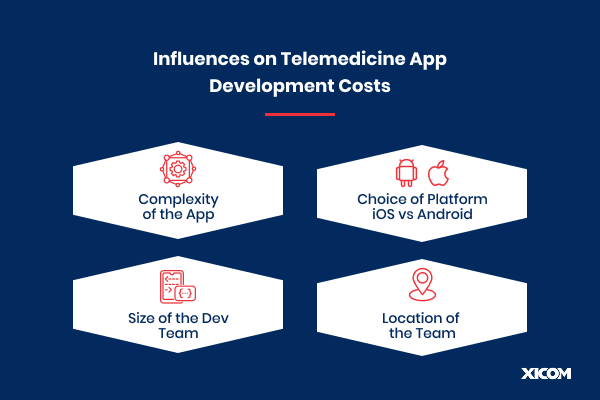
EHR integration is often the single largest variable. Modern EHRs expose HL7 FHIR APIs, but each vendor has its own app marketplace, review process, and fees, and older systems may need HL7 v2 interfaces. E-prescribing, insurance eligibility, labs, and pharmacy networks each add their own integration work. If your first customers do not need an EHR connection, launching without one can cut weeks from the timeline.
2. Compliance and security
HIPAA applies to US apps that handle protected health information on behalf of providers or health plans. That means encryption, access controls, audit logging, breach procedures, and BAAs with your hosting, video, messaging, and analytics vendors. Serving users in Europe adds GDPR, and some states have their own health privacy laws. Our guide to HIPAA-compliant app development covers the controls in detail.
3. Platforms and tech stack
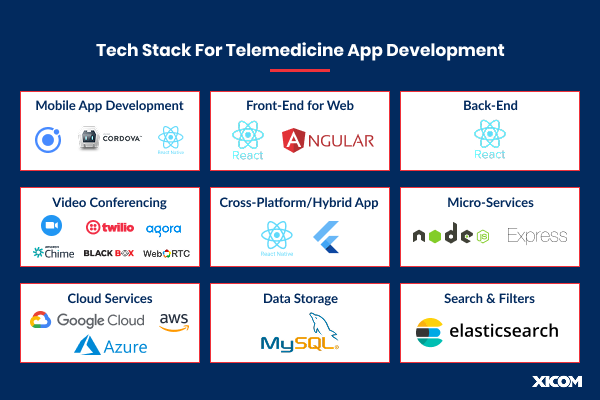
Patients usually need iOS and Android apps, while providers often prefer a web dashboard. A cross-platform framework such as Flutter or React Native covers both mobile platforms with one codebase, which lowers build and maintenance cost for most telemedicine apps. Native development is worth the extra cost when the app depends on heavy device integrations, such as Bluetooth medical devices with strict connection requirements.
4. Design and accessibility
Telemedicine users include older adults, people who are unwell, and caregivers acting for someone else. Large touch targets, clear language, screen reader support, and simple recovery when a call drops are not optional extras; they decide whether visits actually happen. Following WCAG guidelines adds design and testing time but reduces support costs and drop-off.
5. Team location and engagement model
Rates are the biggest multiplier. Experienced US-based app developers typically charge about $100 to $200 per hour in 2026, while offshore teams in India and other delivery hubs commonly bill $25 to $60 per hour. Many US healthcare companies use a hybrid model: product and clinical leadership in-house, with an offshore team handling engineering, QA, and maintenance under a BAA. Fixed-price contracts suit a well-defined MVP; time-and-material or a dedicated team suits a product that will keep evolving.
Hidden Costs of Telemedicine App Development
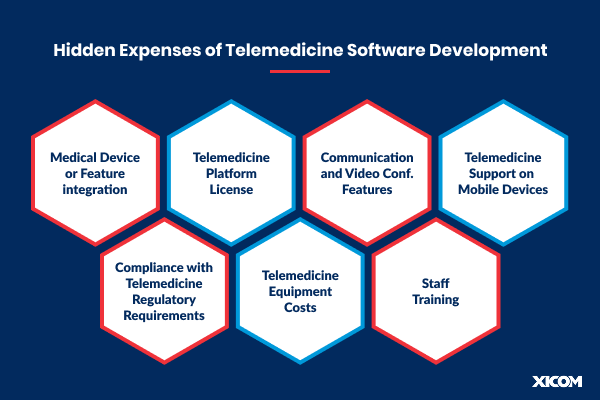
- Legal and compliance review: Healthcare counsel to review consent flows, privacy policies, state telehealth rules, and vendor BAAs.
- EHR marketplace and certification steps: Some EHR vendors charge for listing, API access, or a security review before your app can connect.
- Provider onboarding: Credentialing, license verification across states, and training staff on new workflows.
- Security assessments: Penetration tests and, for enterprise buyers, security questionnaires and third-party audits.
- Patient support: Help with logins, camera and microphone permissions, and connection problems, especially at launch.
How Long Does It Take to Build a Telemedicine App?
A telemedicine MVP usually takes 3 to 5 months, a full-featured app 5 to 9 months, and an enterprise platform 9 to 15 months. Vendor approvals for EHR and e-prescribing integrations can add time outside your team’s control, so start those conversations during discovery.
| Phase | Key Activities | MVP | Full-Featured App |
|---|---|---|---|
| Discovery and compliance planning | Care model, user roles, data flows, vendor selection, BAAs, roadmap | 2 – 3 weeks | 3 – 5 weeks |
| UI/UX design | Patient, provider, and admin flows; prototypes; clinician feedback | 3 – 4 weeks | 5 – 8 weeks |
| Development | Apps, backend, video, messaging, payments, integrations | 8 – 12 weeks | 14 – 24 weeks |
| Testing and launch | Workflow testing with clinicians, security testing, pilot, store release | 2 – 3 weeks | 4 – 6 weeks |
| Total | Phases overlap | 3 – 5 months | 5 – 9 months |
A short pilot with one clinic or provider group before a wider launch is worth the time. Real visits surface workflow gaps that internal testing rarely catches.
How Telemedicine Apps Make Money
- Per-visit fees: Patients pay a set price per consultation, common for self-pay urgent care and specialty visits.
- Memberships: Monthly or annual plans with unlimited messaging or a set number of visits.
- Insurance billing: Visits billed to Medicare, Medicaid, or commercial payers using telehealth codes; this requires claims workflows and payer enrollment.
- B2B contracts: Employers, health plans, or health systems pay per member or per license.
- Marketplace commission: Platforms that connect independent providers with patients take a share of each visit.
Your revenue model changes the build. Insurance billing needs eligibility checks and claims exports, while memberships need subscription billing and entitlement rules. Choose one model for the MVP and add others once you know what your patients and partners will pay for.
How to Reduce Telemedicine App Development Cost
- Start with one care model and one specialty: A focused launch needs fewer visit types, simpler scheduling, and fewer integrations.
- Use proven healthcare building blocks: HIPAA-ready video SDKs, e-prescribing vendors, and FHIR APIs are faster and safer than custom builds.
- Go cross-platform for patient apps: One codebase for iOS and Android, plus a web dashboard for providers.
- Defer EHR integration if your pilot allows it: Export visit notes as PDFs or structured files first, then integrate once volumes justify the cost.
- Build compliance in from day one: Retrofitting encryption, audit logs, and access controls costs far more than designing for them.
For broader benchmarks across app types, see our mobile app development cost guide.
Build Your Telemedicine App with Xicom
Xicom designs and builds healthcare software with compliance planned from the first sprint. As a telemedicine app development company, we build video visits, virtual waiting rooms, e-prescribing, EHR integration, remote monitoring, and billing for providers, digital health startups, and enterprises. Our broader healthcare app development work includes Health E Livin, an AI-powered mental wellness platform with confidential assessments, a conversational assistant, and provider discovery on privacy-first cloud infrastructure.
If you already have a product team, you can also hire mobile app developers from Xicom to extend it.
- 20+ years of software delivery
- 1,800+ projects for 750+ clients across 50+ countries
- 350+ IT professionals
- ISO 9001, ISO/IEC 27001, and SOC 2 Type II certified; NASSCOM and STPI accredited
- Rated 4.8 on Clutch
Planning a telemedicine app for your practice or platform?
Tell us about your care model and patients. We will recommend the right features, integrations, and budget for your first release.
Conclusion
A successful telemedicine app gets a few things right: reliable video, a booking flow patients can finish without help, prescribing and records that fit clinical workflows, and compliance that holds up to a security review. Budget $40,000 to $80,000 for a focused MVP and $80,000 to $180,000 for a full-featured app, plan for ongoing video, hosting, and integration fees, and design your rules to be configurable while US telehealth policy keeps changing. Start with one care model, prove that patients and providers use it, and expand from there.
Frequently Asked Questions (FAQ)
How much does it cost to develop a telemedicine app?
Telemedicine app development costs about $40,000 to $80,000 for an MVP, $80,000 to $180,000 for a full-featured app with e-prescribing and EHR integration, and $180,000 to $400,000 or more for an enterprise platform with remote patient monitoring and AI. These estimates assume a blended offshore or hybrid team. Hosting, video minutes, integration fees, and maintenance are ongoing costs.
How much does a telemedicine MVP cost for a startup?
A telemedicine MVP typically costs $40,000 to $80,000. It usually includes a cross-platform patient app, a provider web dashboard, scheduling, intake forms, video visits, secure messaging, payments, an admin panel, and core HIPAA security controls. EHR integration and e-prescribing can be added in the next phase.
How long does it take to build a telemedicine app?
A telemedicine MVP takes about 3 to 5 months. A full-featured app with e-prescribing and EHR integration takes 5 to 9 months, and an enterprise platform can take 9 to 15 months. Vendor approvals for EHR and e-prescribing integrations can add time, so start them during discovery.
Does a telemedicine app need to be HIPAA compliant?
In the US, a telemedicine app that creates, stores, or transmits protected health information for healthcare providers or health plans must meet HIPAA requirements. That includes encryption, access controls, audit logs, breach procedures, and business associate agreements with vendors such as hosting, video, and messaging providers.
How much does EHR integration add to telemedicine app cost?
Integrating with one EHR typically adds $8,000 to $22,000 to development, depending on whether the EHR offers modern HL7 FHIR APIs and how much data you exchange. EHR vendors may also charge marketplace, API, or review fees. Each additional EHR adds its own integration work.
What are the monthly running costs of a telemedicine app?
Main running costs are HIPAA-eligible cloud hosting, video minutes, e-prescribing and EHR integration fees, SMS and email reminders, security testing, and maintenance. Video is relatively inexpensive: at Zoom Video SDK’s published rate, a 20-minute two-person visit costs about $0.14 after free monthly minutes.
Can telemedicine apps prescribe controlled substances?
In the US, DEA and HHS flexibilities allow practitioners to prescribe Schedule II to V controlled substances through telemedicine without a prior in-person visit through December 31, 2026. A permanent special registration rule has been proposed but is not final, so apps should keep prescribing rules configurable.
How do telemedicine apps make money?
Common revenue models are per-visit fees, monthly or annual memberships, insurance billing to Medicare, Medicaid, or commercial payers, B2B contracts with employers or health plans, and commissions on marketplace visits. Most new apps launch with one model and add others later.

Make your ideas turn into reality
With our AI & mobile app solutions
Explore related services
Based on this article's topic