Best AI Automation Tools for Enterprises in 2027: Comparison and Buyer’s Guide
Compare the best AI automation tools for enterprises in 2027. See features, pricing models, limitations, build vs buy guidance, and a security checklist.
Nov 20, 2026 Artificial Intelligence
Many enterprises have spent years building RPA bots that move data, fill forms, and keep back-office work running. Now agentic AI promises automation that can read, reason, and adapt when things do not go to plan. That raises a practical question for every automation leader: agentic AI vs RPA, which one should run your business processes?
The honest answer is that the question is usually framed the wrong way. It is rarely about one technology replacing the other. It is about which kind of work each process needs: fixed execution, judgment, or both. This guide explains the difference between agentic AI and RPA, shows the same process handled three ways, compares costs and risks, and gives you a step-by-step roadmap for moving from RPA toward agentic automation without throwing away what already works.
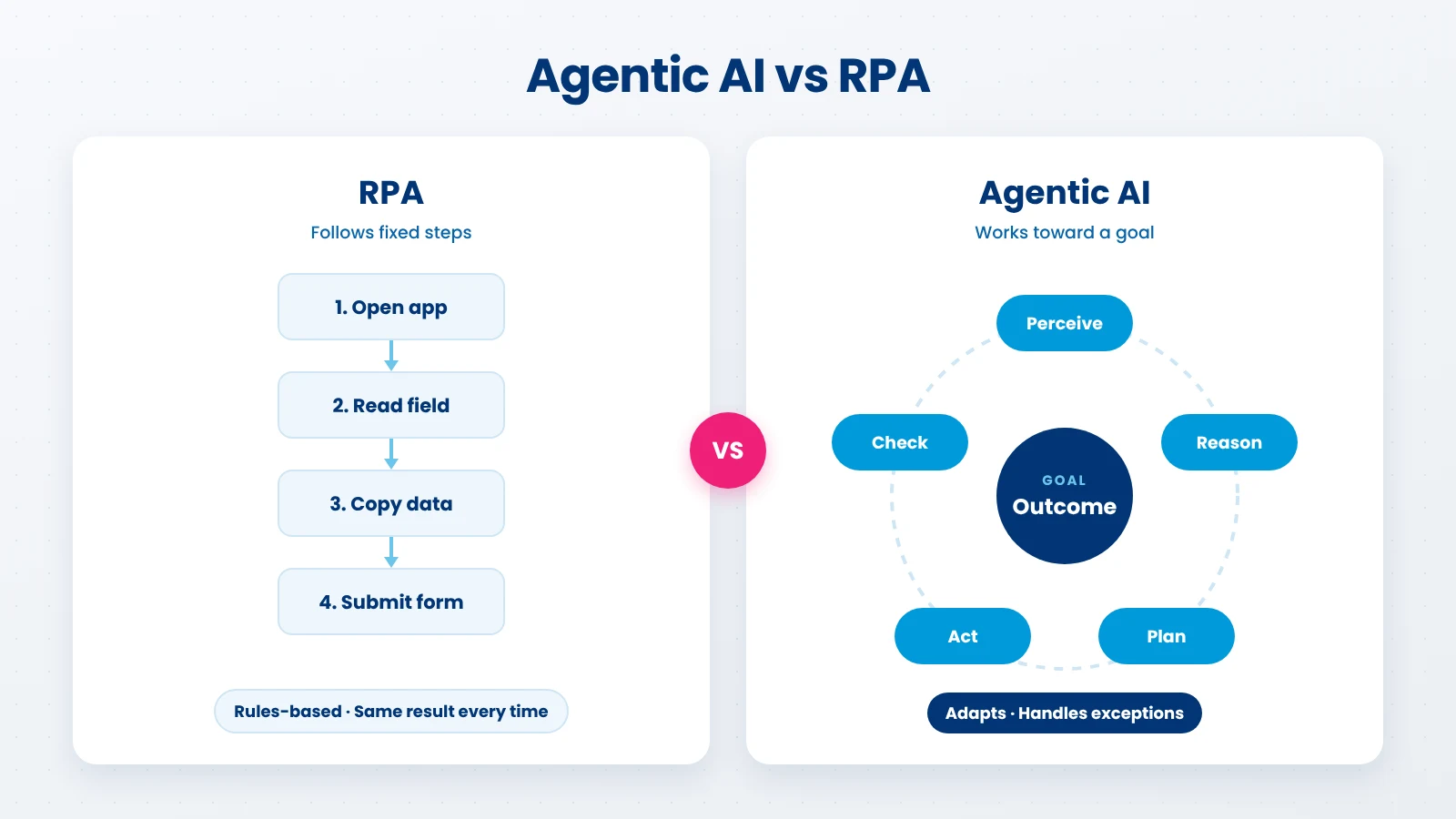
RPA handles the how: it executes a set of steps exactly as defined. Agentic AI handles the what and why: you give it a goal, and it reasons about which steps to take, which tools to use, and what to do when something unexpected happens.
| RPA | Agentic AI | |
|---|---|---|
| Works from | Fixed rules and scripts | Goals and context |
| Best at | Repetitive, structured tasks | Variable, judgment-based work |
| When things change | Often breaks | Adapts within set limits |
| Output | Same result every time | Varies, so it needs monitoring |
Robotic process automation (RPA) is software that mimics the actions a person takes on a computer, such as clicking, copying, typing, and moving files. A developer records or designs each step, and the bot repeats those steps the same way every time. This rule-based design is the starting point for comparing agentic AI vs robotic process automation.
RPA became popular because it can automate work in legacy systems that have no APIs. A bot can log in to an old mainframe screen just like a person would. Platforms such as UiPath, Automation Anywhere, SS&C Blue Prism, and Microsoft Power Automate Desktop are common in large enterprises, and well-planned RPA development still delivers fast returns on stable, rule-based work.
Strengths: predictable results, clear audit trails, low running cost per task, and a fast return on stable processes.
Limitations: bots break when screens, fields, or file formats change. They cannot read meaning in unstructured content, and every exception needs a new rule or a human.
Typical enterprise examples:
Agentic AI refers to AI systems that can pursue a goal with some autonomy. Instead of following a fixed script, an AI agent uses a large language model (LLM) to understand the task, plan steps, call tools such as APIs, databases, or even RPA bots, check results, and adjust its approach.
A simple way to picture it is a loop: perceive (read the input), reason (understand what is needed), plan (choose the steps), act (use tools), and check (verify and correct). A chatbot answers questions. An agent completes work. Agentic automation goes a step further by coordinating several agents, systems, and people inside one business process. That is the key idea in agentic automation vs RPA: one pursues goals, the other repeats steps.
Strengths: handles unstructured data such as emails, PDFs, and chats, deals with exceptions, and adapts when inputs vary.
Limitations: results can vary between runs, models can make confident mistakes (hallucinations), each run has a model usage cost, and agents need careful permissions and testing.
Typical enterprise examples:
The core difference between agentic AI and RPA is how decisions are made. RPA executes decisions that a person has already written into rules. Agentic AI makes decisions at run time, within the limits you set. That single difference changes cost, risk, maintenance, and the kind of work each one suits.
| Factor | RPA | Agentic AI |
|---|---|---|
| Core approach | Deterministic: same input, same output | Probabilistic: reasons toward a goal |
| Decision-making | Predefined if/then rules | Context-based decisions within guardrails |
| Data types | Structured data, fixed formats | Structured and unstructured data |
| Exception handling | Stops or routes to a human | Tries to resolve, escalates when unsure |
| Adapting to change | Breaks when UIs or processes change | Adapts to variation within limits |
| Setup effort | Map every step and rule | Define goals, tools, guardrails, and tests |
| Maintenance | Frequent fixes for brittle bots | Ongoing evaluation, prompt and model updates |
| Predictability | High | Lower, needs monitoring |
| Auditability | Simple step logs | Needs reasoning and action logs |
| Main cost drivers | Licenses, bot maintenance, CoE staff | Model usage, integration, monitoring |
| Governance needs | Moderate | High |
| Best use cases | Stable, high-volume, rule-based tasks | Variable, judgment-heavy, multi-system work |
Predictability vs flexibility. RPA gives you the same result every time, which auditors and regulators like. Agentic AI gives you flexibility, but that flexibility means outputs must be tested and monitored.
Where maintenance happens. With RPA, effort goes into fixing bots when a screen or file changes. With agents, effort moves to evaluation: checking accuracy, reviewing escalations, and updating instructions as the business changes.
Scope of work. RPA automates tasks. Agentic AI can own larger parts of a process, which is why AI agents vs RPA is less of a head-to-head contest and more a question of where each one sits in the workflow.
Invoice processing is a good test case because it mixes clean, repetitive steps with messy exceptions. Here is how the same workflow plays out with each approach.
A bot downloads invoices from a shared inbox, reads fields from a known template, matches them to purchase orders, and posts them to the ERP. It works well when every supplier uses the same format. When a new supplier sends a different layout, a scanned PDF, or an invoice that does not match the PO, the bot stops and the item lands in a human queue.
An agent reads invoices in any format, understands line items, compares them with POs and receipts, and investigates mismatches by checking emails or contract terms. It handles variety much better. But using an LLM for every routine posting adds cost and variability to steps that a rule could do perfectly, and posting directly to the ERP without controls adds risk.
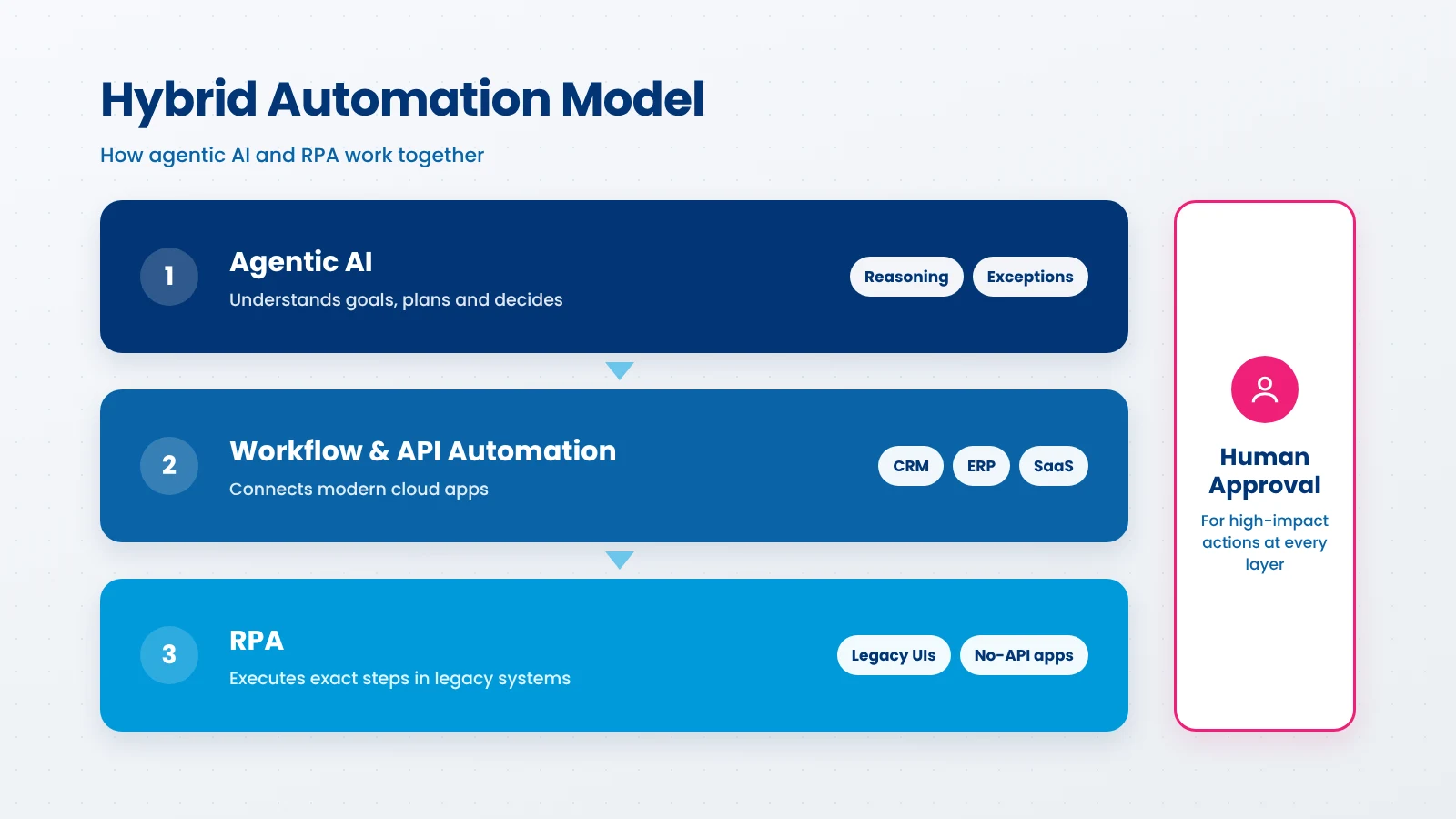
The agent reads and understands each invoice, resolves common mismatches, and decides what should happen. The existing RPA bot performs the final, repeatable ERP posting. Invoices above a set value, or with unclear issues, go to a person for approval. This keeps the reliable parts deterministic and uses AI only where judgment is needed.
Neither is better in every case. In the agentic AI vs RPA decision, choose based on the traits of the process, not the popularity of the technology, because good business automation starts with the process. Use this guide to decide when to use RPA vs agentic AI:
| Process Trait | Best Fit |
|---|---|
| Structured data, fixed format, stable rules | RPA |
| High volume, low variation, must be identical every time | RPA |
| Legacy system with no API, simple steps | RPA |
| Unstructured inputs such as emails, PDFs, or chats | Agentic AI |
| Frequent exceptions that need judgment | Agentic AI |
| Work spread across many systems and data sources | Agentic AI or Hybrid |
| Judgment needed, but final actions must be exact and auditable | Hybrid |
| High-risk decisions such as payments or approvals | Hybrid with human approval |
Gartner makes a similar point. In its June 2025 prediction that over 40% of agentic AI projects will be canceled by the end of 2027, it noted that many use cases positioned as agentic today do not require agentic implementations, and recommended pursuing agentic AI only where it delivers clear value or ROI. That is why the business case should come first, whether you adopt a platform or invest in custom AI development services built around your own data and systems.
No, not in most enterprises. Agentic AI is changing how RPA is used rather than replacing it. Bots remain the most reliable way to run deterministic, high-volume tasks and to work with legacy screens. What changes is who decides what the bots do.
A useful way to see this is a three-layer model:
Over time, RPA may shrink as more systems offer APIs and agents grow more reliable. But for the next several years, the realistic answer to “will AI agents replace RPA” is that they will work alongside it.
Yes, agentic AI and RPA can work together. In practice, the RPA vs AI agents debate often ends with a hybrid automation model, which is where many enterprise automation teams see the best results. Three patterns are common:
This approach protects your existing RPA investment while adding intelligence where it creates the most value. It is often called intelligent automation or agentic process automation.
The cost of agentic AI vs RPA depends far more on the process than on the technology. Instead of comparing price tags, compare the cost drivers and total cost of ownership (TCO) over time.
| Cost Factor | RPA | Agentic AI |
|---|---|---|
| Licensing | Per bot, robot, or user licenses | Platform fees plus model or token usage |
| Build | Step-by-step bot development | Agent design, tool integration, guardrails, testing |
| Running cost per task | Low and predictable | Varies with model, prompt size, and steps |
| Maintenance | Fixing bots after UI or process changes | Evaluation, monitoring, and instruction updates |
| People | RPA developers and CoE staff | AI engineers, process owners, reviewers |
| Hidden costs | Human handling of exceptions | Error review, escalations, cost overruns |
Tips to control cost:
Moving from RPA to agentic AI works best as a gradual upgrade, not a replacement project. These seven steps reduce risk and show value early:
Agentic automation brings risks that RPA does not, because agents make decisions and take actions on their own. Governance must be designed in from the start.
Watch for “agent washing” as well. Gartner has warned that some vendors rebrand existing products, including RPA tools and chatbots, as agentic AI without real agentic capabilities. Ask vendors to show how their agents plan, use tools, and handle exceptions in your own processes.
The agentic AI vs RPA debate has a practical answer. Use RPA for stable, rule-based, high-volume tasks. Use agentic AI where work involves unstructured data, exceptions, and judgment. For most enterprises, the strongest setup combines both, with agents deciding and bots executing under clear governance. Start with the processes that cause the most manual exceptions, prove value in a controlled pilot, and scale from there. If you need agents that work alongside your existing bots and systems, explore our agentic AI development services.
Disclosure: Xicom is not affiliated with any RPA or AI agent vendor mentioned here. We build custom AI agents and integrate them with existing automation, and this guide reflects that perspective.
RPA follows fixed, predefined rules to repeat tasks the same way every time, mostly on structured data. Agentic AI works toward a goal, reasons about the steps, handles unstructured data, and adapts to exceptions within set limits. RPA executes decisions people wrote; agentic AI makes decisions at run time.
Not in every case. Agentic AI is better for variable, judgment-heavy work with unstructured data. RPA is better for stable, high-volume, rule-based tasks where every output must be identical. Many enterprises get the best results by combining both in a hybrid automation model.
Not in most enterprises in the near term. Agentic AI adds a reasoning layer that decides what needs to happen, while RPA remains reliable for exact steps in legacy systems. RPA use may shrink over time as more systems offer APIs, but today the two usually work together.
Yes. A common pattern is an AI agent acting as the orchestrator that reads inputs, makes decisions, and calls existing RPA bots as tools to perform exact system steps. Bots can also hand exceptions to agents, with people approving high-impact actions.
Use RPA when a task is stable, rule-based, uses structured data, runs at high volume, and must produce the same result every time. It is also a good fit for simple steps in legacy systems without APIs, where model costs and variability would add little value.
Agentic AI can produce incorrect outputs, take unintended actions, and create unpredictable usage costs. It needs least-privilege permissions, detailed logging, testing on real cases, escalation rules, and human approval for high-impact decisions. RPA is more predictable but breaks when systems change.
Start by auditing your bots and flagging those that break often or create many exceptions. Pilot an agent on one judgment-heavy process, wrap existing bots as agent tools instead of replacing them, keep human approval in place, measure accuracy and cost, then scale with governance.

Based on this article's topic
Compare the best AI automation tools for enterprises in 2027. See features, pricing models, limitations, build vs buy guidance, and a security checklist.
EU AI Act compliance made simple. See the updated Digital Omnibus timeline, risk tiers, penalties, and a step-by-step checklist for AI businesses.
See how on-device AI works in mobile apps, which Android, iOS and cross-platform frameworks to use, real use cases and the steps to build.