AI Consulting Cost: Rates, Pricing Models and Real Budgets
AI consulting cost ranges from $15,000 for a strategy sprint to $500,000+ for production work. See rates, pricing models and budgets by company size.
Nov 25, 2026 Artificial Intelligence
Vendor management plays an important role in maintaining supplier relationships, controlling business expenditure, ensuring service quality, and minimizing operational risks. As organizations work with increasingly complex vendor networks, managing supplier information, evaluating performance, tracking contractual obligations, and ensuring compliance can become difficult. Fragmented data and manual processes further limit visibility into vendor activities and make timely decision-making challenging.
Artificial intelligence (AI) is changing vendor management by helping organizations automate supplier assessments, analyze performance, monitor risks, and improve decisions across the vendor lifecycle. A 2025 Economist Impact report found that 62% of surveyed firms anticipate using AI agents for supplier onboarding and query management, while 60% expect to use them for supplier performance monitoring. These developments highlight the growing role of AI in making vendor management more efficient, data-driven, and proactive.
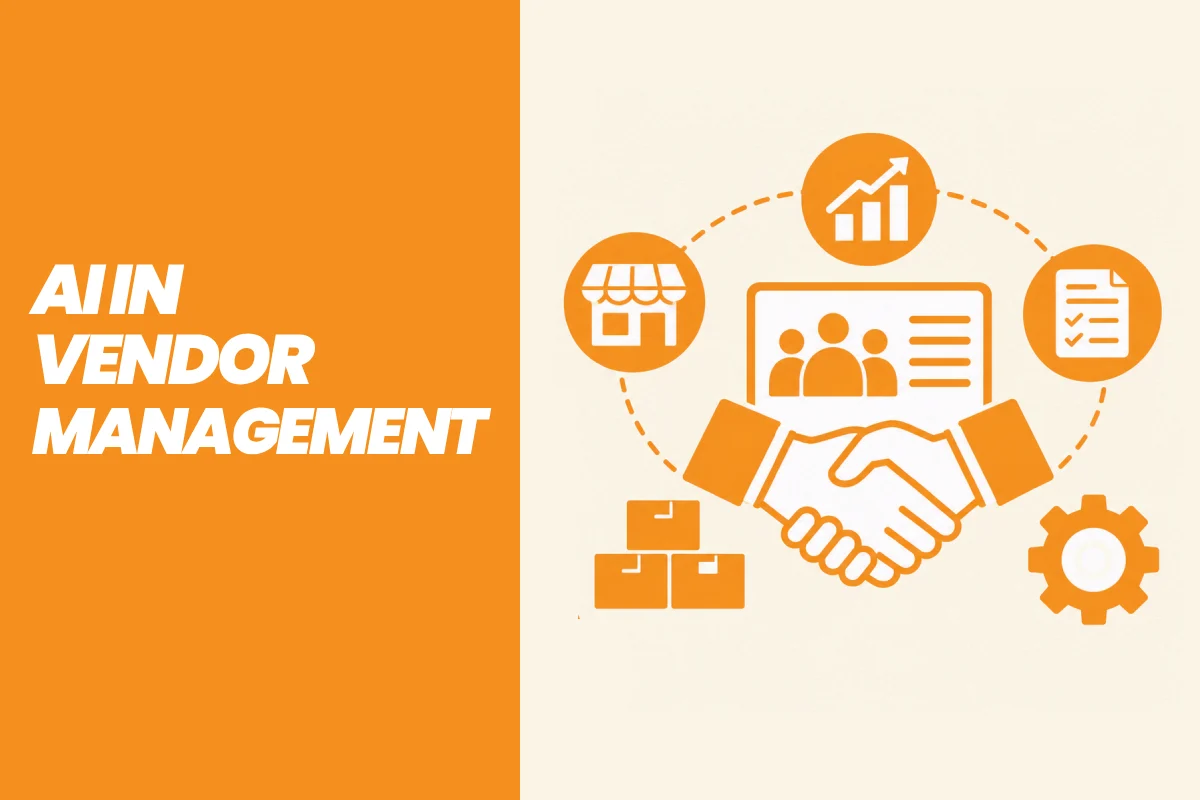
AI systems use information from multiple enterprise sources to build a more comprehensive picture of vendor relationships. This information may include supplier profiles, purchase orders, invoices, financial statements, contracts, delivery records, audit reports, and performance histories. By analyzing these datasets together, AI can identify relationships, detect anomalies, recognize recurring patterns, and generate insights that may be difficult to obtain through manual reviews.
Different AI technologies support different analytical activities. Machine learning identifies patterns in vendor performance and financial data, natural language processing extracts information from contracts and compliance documents, and predictive analytics estimates potential risks or delivery delays. Generative AI can summarize vendor records, answer employee queries, and prepare assessment reports using information available in connected enterprise systems.
When integrated with procurement, ERP, contract management, and vendor management platforms, these technologies help organizations move from fragmented supplier records to more connected, data-driven vendor oversight. The following applications demonstrate how these capabilities support specific vendor management activities.
Selecting suitable vendors requires organizations to evaluate technical capabilities, pricing, delivery capacity, financial stability, certifications, and business suitability. Reviewing proposals and comparing suppliers manually can become difficult when procurement teams manage hundreds or thousands of potential vendors. AI can help analyze supplier information and identify candidates that align with specific business requirements.
Machine learning models can evaluate vendor profiles against predefined selection criteria, while natural language processing extracts relevant information from proposals, capability statements, product catalogs, and qualification documents. AI can also compare supplier offerings to identify differences in pricing, service coverage, delivery commitments, and technical capabilities.
For example, a manufacturing company sourcing specialized components can use AI to analyze vendor catalogs, technical specifications, certifications, and historical purchasing records. The system can shortlist suppliers that meet its technical requirements and compare their commercial offerings.
| AI capability | Vendor selection application |
|---|---|
| Intelligent vendor discovery | Identifies potential suppliers based on business requirements |
| Proposal analysis | Extracts pricing, capabilities, and service commitments |
| Vendor scoring | Evaluates candidates against predefined selection criteria |
| Historical analysis | Identifies patterns in previous vendor performance |
| Recommendation models | Suggests suitable suppliers for specific requirements |
AI-generated rankings help procurement teams evaluate a broader supplier base and make more consistent sourcing decisions. However, final selection should also consider negotiation outcomes, technical validation, business priorities, and human judgment.
Vendor onboarding involves collecting registration information, verifying business credentials, reviewing certifications, completing compliance checks, and obtaining internal approvals. These activities often require coordination between procurement, finance, legal, information security, and other departments. Manual document reviews and repeated requests for missing information can delay vendor activation.
AI-powered document processing can extract information from registration forms, tax records, insurance certificates, financial statements, bank documents, and compliance records. Machine learning models can identify missing fields, detect inconsistencies, and flag submissions that require additional verification. AI can also compare submitted documents against predefined qualification requirements.
Generative AI can help summarize vendor submissions and provide employees with answers to questions about onboarding requirements. When connected to workflow automation, AI can route applications to the appropriate teams based on vendor category, risk level, and approval requirements.
| Onboarding activity | AI application |
|---|---|
| Document processing | Extracts information from vendor registration documents |
| Credential verification | Identifies inconsistencies and missing information |
| Financial assessment | Analyzes available financial indicators and records |
| Compliance screening | Flags potential regulatory and policy violations |
| Application review | Compares submissions against qualification criteria |
| Approval management | Routes applications to relevant stakeholders |
For example, when a new technology vendor submits its registration documents, AI can extract company details, identify missing security certifications, and flag discrepancies for review. The application can then be routed to procurement and information security teams for approval.
This reduces repetitive administrative work while establishing more consistent vendor qualification processes. It also creates a structured record of the checks completed before a vendor is approved.
Also Read: AI Consulting Cost
Vendor relationships can expose organizations to financial, operational, cybersecurity, regulatory, and reputational risks. A supplier’s financial deterioration, security incident, regulatory violation, or inability to meet contractual obligations can affect business continuity. Periodic assessments may not capture these developments quickly enough, particularly when organizations depend on large networks of suppliers.
AI can combine internal vendor records with external information such as financial reports, regulatory announcements, cybersecurity intelligence, news, and supply chain developments. Machine learning models analyze these signals to identify changes in vendor risk profiles, while anomaly detection highlights unusual activity or emerging warning signs.
| Risk category | AI-driven assessment |
|---|---|
| Financial risk | Analyzes financial indicators, credit information, and payment patterns |
| Cybersecurity risk | Identifies reported security incidents and potential vulnerabilities |
| Operational risk | Detects delivery delays, capacity constraints, and service disruptions |
| Regulatory risk | Monitors compliance developments and regulatory changes |
| Geographic risk | Assesses exposure to regional instability and disruptions |
| Reputational risk | Analyzes relevant news, public records, and reported incidents |
Predictive models can also help prioritize vendors based on their importance to business operations and potential exposure. A critical technology provider with access to sensitive company data may require more frequent monitoring than a low-impact service provider.
AI-powered monitoring can generate alerts when a vendor’s risk profile changes, allowing risk and procurement teams to investigate potential problems earlier. These systems do not independently establish that a vendor is unsafe or noncompliant; they identify signals that require further assessment.
Also Read: AI-Powered Contract Analysis
Vendor performance management requires organizations to determine whether suppliers consistently meet expectations for quality, delivery, cost, responsiveness, and service levels. Manual reviews often rely on periodic scorecards and individual assessments, making it difficult to identify recurring problems or gradual performance deterioration.
AI can analyze purchase orders, delivery records, inspection reports, service tickets, quality metrics, and contractual performance data. Machine learning models identify patterns associated with late deliveries, recurring defects, or potential service-level agreement (SLA) violations. Predictive analytics can also estimate the likelihood of future performance issues using historical records and current operating conditions.
| Performance metric | AI application |
|---|---|
| On-time delivery | Identifies delivery patterns and predicts delays |
| Product or service quality | Detects recurring defects and quality deviations |
| Cost performance | Identifies pricing variations and unexpected increases |
| SLA compliance | Monitors performance against contractual commitments |
| Issue resolution | Analyzes response times and resolution patterns |
| Vendor reliability | Evaluates consistency across historical records |
For example, an organization managing several logistics providers can use AI to compare delivery records, shipment exceptions, response times, and service-level compliance. If a particular provider shows a recurring increase in late deliveries, the system can flag the trend for investigation.
AI-generated performance insights help procurement teams identify underperforming vendors, investigate recurring issues, and initiate corrective actions. They can also support quarterly business reviews by providing a consolidated view of performance over time.
Also Read: Synthetic Data Generation for AI
Vendor contracts contain important information about pricing, payment terms, service-level agreements, delivery schedules, warranties, confidentiality, liability, and termination conditions. Reviewing large contract portfolios manually can be time-consuming and makes it difficult to maintain visibility into obligations, renewal conditions, and changes in commercial terms.
Natural language processing and large language models can extract contractual provisions, summarize obligations, compare agreement versions, and identify clauses requiring further review. AI can also classify contracts by vendor category, agreement type, renewal date, and risk exposure.
| Contract management activity | AI application |
|---|---|
| Contract extraction | Identifies important terms and contractual provisions |
| Clause analysis | Locates liability, confidentiality, and termination clauses |
| Obligation tracking | Monitors deliverables and contractual commitments |
| Renewal monitoring | Identifies upcoming expiry and renewal dates |
| Contract comparison | Highlights differences between agreement versions |
| Risk identification | Flags unusual or potentially unfavorable clauses |
AI can also connect contract information with vendor performance data. For example, if a vendor repeatedly misses delivery commitments, the system can help procurement teams locate the relevant delivery clauses and service-level requirements in the agreement.
These capabilities improve contract visibility and help legal and procurement teams manage vendor obligations throughout the relationship. Human review remains essential for interpreting complex clauses, evaluating legal implications, and approving contractual changes.
Also Read: AI Development Cost
Vendor expenditure is often distributed across departments, business units, purchase orders, invoices, and procurement systems. This fragmentation makes it difficult to understand total spending, identify pricing inconsistencies, and negotiate favorable commercial terms.
AI can classify vendor transactions, analyze purchasing patterns, identify duplicate payments, and compare prices across suppliers. Machine learning models can detect unusual spending patterns, while predictive analytics can forecast future expenditure using historical purchasing data, contract terms, and business demand.
For example, AI can identify situations where different departments purchase similar services from the same vendor at different rates. It can also highlight spending concentration, unexpected price increases, and opportunities to consolidate purchasing volumes.
| Spend analysis area | AI application |
|---|---|
| Spend classification | Categorizes transactions by vendor and purchase type |
| Price benchmarking | Identifies pricing variations across suppliers |
| Duplicate detection | Flags potentially duplicated invoices or payments |
| Spend forecasting | Predicts future vendor expenditure |
| Supplier concentration | Identifies excessive dependence on individual vendors |
| Cost optimization | Highlights consolidation and negotiation opportunities |
Generative AI can further help procurement teams investigate spending trends by allowing employees to ask questions in natural language. For example, a category manager could request a summary of expenditure with a particular supplier across business units and review the factors contributing to cost increases.
These insights help organizations improve spending visibility, strengthen negotiation strategies, and make more informed commercial decisions. AI can identify opportunities, but procurement teams must validate them against service quality, contractual obligations, and operational requirements before making sourcing changes.
Dependence on critical vendors can expose organizations to supply interruptions, production delays, and service delivery failures. Disruptions may result from supplier capacity constraints, transportation issues, natural disasters, geopolitical developments, or financial difficulties. Organizations that rely on a limited number of suppliers may face greater exposure when one provider becomes unavailable.
AI-powered predictive models can analyze historical delivery records, supplier capacity information, logistics data, weather conditions, and external risk signals to identify potential disruptions. These models can estimate the likelihood of delays and highlight vendors or supply routes that require attention.
AI can also support supplier dependency analysis by mapping relationships between primary vendors, their subsidiaries, and lower-tier suppliers where relevant data is available. This helps organizations understand whether several suppliers depend on the same upstream source or geographic region.
| Continuity requirement | AI application |
|---|---|
| Disruption prediction | Identifies signals associated with potential supply interruptions |
| Supplier dependency analysis | Highlights reliance on critical vendors and shared sources |
| Alternative sourcing | Identifies potential replacement suppliers |
| Delivery forecasting | Predicts shipment delays and delivery uncertainty |
| Inventory planning | Supports stock adjustments based on supply risk |
| Scenario analysis | Evaluates potential operational impacts of disruptions |
For example, a manufacturer can combine AI-based delivery forecasts with production schedules and inventory records. If a critical component supplier shows signs of a potential delay, procurement teams can assess alternative suppliers, adjust purchasing plans, or review inventory requirements.
This approach helps organizations move beyond reactive supplier management and prepare for potential disruptions before they affect business operations.
Also Read: Best AI Automation Tools for Enterprises
Organizations must ensure that vendors meet applicable regulations, contractual requirements, industry standards, and internal policies. Depending on the supplier category, these requirements may cover data protection, labor practices, environmental standards, ethical sourcing, financial controls, and information security.
AI can analyze compliance documents, certifications, audit reports, supplier questionnaires, and regulatory updates to identify missing evidence or potential violations. Natural language processing can compare vendor documentation against defined requirements, while automated monitoring can flag expired certifications and changes in regulatory status.
AI also supports environmental, social, and governance (ESG) assessments by analyzing sustainability reports, emissions data, supplier disclosures, and audit findings. Machine learning models can identify inconsistencies in reported information and highlight suppliers whose performance requires further investigation.
For example, an organization sourcing raw materials from multiple regions can use AI to review supplier declarations, sustainability certifications, and available audit records. The system can flag missing evidence or discrepancies for further assessment.
| Assessment area | AI application |
|---|---|
| Regulatory compliance | Identifies missing documentation and potential violations |
| Certification management | Tracks certification status and expiry dates |
| Data protection | Supports review of vendor security documentation |
| Labor practices | Analyzes supplier declarations and audit findings |
| Environmental performance | Evaluates available emissions and resource-use data |
| Ethical sourcing | Flags potential concerns in supplier disclosures |
These capabilities improve compliance visibility and help organizations incorporate sustainability considerations into vendor evaluations. However, AI-generated findings should not be treated as proof of compliance or misconduct. Formal assessments require reliable evidence and appropriate human review.
AI-powered vendor management combines several technologies to process supplier information, automate workflows, and support business decisions. Each technology contributes to a different part of the vendor lifecycle.
| Technology | Role in vendor management |
|---|---|
| Machine learning | Analyzes vendor performance, predicts risks, and identifies patterns |
| Natural language processing | Extracts information from contracts, questionnaires, and reports |
| Generative AI | Summarizes vendor information and supports employee queries |
| Predictive analytics | Forecasts delivery delays, performance issues, and disruptions |
| Computer vision | Extracts information from scanned documents and visual records |
| Robotic process automation | Automates repetitive administrative workflows |
| Knowledge graphs | Connect vendors, subsidiaries, contracts, and risk relationships |
| Agentic AI | Coordinates multi-step vendor workflows under defined controls |
These technologies can work together. For example, document processing can extract information from vendor submissions, machine learning can evaluate risk indicators, and generative AI can prepare an assessment summary for procurement teams. An AI agent can then route the assessment through an established approval workflow.
The choice of technology depends on the business objective, data availability, complexity of the workflow, and level of automation required.
AI can improve vendor management by reducing manual effort, strengthening oversight, and providing more consistent information across supplier relationships. Its value extends beyond administrative automation to include better commercial decisions and improved operational resilience.
| Business benefit | Organizational impact |
|---|---|
| Faster onboarding | Reduces document processing and verification time |
| Improved risk visibility | Identifies emerging vendor risks earlier |
| Better performance evaluation | Provides consistent analysis across vendor relationships |
| Greater cost control | Identifies pricing variations and spending inefficiencies |
| Stronger compliance oversight | Tracks documentation and regulatory requirements |
| Improved decision-making | Consolidates vendor information into actionable insights |
| Operational efficiency | Automates repetitive administrative workflows |
| Business continuity | Helps identify suppliers that may affect critical operations |
AI can also improve collaboration between procurement, finance, legal, compliance, and operational teams by making vendor information easier to access and interpret. Instead of maintaining separate records and conducting disconnected reviews, stakeholders can work with more consistent information.
However, these benefits depend on the quality of vendor data, integration with existing systems, and the extent to which AI-generated insights are incorporated into business workflows.
AI delivers greater value when connected to systems managing procurement, finance, contracts, compliance, and business operations. Standalone AI applications may generate useful insights, but their operational impact is limited when they cannot access relevant enterprise information.
Vendor management systems maintain supplier profiles, qualification records, and performance histories. ERP platforms manage financial transactions and purchasing activities, while contract lifecycle management systems store agreements and obligations. Risk management and business intelligence platforms provide additional information for vendor assessments and reporting.
| Enterprise system | AI integration opportunity |
|---|---|
| Vendor management systems | Vendor evaluation and lifecycle monitoring |
| ERP platforms | Spend analysis and financial risk assessment |
| Procurement platforms | Vendor selection and purchasing intelligence |
| Contract management systems | Contract analysis and obligation tracking |
| Risk management platforms | Continuous vendor risk assessment |
| Business intelligence platforms | Vendor performance dashboards |
APIs, cloud platforms, and secure data pipelines enable information exchange between these systems. AI models can then analyze consolidated vendor information and provide insights within existing business workflows. Edge computing is less central to most vendor management applications, but cloud infrastructure and secure integration are important for processing information across distributed enterprise platforms.
For example, integrating vendor performance analytics with ERP and contract management platforms allows organizations to compare delivery records, expenditure, and contractual commitments when reviewing supplier renewals. Procurement teams can use this information to assess whether a vendor should be retained, renegotiated with, or replaced.
Vendor management systems contain commercially sensitive information, including pricing agreements, financial records, contracts, banking details, proprietary documents, and security assessments. Using this information in AI applications requires appropriate data protection, access controls, and governance.
Organizations should establish role-based access permissions, encryption, secure data transfer, and audit logging. AI systems should retrieve only the information users are authorized to access. Sensitive vendor documents should also be handled according to organizational retention policies and applicable data protection requirements.
Generative AI applications require additional safeguards against unauthorized data exposure and inaccurate outputs. Organizations should evaluate model hosting arrangements, data retention practices, third-party model providers, and whether submitted information is used for model training. AI-generated contract summaries, risk assessments, and compliance findings should be traceable to their supporting documents.
Human approval should remain necessary for high-impact decisions, including vendor rejection, contract termination, significant risk classifications, and changes to critical supplier relationships. Organizations should also monitor model accuracy and investigate recurring errors or biased recommendations.
Successful AI adoption requires more than deploying individual models. Organizations need reliable vendor data, clearly defined workflows, appropriate system integration, and governance mechanisms. Before implementation, businesses should assess the maturity of their existing vendor management processes and identify activities where manual effort or fragmented information creates operational bottlenecks.
Key considerations include:
Organizations can begin with focused applications such as document processing, contract analysis, or vendor risk monitoring before expanding AI across the vendor lifecycle. This phased approach helps teams validate business value, address data limitations, and establish appropriate controls before introducing more complex automation.
AI is transforming vendor management by helping organizations evaluate suppliers, automate onboarding, monitor risks, analyze contracts, optimize spending, and anticipate supply disruptions. By combining machine learning, natural language processing, predictive analytics, and generative AI with enterprise systems, businesses can gain better visibility into vendor operations and make more informed decisions. Successful adoption depends on reliable data, secure integration, appropriate governance, and human oversight to ensure that AI-generated insights support responsible vendor management.
Partner with Xicom for AI development services that enable you to build vendor management capabilities that integrate supplier data, automate assessments, strengthen risk monitoring, and support informed decisions across the vendor lifecycle.
AI in vendor management means using machine learning, natural language processing, predictive analytics and generative AI to automate and improve how organizations select, onboard, monitor and evaluate suppliers. It analyzes supplier profiles, contracts, invoices, delivery records and external risk signals together, which helps teams make faster, more consistent, data-driven vendor decisions.
AI improves vendor risk management by monitoring suppliers continuously instead of relying on periodic reviews alone. It combines internal records with external signals, such as financial reports, cybersecurity incidents, regulatory updates and news, and alerts teams when a vendor’s risk profile changes. Risk and procurement teams then investigate the alert before taking action.
Yes. AI can extract data from registration forms, tax records, insurance certificates and compliance documents, flag missing or inconsistent information, check submissions against qualification criteria and route applications to the right approvers. This cuts repetitive manual review, while final approval stays with procurement, finance, legal or security teams.
Yes. AI spend analysis classifies transactions, finds duplicate invoices or payments, compares prices across suppliers and departments, and identifies opportunities to consolidate purchasing. These insights strengthen negotiations. Procurement teams should still validate any savings opportunity against quality, contract terms and operational needs before switching suppliers.
AI agents can carry out multi-step vendor workflows under defined controls. For example, an agent can collect onboarding documents, check them against requirements, follow up with suppliers on missing information, prepare a risk summary, and route it for approval. High-impact actions such as vendor rejection or contract termination should still require human approval.
Common challenges include inconsistent or duplicate supplier data, information spread across ERP, procurement, and contract systems, integration with legacy platforms, data security concerns, inaccurate AI outputs, and unclear rules for how AI recommendations feed into approvals. Clean data, defined workflows, and human oversight address most of these issues.

AI consulting cost ranges from $15,000 for a strategy sprint to $500,000+ for production work. See rates, pricing models and budgets by company size.
Learn how AI-powered contract analysis extracts clauses, flags risks and tracks obligations, plus industry use cases and data security best practices.
Explore synthetic data generation for AI, including key techniques, real-world applications, benefits, limitations, and data quality considerations.