AI in Energy Management: Applications, Benefits, Technologies, and System Integration
Learn how AI in energy management forecasts demand, cuts energy costs, optimizes buildings and industrial sites, and integrates renewables and storage.
Nov 26, 2026 Artificial Intelligence
Enterprise AI systems depend on accurate, accessible, and consistent data. However, organizational data is often distributed across databases, enterprise applications, cloud storage, APIs, documents, and legacy systems. Preparing this information for AI requires reliable pipelines that can ingest, transform, validate, govern, and deliver data without compromising quality, security, or performance. According to Capgemini’s 2025 research, only 9% of surveyed organizations reported very high maturity in data integration and interoperability, highlighting a key challenge for enterprise AI adoption.
AI data engineering builds and maintains the infrastructure through which enterprise data moves from source systems to AI-ready environments. It combines ingestion, transformation, orchestration, quality management, metadata management, and governance to support machine learning, generative AI, retrieval-augmented generation (RAG), and other AI workloads. Well-designed pipelines make data delivery reliable, traceable, scalable, and easier to maintain.
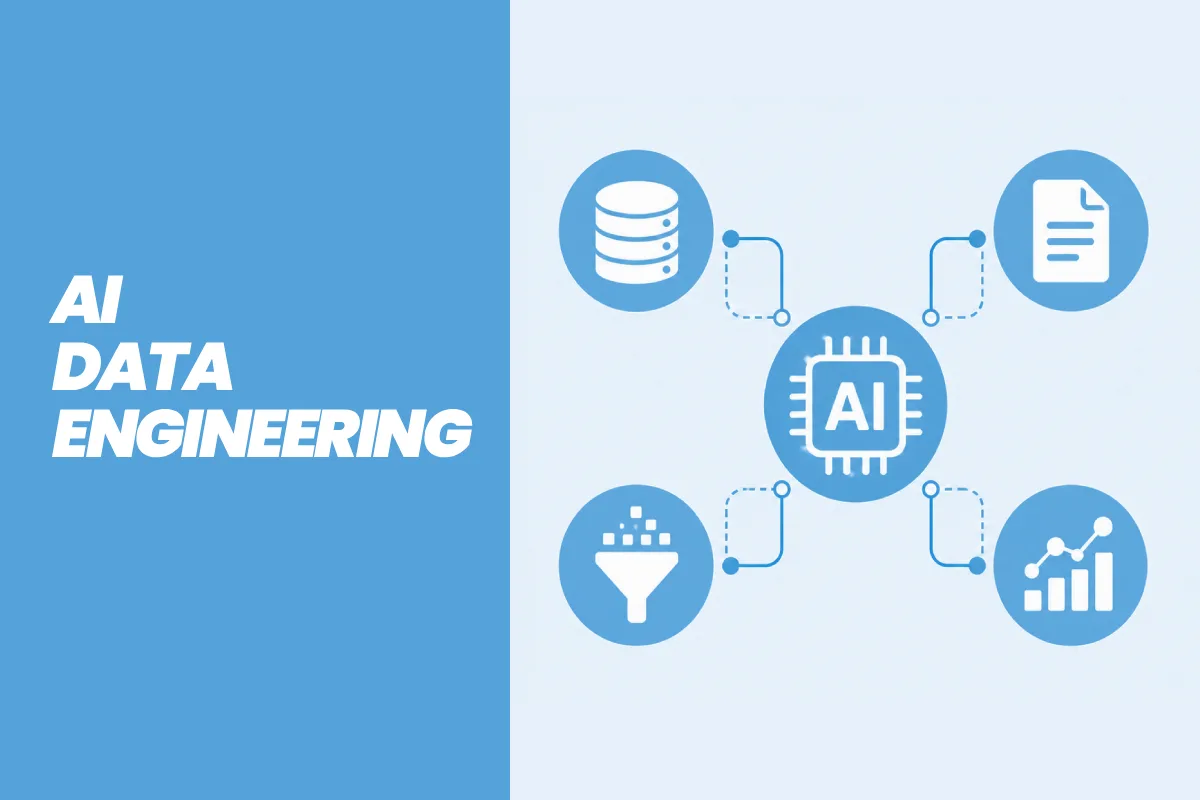
AI data engineering involves designing data architectures and pipelines that prepare enterprise information for AI applications. Traditional data engineering primarily supplies structured data to analytics and business intelligence systems. AI data engineering extends these capabilities to accommodate different data formats, model requirements, continuous updates, and training and inference workloads.
For example, a machine learning model may require structured customer transactions, while a generative AI application may need contracts, policy documents, product manuals, and internal knowledge repositories. Each source requires appropriate ingestion, transformation, validation, and storage.
An AI-ready data pipeline typically performs the following functions:
These capabilities provide the foundation for reliable AI development because model performance depends on the quality and suitability of its input data.
A reliable pipeline architecture connects source systems, processing components, storage environments, and AI applications. It must accommodate structured, semi-structured, and unstructured information while supporting different processing requirements.
A typical enterprise AI data pipeline includes the following layers:
| Pipeline layer | Primary responsibility | Engineering considerations |
|---|---|---|
| Data sources | Supplies information from enterprise systems and external platforms | Source availability, access permissions, API limits |
| Ingestion layer | Collects and transfers source data | Batch ingestion, streaming, change data capture |
| Raw data storage | Retains source information in its original form | Data retention, partitioning, access control |
| Processing and transformation | Cleans, validates, enriches, and standardizes data | Schema handling, deduplication, transformation logic |
| Curated data layer | Stores validated and organized datasets | Data models, business definitions, versioning |
| AI data layer | Prepares features, documents, embeddings, and model inputs | Feature consistency, chunking, vectorization |
| Serving layer | Makes data available to AI models and applications | APIs, query performance, access controls |
| Monitoring and governance | Tracks pipeline health, quality, lineage, and usage | Observability, audit logs, alerting |
Organizations can implement this architecture using cloud-native services, open-source frameworks, enterprise data platforms, or a combination of technologies. Selection depends on data volume, latency, existing infrastructure, security requirements, and AI workloads.
A key design principle is to separate raw, processed, and consumption-ready data. Retaining original source data allows reprocessing when transformation rules change, while curated datasets provide consistent inputs for AI applications.
Organizations should also build reusable ingestion connectors, transformation components, and quality rules rather than creating isolated pipelines for every AI project.
Data ingestion moves information from source systems into enterprise data environments. The approach depends on how frequently data changes, how quickly applications need updates, and the volume of information being transferred.
Three common ingestion patterns are batch processing, streaming, and change data capture.
| Ingestion method | How it works | Suitable requirements |
|---|---|---|
| Batch ingestion | Collects and transfers data at scheduled intervals | Historical records, daily reports, periodic model training |
| Streaming ingestion | Processes data continuously as events are generated | Real-time monitoring, event-driven applications, immediate updates |
| Change data capture (CDC) | Captures database changes such as inserts, updates, and deletions | Synchronizing operational databases with downstream systems |
Batch ingestion suits applications that do not require immediate updates. Data is extracted at scheduled intervals, processed in groups, and loaded into the target environment. It is often simpler and more cost-effective for historical information.
Streaming ingestion supports applications that require continuously updated information. Event streaming platforms process data as it is generated, but pipelines must handle event ordering, duplicate messages, late-arriving data, and failures.
Change data capture synchronizes operational databases with analytical and AI environments without repeatedly extracting entire tables. Engineers must account for transaction ordering, schema changes, deleted records, and initial synchronization.
A practical strategy may combine all three approaches: batch ingestion for historical customer records, CDC for database synchronization, and streaming for events requiring rapid processing. The choice should reflect business latency requirements rather than defaulting to real-time infrastructure.
Also Read: AI in Energy Management
Raw enterprise data is rarely ready for AI models. It may contain duplicates, inconsistent formats, missing values, outdated information, and incorrect labels. Data transformation converts these inputs into standardized datasets for downstream applications.
The process involves several engineering activities:
Data cleaning: Handles missing values, duplicate entries, invalid records, inconsistent formats, and incorrect data types. Missing information should be treated according to its meaning rather than automatically replaced.
Data standardization: Aligns naming conventions, date formats, measurement units, identifiers, and categorical values across sources.
Data enrichment: Combines source information with additional attributes, such as geographic details, product information, or approved external reference data.
Data modeling: Organizes information into structured datasets with defined relationships, entities, and business rules.
Data deduplication and entity resolution: Identifies records referring to the same customer, product, or supplier despite differences in names or identifiers.
Transformation workflows should be modular and reusable. Separate components for cleaning, standardization, enrichment, and validation make testing and maintenance easier. Transformation code should also be version-controlled so teams can identify which logic produced a particular dataset.
This is particularly important in machine learning, where changes in preprocessing can affect model performance.
Also Read: AI in Vendor Management
Data quality is essential for enterprise AI pipelines. Incorrect, incomplete, duplicated, or outdated information can affect model training, produce unreliable predictions, and generate inaccurate responses from generative AI applications.
Data should be validated at multiple pipeline stages rather than only after reaching its final destination.
| Data quality dimension | What to validate | Example checks |
|---|---|---|
| Accuracy | Whether values correctly represent the underlying information | Validate totals, identifiers, and reference values |
| Completeness | Whether required fields and records are present | Check mandatory fields and missing records |
| Consistency | Whether information follows common formats and business rules | Compare customer IDs and date formats across systems |
| Uniqueness | Whether records contain unintended duplicates | Identify duplicate transactions or customer profiles |
| Validity | Whether values meet defined constraints | Check permitted ranges, data types, and formats |
| Timeliness | Whether information is sufficiently current | Monitor data arrival time and update frequency |
| Referential integrity | Whether related records maintain valid relationships | Verify that transactions reference existing customers |
Engineering teams can implement validation using schema checks, SQL assertions, Python-based tests, and data quality frameworks. These tests should run automatically during pipeline execution.
For example, a transaction dataset can be checked for missing customer identifiers, duplicate transaction IDs, invalid currency codes, and impermissible negative values. If a critical check fails, the pipeline can quarantine affected records, stop downstream processing, or route the issue for review.
Teams should distinguish between critical and non-critical failures. Missing mandatory identifiers may require the pipeline to stop, while optional descriptive fields may be handled through controlled exception processing.
Business stakeholders should help define quality rules because technical validation alone cannot determine whether information is meaningful for a specific business purpose.
Also Read: AI Consulting Cost
Enterprise AI applications have different storage requirements. A single system may not efficiently support analytical queries, raw data retention, machine learning features, and semantic retrieval.
Organizations commonly combine data lakes, data warehouses, lakehouses, feature stores, and vector databases.
| Storage component | Primary purpose | AI engineering relevance |
|---|---|---|
| Data lake | Stores structured, semi-structured, and unstructured data | Retains raw and historical information |
| Data warehouse | Stores structured, curated data for analytical queries | Supplies datasets for reporting and model development |
| Data lakehouse | Combines data lake flexibility with warehouse-style management | Supports analytics and AI workloads |
| Feature store | Manages reusable machine learning features | Maintains consistent features across training and inference |
| Vector database | Stores and retrieves vector embeddings | Supports semantic search and RAG |
A data lake can serve as the landing environment for raw information. A warehouse or lakehouse can hold curated datasets, while feature stores manage machine learning variables and vector databases support similarity-based retrieval.
Storage design should account for partitioning, indexing, retention, access patterns, and query performance. For example, partitioning transaction datasets by date can reduce the data scanned during time-based queries. Appropriate indexing and metadata filtering can improve vector search performance.
Organizations should also establish retention policies. Keeping every dataset indefinitely can increase storage costs and create unnecessary privacy and compliance risks.
Also Read: AI Cost Optimization
Machine learning and generative AI applications consume data differently. Data engineering architectures must account for these differences when preparing model inputs.
Machine learning pipelines prepare information for model training, validation, and inference. This involves selecting fields, generating features, applying transformations, managing labels, and dividing datasets into training and evaluation groups.
Feature engineering converts raw attributes into meaningful variables. For example, transaction records can be transformed into features such as purchase frequency, average transaction value, and time since the last purchase.
A feature store helps maintain consistency between features used during training and those generated during deployment. Without this consistency, a model may receive differently processed information in production, creating training-serving skew.
Generative AI applications often require pipelines that process documents, knowledge repositories, and unstructured information. In a RAG architecture, content is extracted, divided into manageable sections, converted into embeddings, and indexed for retrieval.
A typical RAG data preparation workflow includes:
Chunking strategy directly affects retrieval quality. Small chunks may lose context, while large chunks can introduce irrelevant information. Engineers should test chunk size, overlap, metadata filters, and retrieval strategies against representative queries.
Document updates also require careful handling. When a policy is replaced, the pipeline should process the new version, refresh its embeddings, and retire outdated records.
Access permissions must be preserved throughout this process. Vector search should not return information from documents that the requesting user is unauthorized to access. This requires permission-aware indexing and retrieval.
Also Read: AI in Customer Success
Enterprise pipelines often contain dependent tasks. Data extraction must finish before transformation begins, and validation must pass before curated data becomes available to AI applications. Workflow orchestrators coordinate these tasks and manage execution.
Tools such as Apache Airflow, Dagster, and Prefect coordinate data workflows, while managed cloud services provide orchestration within specific environments.
A well-designed workflow should include:
Idempotency is particularly important. A task may fail after writing some records but before completing. Restarting it without controls can create duplicates. Stable keys, merge operations, transaction controls, and deduplication help prevent this.
Orchestration should also account for source system availability. If an application is temporarily unavailable, the pipeline should not publish incomplete data as a successful update.
Also Read: AI in Data Analytics
A pipeline can complete successfully while delivering incorrect or outdated information. Monitoring only whether a job ran or failed is insufficient for enterprise AI systems.
Data observability tracks pipeline execution, data quality, freshness, volume, schema changes, and downstream dependencies.
| Monitoring area | What to track | Example warning condition |
|---|---|---|
| Pipeline execution | Job status, duration, retries, and failures | A scheduled job fails repeatedly |
| Data freshness | Time since the latest successful update | A dataset exceeds its freshness threshold |
| Data volume | Record counts and processing volume | Incoming records fall below normal levels |
| Schema changes | Changes in fields, types, and structures | A source application changes a required column |
| Data quality | Validation failures and anomalous values | Duplicate or incomplete records exceed limits |
| Processing performance | Latency, resource utilization, and throughput | Processing time exceeds the expected range |
| Downstream dependencies | Datasets and applications relying on a pipeline | A failed upstream task affects an AI application |
Teams should define service-level objectives (SLOs) for critical data products. These may cover freshness, pipeline availability, quality thresholds, and delivery latency.
For example, a business-critical AI application may require customer information to be updated within a defined period. If the pipeline falls behind, an alert should notify the responsible team before the application uses stale information.
Lineage tracking records where data originated, how it was transformed, and which datasets, models, or applications consume it. This helps engineers identify affected components when source fields change or quality issues arise.
Also Read: Latest Developments in AI
AI data pipelines often process confidential business information, customer records, financial data, and employee information. Security and governance must therefore be built into the architecture.
A practical governance framework should address:
Data access controls: Apply role-based or attribute-based permissions to restrict who can view, modify, process, or export datasets. Service accounts should receive only the permissions needed for their tasks.
Encryption: Protect data during transfer and storage. Manage credentials and API keys through secure secrets management services rather than embedding them in pipeline code.
Data classification: Categorize information by sensitivity and define how each category can be stored, processed, shared, and used.
Data masking and anonymization: Remove or obscure personal and confidential attributes when identifiers are unnecessary for model development or testing.
Audit logging: Record data access, pipeline execution, transformations, administrative changes, and relevant AI data operations.
Retention and deletion: Define retention periods and ensure deletion requests are reflected across raw storage, curated datasets, feature stores, and vector indexes.
Governance should also cover third-party sources, model training datasets, and external AI services. Organizations need to understand where information is transferred, how it is processed, and whether its use meets contractual, regulatory, and internal requirements.
Data pipelines evolve as source applications, business rules, and AI requirements change. Managing these changes manually can introduce production failures and make results difficult to reproduce.
Data engineering teams should apply software development practices to pipeline development and deployment.
Version control systems such as Git maintain source code, SQL transformations, configuration files, and pipeline definitions. Automated testing validates changes before production, while continuous integration and continuous delivery (CI/CD) workflows standardize deployment.
A practical deployment process includes:
Data and transformation versioning are equally important. Teams should identify which source data, transformation logic, feature definitions, and configurations produced a particular training dataset. This supports reproducibility, debugging, model evaluation, and audits.
Rollback procedures should also be defined for high-impact pipelines so teams can restore a stable version if a deployment causes issues.
As AI adoption grows, enterprise pipelines must process larger datasets and support more applications. Scaling requires attention to processing capacity, storage performance, workload isolation, and operating costs.
Distributed processing frameworks such as Apache Spark handle large datasets across multiple machines. Cloud data platforms offer elastic compute resources, while streaming platforms support continuous event processing. Containerized deployments help standardize pipeline execution across environments.
Organizations should consider these engineering practices:
Cost monitoring should be part of pipeline observability. Infrastructure that delivers reliable data but consumes excessive resources may become difficult to sustain as usage grows.
Organizations should approach AI data engineering incrementally rather than redesigning every data system at once.
| Implementation stage | Key activities | Expected output |
|---|---|---|
| Assess data requirements | Identify AI workloads, source systems, formats, and latency needs | Defined data requirements |
| Design architecture | Select ingestion patterns, storage layers, processing frameworks, and integration methods | Reference data architecture |
| Build ingestion workflows | Develop connectors and pipelines for prioritized sources | Reliable source data collection |
| Implement transformation and quality controls | Standardize schemas, clean data, and automate validation | Curated and validated datasets |
| Integrate AI data services | Prepare features, model inputs, documents, and embeddings | AI-ready data assets |
| Establish governance and observability | Configure permissions, lineage, monitoring, and audit controls | Governed and traceable pipelines |
| Automate deployment | Implement testing, version control, and CI/CD workflows | Repeatable pipeline releases |
| Optimize and scale | Review performance, costs, reliability, and workload demands | Sustainable enterprise data infrastructure |
A practical starting point is to select one AI initiative with clear data requirements and business value. Teams can map its source systems, build reusable ingestion and transformation workflows, implement quality checks, and establish monitoring before expanding to other workloads.
This approach helps validate technology choices and operating processes while creating reusable components for future AI projects.
Reliable data pipelines are essential for enterprise AI systems. AI data engineering combines ingestion, transformation, storage, validation, orchestration, governance, and observability to deliver accurate and relevant information to models. Organizations need pipelines suited to their AI workloads, consistent data quality, secure information handling, and automated testing and deployment. Reusable, well-governed data infrastructure enables enterprises to support machine learning, generative AI, and other advanced applications while controlling performance, reliability, and operational costs.
Enterprise AI requires data infrastructure that scales with changing workloads. Xicom’s AI development services include data engineering solutions that connect enterprise sources, automate data processing, and prepare reliable, high-quality data for AI applications.
AI data engineering is the practice of designing and running the pipelines and architecture that move enterprise data from source systems into AI-ready environments. It covers ingestion, transformation, validation, storage, orchestration, governance, and delivery. The result is accurate, traceable data for machine learning models, generative AI applications, and retrieval-augmented generation (RAG) systems.
Traditional data engineering mainly delivers structured data to analytics and business intelligence tools. AI data engineering also handles unstructured content such as documents and manuals, prepares features and embeddings, and supports both model training and real-time inference. It also puts more weight on versioning, reproducibility and consistency between training and production data.
An enterprise AI data pipeline usually has these layers: data sources, ingestion, raw storage, processing and transformation, a curated data layer, an AI data layer for features and embeddings, a serving layer, and monitoring and governance. Keeping raw, processed, and consumption-ready data separate lets teams reprocess data when rules change without losing the original source records.
Data quality directly shapes how well AI models perform. Duplicate, incomplete, outdated, or inaccurate data can weaken model training, produce unreliable predictions, and lead generative AI to give wrong answers. Pipelines should check accuracy, completeness, consistency, uniqueness, validity, timeliness and referential integrity at several stages, with automated tests that stop or quarantine bad records.
Preparing data for RAG means ingesting documents, extracting and cleaning their content, splitting it into chunks that keep context, enriching chunks with metadata, generating embeddings, and indexing them in a vector database. The pipeline must also refresh or retire embeddings when source documents change. It must keep access permissions so users only retrieve content they are authorized to see.
Securing AI data pipelines starts with role-based or attribute-based access controls and encryption in transit and at rest. Secrets should live in a managed vault rather than in code. Strong governance also adds data classification, masking or anonymization of personal data, audit logging, lineage tracking, and retention and deletion rules that apply across raw storage, feature stores, and vector indexes.

Learn how AI in energy management forecasts demand, cuts energy costs, optimizes buildings and industrial sites, and integrates renewables and storage.
Learn how AI in vendor management automates onboarding, monitors supplier risk, tracks performance and contracts, and cuts vendor costs for enterprises.
AI consulting cost ranges from $15,000 for a strategy sprint to $500,000+ for production work. See rates, pricing models and budgets by company size.