Oct 9, 2026 Artificial Intelligence
Key Takeaways
- Edge AI for real-time analytics runs model inference where data is created, so time-critical decisions do not wait on a cloud round trip.
- “Real-time” is a decision window, not a single number: safety stops need the device, technician alerts suit a gateway, and shift briefings belong in the cloud.
- Gartner forecasts that more than two-thirds of enterprises will deploy edge AI by 2029, up from 10% in 2025.
- The 2026 edge stack adds NPUs, small language models and local agents, which makes edge MLOps (over-the-air updates, drift monitoring, fleet management) a requirement.
- Most edge programs stall for operational reasons, such as alert fatigue, model drift and stale data shown as live, rather than model accuracy.
Edge AI for real-time analytics is moving from pilot projects into standard enterprise architecture. Gartner expects more than two-thirds of enterprises to deploy edge AI by 2029, up from 10% in 2025 (Gartner, Predicts 2026: Physical AI Pushes I&O to the Edge).
The driver is practical. A hand near a press, a shifting motor vibration or a refrigerated trailer drifting out of range all create decisions with a short shelf life. Sending every frame and reading to the cloud adds network delay, bandwidth cost and a dependency on connectivity that some decisions cannot tolerate.
This guide covers the architecture layer by layer, when to choose edge, cloud or hybrid, the 2026 tools worth comparing, industry use cases, success metrics, governance, and a step-by-step implementation roadmap.
What Is Edge AI for Real-Time Analytics?
Edge AI for real-time analytics is the practice of running trained machine learning models on devices, gateways or nearby servers, so data is analyzed where it is generated and decisions land inside the time window the operation requires. Only events, summaries and exceptions travel to the cloud for storage, reporting and retraining.
Three terms anchor this guide. Inference is running a trained model on new data to produce a prediction. Edge is any compute close to the data source, from a sensor’s microcontroller to an on-site server. Latency is the time between an event and the system acting on it.
How fast does “real-time” need to be?
Real-time means “fast enough for the decision”. Mapping each decision to its window tells you where processing must happen.
| Use case | Required decision window | Where processing should happen |
|---|---|---|
| Person in a machine danger zone | Milliseconds | Device, alongside a certified safety controller |
| Rejecting a defective part on a fast line | Milliseconds to sub-second | Device or line-side gateway |
| Bearing anomaly alert to a technician | Seconds | Gateway |
| Patient deterioration flag at the bedside | Seconds | Device or ward gateway, clinician confirms |
| Cold-chain temperature excursion | Seconds to minutes | Gateway, synced to cloud |
| Shelf gap or checkout queue alert | Seconds to minutes | Near-edge server in the store |
| Fleet-wide pattern for a shift briefing | Hours, shift or daily | Cloud |
| Model retraining | Days to weeks | Cloud |
Near-edge means an on-site server or a telecom multi-access edge computing (MEC) node: close enough to avoid long network hops, more powerful than a single device.
Edge AI vs Cloud AI vs Hybrid
Edge AI wins when decisions are time-critical, bandwidth-heavy or privacy-sensitive; cloud AI wins when workloads need large models, cross-site data or elastic compute. Most production systems in 2026 are hybrid: infer at the edge, learn and coordinate in the cloud.
| Criterion | Edge AI | Cloud AI | Hybrid |
|---|---|---|---|
| Decision speed | Fastest, no network round trip | Bound by network and queueing | Fast local action, slower global insight |
| Connectivity | Works offline | Needs a stable connection | Degrades gracefully |
| Bandwidth cost | Low, sends events only | High for video and dense sensor data | Low to moderate |
| Data privacy | Raw data stays on site | Raw data leaves the site | Raw local, derived data central |
| Model size | Limited by device memory and power | Effectively unconstrained | Small local, large central |
| Operational effort | High, many devices | Lower, centralized | Highest design effort, best balance |
When to choose which: choose edge for safety, quality rejection, in-vehicle decisions and weak-connectivity sites; cloud for cross-site analytics, forecasting, large generative models and training; hybrid for almost every enterprise deployment that needs both.
How Edge AI Real-Time Analytics Works
Edge AI real-time analytics moves data through seven layers, from sensors to an analytics and agent layer, turning raw signals into decisions. Each layer has a distinct job and a distinct way to fail.
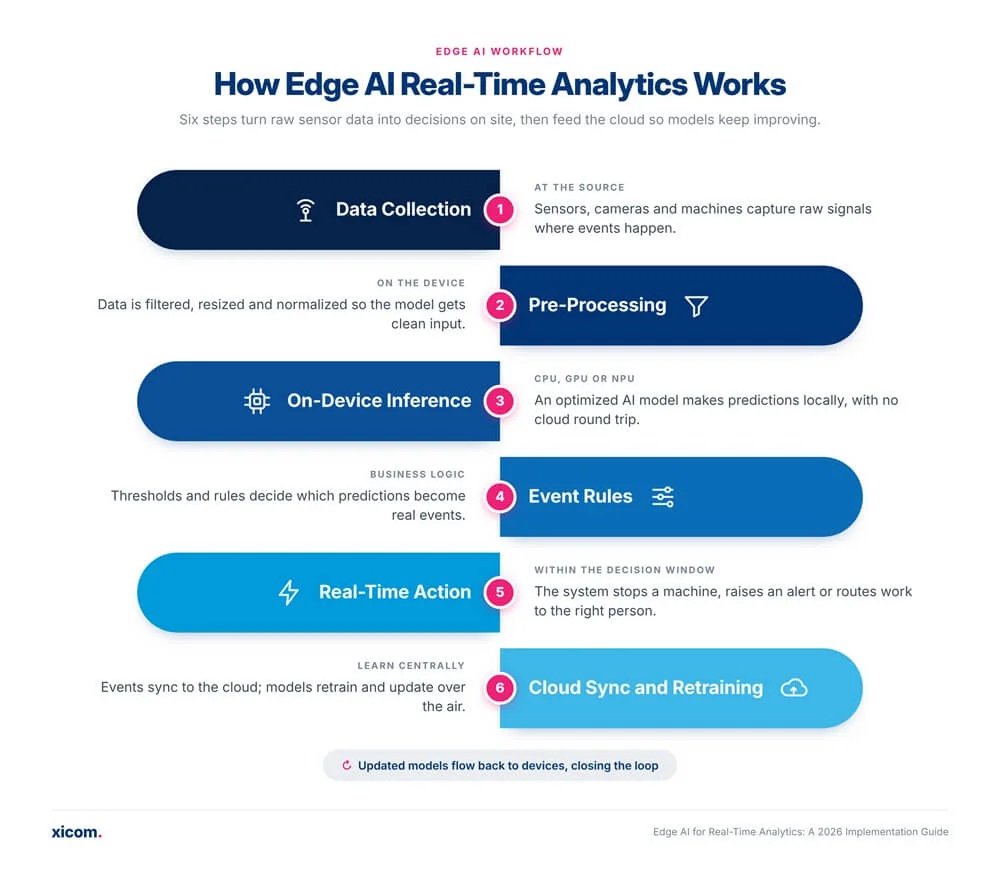
| Layer | Role | Main risk |
|---|---|---|
| 1. Devices and sensors | Capture video, vibration, temperature and machine signals | Poor calibration or placement corrupts data at the source |
| 2. Edge gateway | Aggregates devices, translates protocols, buffers data | Single point of failure and attack surface |
| 3. On-device inference | Runs optimized models on CPU, GPU or NPU | Accuracy loss after compression; silent drift |
| 4. Event rules | Applies thresholds and business logic to model outputs | Poorly tuned rules flood or miss alerts |
| 5. Streaming layer | Moves events through a message broker | Message loss or reordering during outages |
| 6. Cloud or data platform | Stores history, joins enterprise data, retrains models | Late or duplicate syncs corrupt reports |
| 7. Analytics and agent layer | Dashboards, alerts and agents that triage and route work | Stale data shown as live; agents acting unchecked |
The flow: collect → preprocess → infer → apply event rules → act locally → publish an event payload → sync to cloud → analyze and retrain.
An event payload is the compact message sent upstream instead of raw data: timestamp, device ID, model version, prediction and confidence.
What’s New in 2026: SLMs, NPUs, Agentic Edge and Edge MLOps
Four shifts define edge AI in 2026: language models small enough for devices, neural processing units in mainstream hardware, agents that triage events locally, and MLOps built for fleets.
Small language models at the edge
A small language model (SLM) is a language model compact enough to run on local hardware. On-device generative AI lets an edge system summarize alarm history, explain an anomaly in plain language, or answer a technician offline. Google’s Gemma 3 270M runs on the Synaptics Coral development board, and Hailo-10H accelerators run LLMs and vision-language models entirely on-device.
NPUs move into every device class
A neural processing unit (NPU) is a processor built for neural network math, delivering more inference per watt than a CPU. NPUs now ship in phones, AI PCs and industrial processors such as Qualcomm’s Dragonwing line. Gartner forecasts fivefold growth in per-node compute for embedded edge devices by 2029 versus 2026, with flat power envelopes. Google moved LiteRT’s GPU and NPU acceleration into production in March 2026 (Google Developers Blog).
Agentic AI at the edge
An AI agent is software that interprets a goal, decides the next step and uses tools to act. At the edge, agents detect an issue, triage severity, gather context such as maintenance history, and route it to the right person or system. Our guide to enterprise AI agent architecture covers these controls.
Edge MLOps becomes non-negotiable
Edge MLOps applies machine learning operations to distributed devices: over-the-air (OTA) model updates, staged rollouts, shadow testing, drift monitoring, rollback and fleet inventory.
Top 15 Edge AI Tools and Platforms in 2026
The right edge AI tools for real-time analytics depend on target hardware, model framework and fleet size. Choose the hardware class first, then a runtime that supports its accelerator, then an orchestration layer that can update the whole fleet.
Frameworks and Runtimes
An inference runtime loads a trained model on the device and executes it on the available CPU, GPU or NPU (neural processing unit). Runtimes also handle model conversion and hardware acceleration, so your choice affects both speed and which devices you can target.
1. LiteRT (formerly TensorFlow Lite) runs models on Android, embedded Linux and microcontrollers. Its GPU and NPU acceleration reached production in March 2026. NPU support still varies by chip vendor.
2. ONNX Runtime executes models exported from PyTorch, TensorFlow and other frameworks in one open format. It suits teams that need portability across mixed hardware, though tuning differs per execution provider.
3. OpenVINO (2026.1) is Intel’s toolkit for optimized inference on Intel CPUs, GPUs and NPUs, including AI PCs. It is strongest on Intel silicon and adds little elsewhere.
4. ExecuTorch (1.0) is Meta’s PyTorch-native runtime for mobile, wearable and embedded devices, generally available since October 2025. It removes the conversion step for PyTorch teams, but its ecosystem is younger than LiteRT’s.
Hardware Platforms
Edge AI hardware sets the ceiling for model size, speed and power draw. Options range from high-performance modules that run generative AI on site to microcontrollers that run tiny models on milliwatts.
5. NVIDIA Jetson (Orin and Thor) leads in robotics and multi-camera vision. Jetson Thor (T4000 and T5000 modules) handles on-site generative AI, while Orin remains the mature mid-range option. Power and thermal design are the main constraints.
6. Qualcomm Dragonwing (IQ9, IQ-X, IQ2) targets industrial PCs, gateways, robots and vision systems with integrated NPUs. It is power-efficient, but its toolchain differs from NVIDIA’s.
7. Hailo-8 and Hailo-10H are accelerator modules that add AI to an existing host, including Raspberry Pi-based prototypes. Hailo-10H runs language and vision-language models on-device. Both need a host processor.
8. Google Coral NPU (Synaptics Astra SL2610) is the successor to the original Coral Edge TPU line. It is built for always-on, battery-powered devices running on milliwatts, but the platform is new and its ecosystem is still forming.
9. MCU-class devices (Arm Cortex-M with Ethos-U NPU) run keyword spotting, vibration analysis and simple sensor models at very low power. They suit only very small models.
Optimization Tools
Optimization tools shrink cloud-trained models until they fit an edge device’s memory, power and latency budget. Quantization lowers numeric precision, pruning removes low-value weights, and distillation trains a small model to mimic a larger one.
10. Built-in quantization toolchains in LiteRT, ONNX Runtime and ExecuTorch convert models to lower precision with little code. Each technique trades some accuracy, so validate per use case.
11. NVIDIA TensorRT compiles models for peak throughput on NVIDIA GPUs, including Jetson. It works on NVIDIA hardware only.
12. Apache TVM is an open-source compiler that optimizes models for almost any hardware, including uncommon accelerators. It is actively maintained (v0.24, May 2026) but needs compiler expertise.
Cloud and Edge Orchestration
Orchestration platforms deploy, update and monitor models across a distributed fleet and sync results to the cloud. They are the backbone of edge MLOps: over-the-air updates, staged rollouts and rollback.
13. AWS IoT Greengrass runs AWS services and model deployments on edge gateways. It is the natural fit for AWS-standardized fleets, but it ties operations to AWS.
14. Azure IoT Edge 1.6 LTS with Azure Arc manages containerized AI workloads on gateways and hybrid Kubernetes for Microsoft-centric estates. Version 1.5 LTS loses support on November 10, 2026, so new deployments should start on 1.6.
15. KubeEdge extends Kubernetes to edge nodes for cloud-neutral, container-based delivery. It requires in-house Kubernetes skills.
Edge AI for Real-Time Analytics: Use Cases by Industry
Strong edge AI use cases share a recurring decision, an on-site signal and a real cost to acting late. Each row reads problem → edge signal → AI action → outcome.
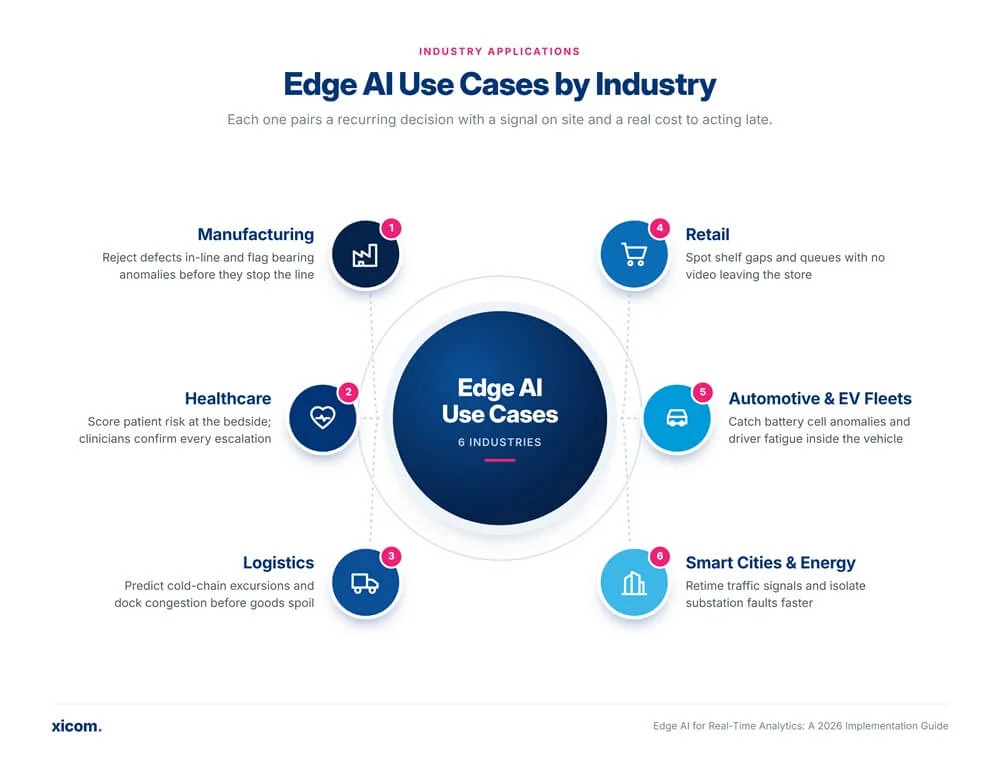
| Industry | Problem | Edge signal | AI action | Business outcome |
|---|---|---|---|---|
| Manufacturing | Defects and stops found too late | Line cameras, vibration sensors | Reject parts in-line; flag bearing anomalies | Lower scrap, less unplanned downtime |
| Healthcare | Deterioration noticed late | Bedside vitals, wearables | Score risk locally; clinician confirms | Earlier intervention, data stays on site |
| Logistics | Cold-chain breaches, dock congestion | Reefer probes, yard cameras | Predict excursions; detect queue build-up | Less spoilage, faster dock turnaround |
| Retail | Empty shelves, long queues | Shelf cameras, checkout counters | Detect gaps; send tasks to staff | Better availability, no video leaves store |
| Automotive and EV fleets | Battery issues become breakdowns | BMS data, driver-monitoring cameras | Flag cell anomalies; warn of fatigue | Fewer breakdowns, safer drivers |
| Smart cities and energy | Slow reaction to traffic and grid faults | Intersection cameras, substation sensors | Adjust signal timing; isolate faults | Smoother traffic, faster fault isolation |
For deeper industry context, see agentic AI in manufacturing and edge computing in autonomous vehicles.
Metrics to Measure Success
Measure edge AI across four groups: business outcome, real-time performance, AI quality and adoption. An accurate model still fails if alerts arrive late or operators ignore them.
| Group | Metrics | What they reveal |
|---|---|---|
| Business outcome | Unplanned downtime, defect rate, throughput | Whether the system changes operational results |
| Real-time performance | Event latency, alert age, sync delay | Whether decisions land inside their window and the cloud view is current |
| AI quality | Precision and recall, false-positive rate, drift | Whether alerts are real, events are caught, and accuracy holds over time |
| Adoption | Response time, closure rate, alert fatigue | Whether people trust and act on the output |
Precision is the share of alerts that are real; recall is the share of real events caught.
Edge AI for Real-Time Analytics: Challenges and How to Overcome Them?
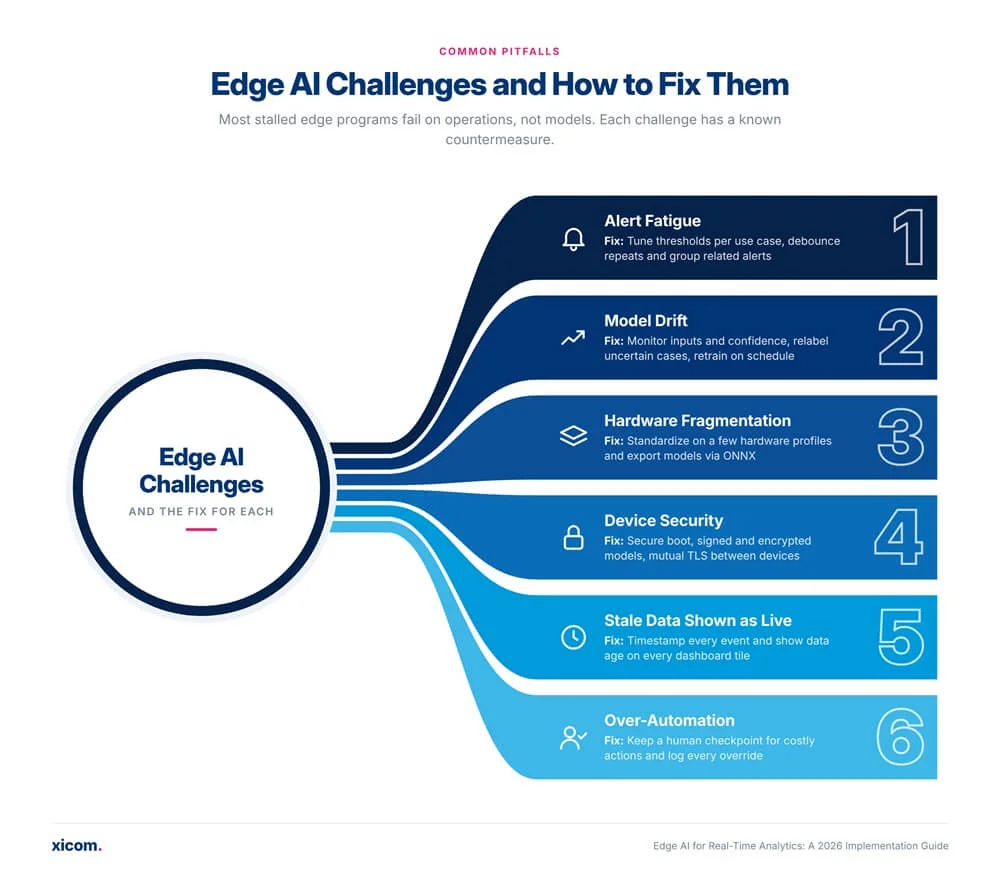
Most stalled edge AI for real-time analytics programs fail on operations rather than models. Each challenge below has a known countermeasure that belongs in the pilot design.
How do you prevent alert fatigue?
Set confidence thresholds per use case, debounce repeated events and group related alerts into one incident. Retire alerts nobody acts on.
How do you handle model drift?
Drift occurs when real-world data moves away from training data, such as new lighting or a new product variant. Monitor input distributions and confidence, sample uncertain cases for labeling, and retrain on a schedule.
What about hardware fragmentation?
Standardize on two or three hardware profiles, export models through a portable format such as ONNX, and maintain a device compatibility matrix.
How do you secure distributed devices?
Use secure boot, a hardware root of trust, signed and encrypted models, mutual TLS and least-privilege credentials. Treat every gateway as internet-facing.
How do you stop stale data appearing live?
Stamp every event with capture time and sync status, show data age on every dashboard tile, and flag views older than their decision window.
How do you avoid over-automation?
Classify actions as automatic, approval-required or advisory. Keep a human checkpoint for anything costly to reverse, and log every override.
Governance, Security and Compliance
Edge AI keeps raw data local but spreads decisions across many devices. Governance must cover data minimization, decision traceability and the EU AI Act where it applies.
Data minimization (GDPR and HIPAA). Process raw video and health data on the device, send only derived events, blur faces before upload and keep raw buffers short-lived.
Audit trails. For every edge decision, log model version, input reference, output, confidence, action, any human override and a synchronized timestamp.
EU AI Act relevance. Edge AI used as a safety component, for remote biometric identification or in critical infrastructure may be high-risk. The Digital Omnibus on AI, Regulation (EU) 2026/1744, entered into force on July 27, 2026 (EUR-Lex). Obligations for standalone high-risk systems in Annex III, including biometrics and critical infrastructure, now apply from December 2, 2027. AI embedded in regulated products such as machinery or medical devices (Annex I) applies from August 2, 2028. Confirm classification with counsel. Xicom’s AI governance consulting team maps edge use cases to these obligations.
Implementation Roadmap
A successful edge AI implementation starts with one recurring decision, proves value in a pilot, and scales only once monitoring and human review work.
- Pilot one recurring decision with a clear owner and a measurable cost of delay.
- Map edge data: sensors, sample rates, quality, connectivity and physical location.
- Choose model and hardware by matching the decision window to device, gateway or near-edge.
- Define the event payload: exactly which fields, model version and evidence leave the edge.
- Connect analytics: route events into streaming, data platform and dashboards with data age visible.
- Build the human review loop: approval rules, captured overrides and confirmed cases fed back into training.
- Scale with edge MLOps: OTA updates, staged rollouts, drift monitoring and fleet inventory before adding sites.
Should you build or partner?
Build in-house when you already run embedded, data and MLOps teams and the use case is core intellectual property. Partner when you need hardware selection, model optimization and fleet operations together, or when a governed pilot is needed quickly.
What drives cost and ROI?
Costs come from hardware (device class, accelerators, ruggedization), model maintenance (labeling, retraining, OTA rollout) and integration with MES, ERP or clinical systems, often the largest single effort. Connectivity savings offset part of this, because events replace raw video and dense sensor streams. ROI comes from the avoided cost of late decisions, so size it per decision, not per device.
From Edge AI Pilot to Production Fleet with Xicom
Most edge AI projects stall at the same point: a model that performs well in testing has to run reliably on hundreds of devices, with alerts people actually act on. Xicom works on that gap.
We start with a short AI consulting engagement. It pins down the one decision worth automating first, its decision window, and whether it belongs on the device, a gateway or the cloud. Our AI development team then optimizes the model for your hardware and sets up the update and monitoring pipeline. Where events need triage or routing, we add AI agents with scoped permissions and approval steps.
Conclusion
Edge AI for real-time analytics pays off when every decision is placed in the right window: milliseconds on the device, seconds at the gateway, and hours or days in the cloud. The 2026 stack makes this more practical than ever, with NPUs in mainstream hardware, small language models on-device and agents that triage events locally. What separates production systems from pilots is operational discipline: edge MLOps, clear metrics, audit trails and human checkpoints. Start with one recurring decision, measure it honestly and scale from evidence.
Ready to scope your first edge AI pilot? Talk to Xicom’s AI consultants to map your highest-value decision to the right edge architecture.
FAQs
1. What is the difference between edge AI and cloud AI?
Edge AI runs model inference on or near the device that collects the data, so it can act without a network round trip and keep raw data on site. Cloud AI runs inference in remote data centers, which suits large models and cross-site analysis but depends on connectivity and moves raw data off site.
2. What is real-time edge inference?
Real-time edge inference means a trained model processes incoming data on local hardware and returns a result within the decision window the task requires. For a safety stop that is milliseconds; for a maintenance alert it can be seconds. The defining feature is that the result does not depend on reaching the cloud.
3. Can small language models run at the edge?
Yes. Small language models can run on NPUs and edge accelerators in 2026. Google’s Gemma 3 270M runs on the Synaptics Coral development board, and Hailo-10H modules run language and vision-language models on-device. They suit summarizing alarms, explaining anomalies and answering technician questions offline, not open-ended reasoning.
4. Which edge AI tools are best for real-time analytics?
There is no single best tool. Common 2026 choices are LiteRT, ONNX Runtime, OpenVINO and ExecuTorch for inference; TensorRT and quantization for optimization; NVIDIA Jetson, Qualcomm Dragonwing and Hailo for hardware; and AWS IoT Greengrass, Azure IoT Edge or KubeEdge for fleet management. Choose hardware first.
5. What is edge MLOps?
Edge MLOps is the practice of deploying, monitoring and updating machine learning models across a fleet of distributed devices. It includes over-the-air model updates, staged rollouts, shadow testing, drift monitoring, rollback and an inventory of which model version runs where. Without it, edge fleets become impossible to audit or improve.
6. Does the EU AI Act apply to edge AI systems?
It can. The Act regulates AI by use, not by where it runs. Edge systems used as safety components, for remote biometric identification or in critical infrastructure may be high-risk. Under the Digital Omnibus, Annex III high-risk obligations apply from December 2, 2027, and Annex I product-embedded AI from August 2, 2028.

Make your ideas turn into reality
With our AI & mobile app solutions
Explore related services
Based on this article's topic